
What this calculator does
This tool builds a table and line graph of the reciprocal gamma function, \(1/\Gamma(a)\), over a sequence of values of the argument a. You choose where the sequence starts, how big each step is, and how many points (rows) you want. The result is a clean two-column table of a versus \(1/\Gamma(a)\) plus a plotted curve. This is pure mathematics and applies identically everywhere.
How to use it
Enter the initial value of a (the first argument), the increment (step) added to a for each successive row, and the number of iterations (how many rows to generate). For example, start = -3, step = 0.1, and 101 rows produce the sequence a = -3, -2.9, -2.8, ..., up to a = 7.0.
The formula explained
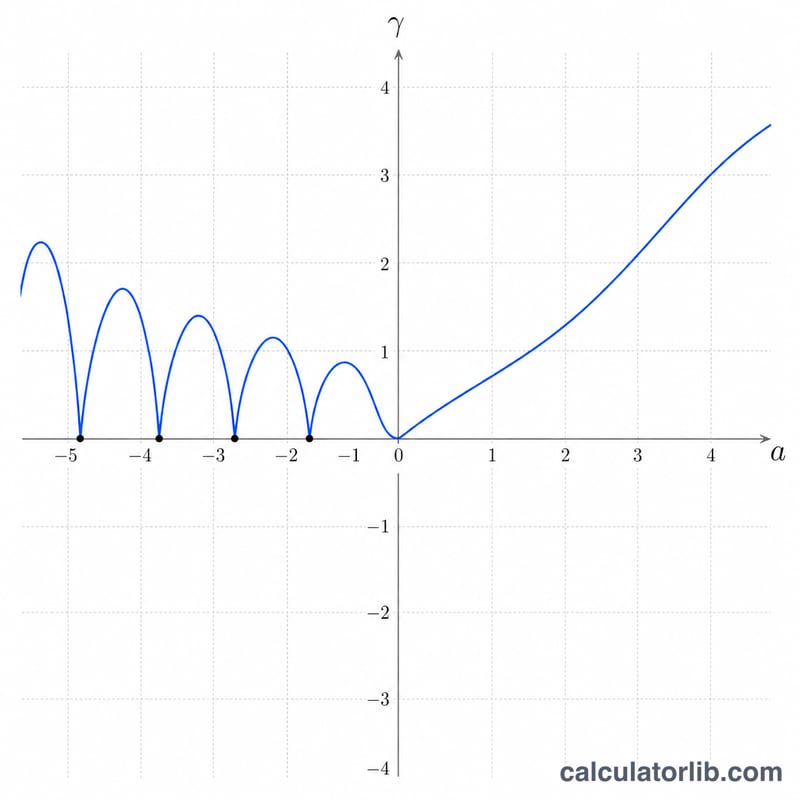
The gamma function generalizes the factorial: \(\Gamma(n+1) = n!\) and \(\Gamma(1/2) = \sqrt{\pi}\). For \(\mathrm{Re}(a) > 0\) it is defined by the integral $$\Gamma(a) = \int_{0}^{\infty} t^{a-1}e^{-t}\, dt,$$ and extended to other values by the recurrence \(\Gamma(a) = \Gamma(a+1)/a\) and the reflection formula \(\Gamma(a)\Gamma(1-a) = \pi/\sin(\pi a)\). We evaluate \(\Gamma(a)\) with the Lanczos approximation (g = 7) and use reflection for a < 0.5. The output is simply $$f(a_k) = \frac{1}{\Gamma(a_k)}, \quad a_k = \text{Start } a + k \cdot \text{Step}, \quad k = 0,1,\dots,\text{Rows}-1$$ Unlike \(\Gamma(a)\) itself, the reciprocal \(1/\Gamma(a)\) is an entire function with no poles: where \(\Gamma\) blows up (at a = 0, -1, -2, ...), the reciprocal is exactly 0.
Worked example
With the defaults, a few rows are: a = -3 gives \(1/\Gamma(-3) = 0\) (non-positive integer, a pole of \(\Gamma\)); a = -2.5 gives about \(-1.0579\); a = 0.5 gives \(1/\sqrt{\pi} \approx 0.5642\); a = 1 and a = 2 both give 1; a = 5 gives \(1/24 \approx 0.04167\); and a = 7 gives \(1/720 \approx 0.001389\). The curve peaks near \(a \approx 1.46\), where \(\Gamma(a)\) reaches its minimum (\(\approx 0.8856\)), giving a maximum \(1/\Gamma \approx 1.129\).
FAQ
Why is \(1/\Gamma(a)\) zero at 0 and negative integers? Because \(\Gamma(a)\) has simple poles there, so its reciprocal vanishes. We detect non-positive integers and return exactly 0.
What about very large a? \(\Gamma(a)\) grows extremely fast and overflows; we return \(1/\Gamma = 0\) instead of NaN.
How accurate is it? The Lanczos g=7 approximation is accurate to roughly 15 significant digits across the real line, which is more than enough for tabulation and plotting.