
What this calculator does
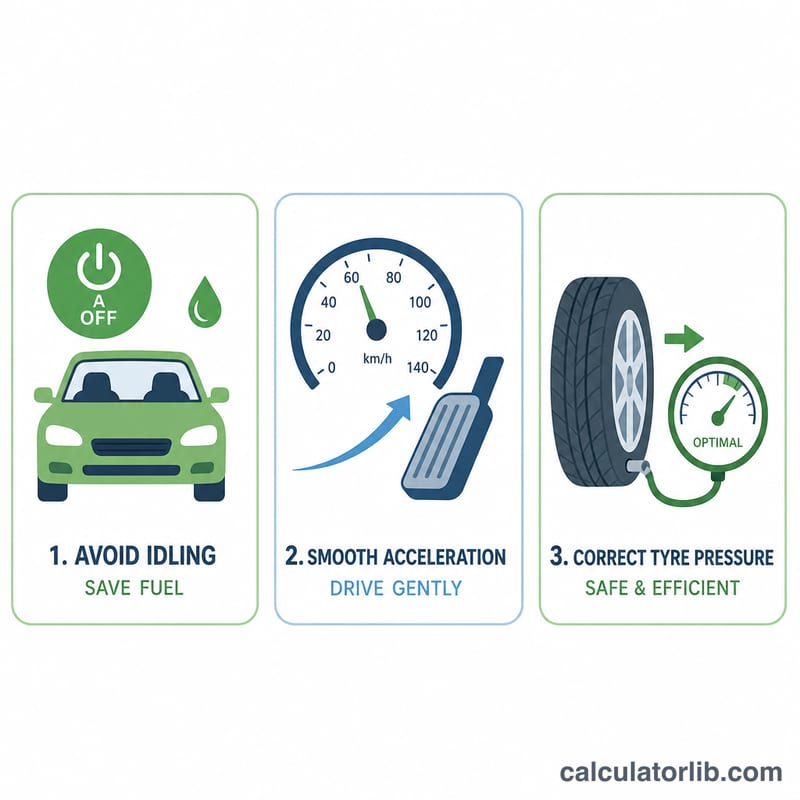
This tool is scoped to Japan. It estimates how much fuel (litres), money (yen) and CO2 you can save over a year by adopting three well-known eco-driving habits: practising idling stop, avoiding rapid starts and acceleration, and keeping your tires correctly inflated. The coefficients are drawn from Japanese sources (JAMA and JAF), and fuel price is entered in yen per litre.
How to use it
Pick your fuel type, then enter the current fuel unit price in yen/L and your annual driving distance in kilometres. Provide the average idling you would eliminate (minutes per km) and the number of rapid starts per km you would avoid. Finally, select whether your tire pressure is currently proper or insufficient — only an insufficient setting credits a tire-related saving. Submit to see your estimated yearly fuel, cost and CO2 savings, broken down by habit.
The formula explained
Each habit is converted to litres saved. Idling: \(\text{minutes/km} \times \text{distance} \times 0.013 \ \text{L/min}\). Rapid starts: \(\text{events/km} \times \text{distance} \times 0.028 \ \text{L/event}\). Tire pressure: insufficient inflation worsens fuel economy by 0.5 km/L, so against an assumed baseline of 15 km/L the saving is \(\tfrac{\text{distance}}{14.5} - \tfrac{\text{distance}}{15}\). The total litres are multiplied by the unit price for money saved. The CO2 reduction is displayed as the equivalent litres figure to match the original source; a stricter CO2 mass uses about 2.32 kg/L for gasoline or 2.62 kg/L for diesel and is shown separately.
$$\begin{gathered} \text{Money Saved} = L_{\text{total}} \times \text{Price} \\[1.5em] \text{where}\quad \left\{ \begin{aligned} L_{\text{total}} &= L_{\text{idle}} + L_{\text{rapid}} + L_{\text{tire}} \\ L_{\text{idle}} &= \text{Idle} \times \text{Dist} \times 0.013 \\ L_{\text{rapid}} &= \text{Starts} \times \text{Dist} \times 0.028 \\ L_{\text{tire}} &= \text{Dist}\left(\tfrac{1}{14.5} - \tfrac{1}{15}\right) \end{aligned} \right. \end{gathered}$$
Worked example
Gasoline, 135 yen/L, 8000 km/year, idling 0.5 min/km, rapid starts 0.5/km, insufficient tires: idling = \(0.5 \times 8000 \times 0.013 = 52\ \text{L}\); rapid = \(0.5 \times 8000 \times 0.028 = 112\ \text{L}\); tires = \(\tfrac{8000}{14.5} - \tfrac{8000}{15} = 18.39\ \text{L}\). Total = 182.39 L, saving \(182.39 \times 135 = \) about 24,623 yen, and roughly 423 kg CO2.
FAQ
Why is CO2 shown in litres? To mirror the original Japanese reference page. The more rigorous CO2 mass in kilograms is also displayed using the standard emission factors.
What baseline fuel economy is assumed? 15 km/L for proper inflation, dropping to 14.5 km/L when pressure is insufficient (a 0.5 km/L penalty per JAF).
Why is 0.013 L/min used for idling? This is the corrected JAMA-based value for fuel burned per minute of idling.