What Is a Weight-Based Dosage Calculator?
Many medications—especially in pediatrics, oncology, and critical care—are prescribed according to a patient's body weight rather than a fixed amount. This calculator multiplies a dose per kilogram (mg/kg) by the patient's weight in kilograms to determine the total daily dose, then optionally divides it across the number of administrations per day. This is an educational tool only and is not a substitute for professional medical judgment. Always confirm dosing against the prescribing information and your clinician or pharmacist.
How to Use It
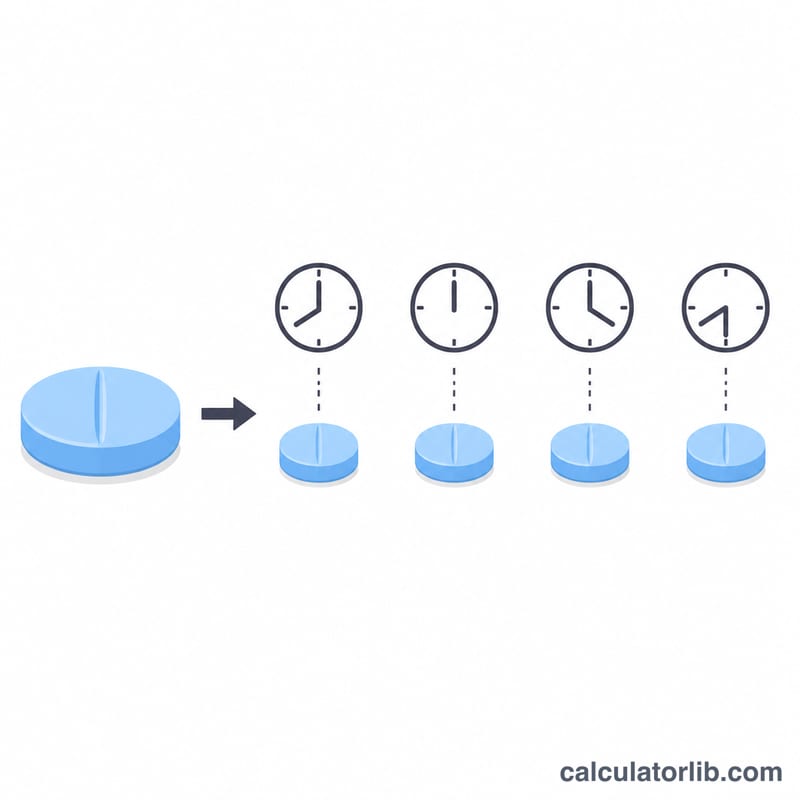
Enter three values: the patient's weight in kilograms, the prescribed dose in milligrams per kilogram (mg/kg), and how many doses are given per day. The calculator returns the total daily dose and the amount for each individual administration.
This tool has no drug-specific limits. Check the medicine label for the maximum single dose, the maximum daily dose and the minimum time between doses, and never exceed them. A child's dose must never exceed the adult maximum.
The Formula Explained
The core relationship is simple: \(\text{Dose (mg)} = \text{Dose per kg (mg/kg)} \times \text{Weight (kg)}\). The dose per kg is the prescriber's chosen intensity of therapy. Multiplying by weight personalizes the amount to the individual. If a drug is split into several daily administrations, the per-dose amount equals the total daily dose divided by the number of doses.
$$\begin{gathered} \text{Dose per Administration} = \frac{D_{\text{daily}}}{\text{Doses/Day}} \\[1.5em] \text{where}\quad \left\{ \begin{aligned} D_{\text{daily}} &= \text{Dose (mg/kg)} \times \text{Weight (kg)} \end{aligned} \right. \end{gathered}$$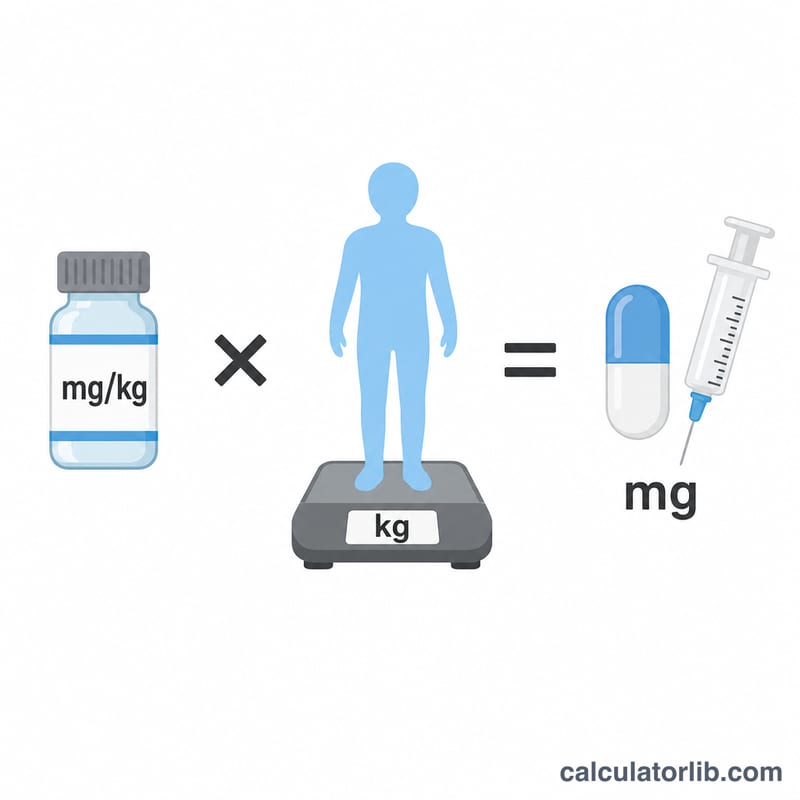
Worked Example
A child weighs 20 kg and is prescribed amoxicillin at 25 mg/kg/day divided into 3 doses. Total daily dose = \(25 \times 20 = \textbf{500 mg/day}\). Per dose = \(500 \div 3 \approx \textbf{166.67 mg}\) given three times daily.
Pounds-to-Kilograms Conversion Table
Weight-based dosing is calculated in kilograms, so a weight recorded in pounds must be converted first. The conversion is exact by definition of the pound: \(1\ \text{lb} = 0.45359237\ \text{kg}\), which is the same as dividing by 2.2046.
$$\text{Weight (kg)} = \frac{\text{Weight (lb)}}{2.2046}$$
| Weight (lb) | Weight (kg) |
|---|---|
| 5 | 2.3 |
| 10 | 4.5 |
| 15 | 6.8 |
| 20 | 9.1 |
| 30 | 13.6 |
| 40 | 18.1 |
| 50 | 22.7 |
| 66 | 29.9 |
| 88 | 39.9 |
| 110 | 49.9 |
| 132 | 59.9 |
| 154 | 69.9 |
| 176 | 79.8 |
| 198 | 89.8 |
| 220 | 99.8 |
Notes on using this table:
- Kilograms are the standard unit in prescribing information worldwide. Drug labels, formularies and pediatric dosing references express weight-based doses in mg/kg, so converting to kg before calculating avoids a roughly 2.2-fold error. Pounds remain in everyday use mainly in the United States, which is why the conversion step appears so often there.
- Pediatric weights should be measured, not estimated. A child's weight should be taken on a calibrated scale at the time of prescribing — ideally in kilograms directly, on a scale that does not display pounds — because in young children a small absolute error is a large relative error. A 1 kg error in a 10 kg child shifts the dose by 10%.
- Record the weight and its date in the chart. Infants, children and patients with rapid fluid shifts outgrow an old weight quickly, and a stale weight silently propagates into every subsequent dose.
- The values above are rounded to one decimal place for readability; for calculation, use the measured weight rather than the nearest table row.
Key Dosing Terms Defined
- Dose per kilogram (mg/kg)
- The amount of drug prescribed for each kilogram of body weight. Units are milligrams per kilogram. Related units appear for potent or dilute drugs: micrograms per kilogram (mcg/kg) and, for infusions, mcg/kg/min or mg/kg/h.
- mg/kg/day
- A weight-based amount covering a whole 24-hour period, which is then divided among the day's administrations. Example: 30 mg/kg/day divided every 8 hours.
- mg/kg/dose
- A weight-based amount given at each administration, not divided further. Example: 10 mg/kg/dose every 8 hours — which equals 30 mg/kg/day.
- Why mg/kg/day and mg/kg/dose must not be confused
- The two differ by exactly the number of doses per day. Treating a mg/kg/day figure as a mg/kg/dose figure with three-times-daily dosing gives a 3-fold overdose; the reverse mistake gives a 3-fold underdose. This is one of the most commonly reported categories of weight-based dosing error, and it is why every reference value should be read together with its "/day" or "/dose" suffix and its interval.
- Total daily dose
- The full amount of drug for 24 hours, in milligrams: \(D_{\text{daily}} = \text{dose (mg/kg/day)} \times \text{weight (kg)}\).
- Dose per administration
- The amount given at one time, in milligrams: the total daily dose divided by the number of doses per day. This is the number that is matched to a tablet strength or a measured volume.
- Dosing frequency and interval
- Frequency is how many administrations occur per day; interval is the time between them. Common abbreviations: q8h = every 8 hours (3 doses/day), q12h = every 12 hours (2 doses/day), q6h = every 6 hours (4 doses/day), BID = twice daily, TID = three times daily, QID = four times daily. "Every 8 hours" (clock-based, round the clock) and "three times daily" (with meals) are not strictly interchangeable for drugs where trough concentration matters.
- Total body weight (TBW)
- The patient's actual measured weight in kilograms. It is the default weight descriptor for most weight-based dosing, including most pediatric dosing.
- Ideal body weight (IBW)
- A weight estimated from height and sex rather than measured. It is used for a small number of drugs whose distribution tracks lean mass rather than fat mass, and for some ventilator settings. Several published formulas exist and they do not all give the same answer, so the specific formula named by the drug reference should be used.
- Adjusted body weight (AdjBW)
- A weight descriptor between IBW and TBW, used for certain drugs in patients with obesity. It is typically formed as ideal body weight plus a stated fraction of the excess over ideal body weight, with the fraction specified by the drug-specific reference.
- Maximum (ceiling) dose
- An absolute mg (or g) limit that a drug's dose must not exceed regardless of weight, usually set at the adult dose. Once weight is high enough, the ceiling — not the mg/kg figure — determines the dose.
- Body surface area dosing (mg/m²)
- A different scaling method in which the dose is proportional to body surface area in square metres rather than to weight. It is standard for most cytotoxic chemotherapy and some other narrow-therapeutic-index drugs. BSA is itself calculated from height and weight by a published formula, and mg/m² doses cannot be converted to mg/kg by any fixed factor — a mg/m² regimen requires a BSA calculation, not this calculator.
FAQ
Do I use total body weight or ideal body weight? It depends on the drug. Some medications use ideal or adjusted body weight, especially in obesity. Follow the specific drug reference.
What if weight is in pounds? Convert to kilograms first by dividing pounds by 2.205, then enter the kilogram value.
Why divide into multiple doses? Splitting maintains steadier drug levels and can reduce side effects, but the prescriber sets the frequency.