What is the Drug Dosage Calculator?
This calculator works out a weight-based medication dose. Many drugs, especially in pediatrics, are prescribed in milligrams per kilogram of body weight (mg/kg). Given the patient weight and the prescribed dose per kilogram, it returns the dose per administration, the total daily dose, and — if you enter a liquid concentration — the volume in millilitres to measure for each dose. It is an educational tool and does not replace clinical judgement or a prescriber.
How to use it
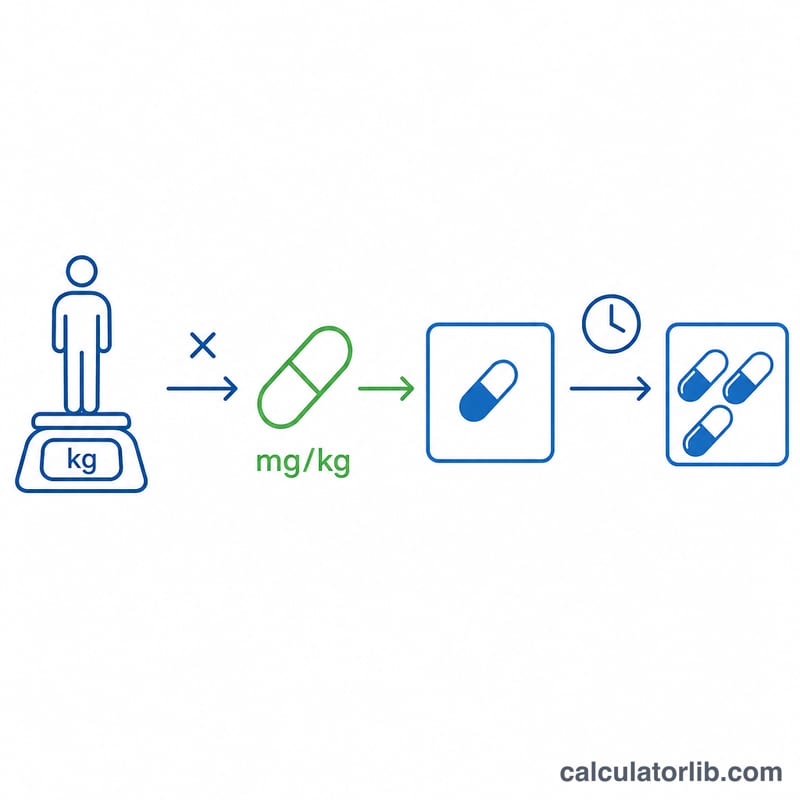
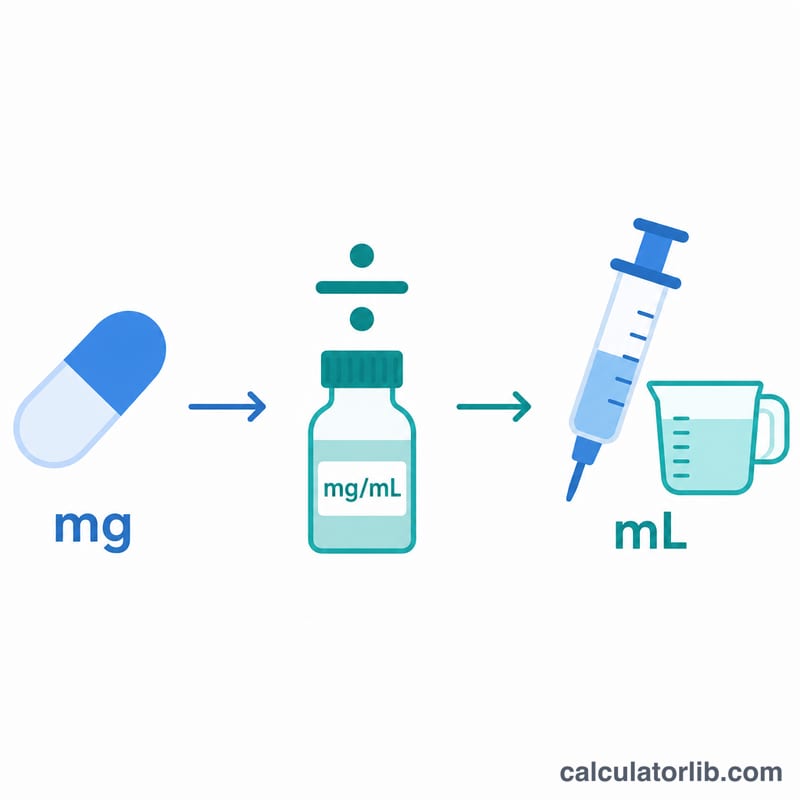
Enter the patient weight in kilograms, the dose in mg per kg, the number of doses per day, and the concentration of the liquid preparation in mg per mL (leave at 0 if using tablets). The calculator multiplies weight by the dose to get a single dose, multiplies by frequency for the daily total, and divides by concentration to convert milligrams into millilitres.
This tool has no drug-specific limits. Check the medicine label for the maximum single dose, the maximum daily dose and the minimum time between doses, and never exceed them. A child's dose must never exceed the adult maximum.
The formula explained
The core relationship is \(\text{Dose} = \text{Weight} \times \text{Dose per kg}\). To find the liquid volume, divide the dose in milligrams by the concentration in mg/mL: \(\text{Volume} = \text{Dose} \div \text{Concentration}\). The daily figures simply multiply the single dose by the number of doses given each day.
$$\begin{gathered} \text{Dose}_{\text{admin}} = \text{Weight (kg)} \times \text{Dose (mg/kg)} \\[1.5em] \text{where}\quad \left\{ \begin{aligned} \text{Daily Dose} &= \text{Dose}_{\text{admin}} \times \text{Doses/day} \\ \text{Vol}_{\text{admin}} &= \frac{\text{Dose}_{\text{admin}}}{\text{Conc. (mg/mL)}} \\ \text{Daily Vol} &= \frac{\text{Daily Dose}}{\text{Conc. (mg/mL)}} \end{aligned} \right. \end{gathered}$$
Worked example
A child weighs 20 kg and is prescribed 10 mg/kg three times a day, using a syrup at 100 mg/mL. Dose per administration = $$20 \times 10 = 200 \text{ mg}$$ Daily dose = $$200 \times 3 = 600 \text{ mg/day}$$ Volume per dose = $$200 \div 100 = 2 \text{ mL}$$ and daily volume = $$600 \div 100 = 6 \text{ mL/day}$$
Key Terms and Variables Explained
Weight-based dosing multiplies a patient's body weight by a dose expressed per kilogram. The terms below are the ones that appear on prescriptions, product labels and in this calculator's input fields.
| Term | Units | What it means |
|---|---|---|
| Body weight | kg | The weight used as the multiplier. Actual body weight is the measured weight; a dosing weight (ideal or adjusted body weight) is a different, calculated number used for some drugs in obesity. This calculator uses whatever number you enter in weight and assumes it is the intended dosing weight. |
| Dose per kg | mg/kg/dose | Milligrams given per kilogram at each administration. This is the dose field. |
| Dose per administration | mg | The amount actually given at one time: \(\text{weight} \times \text{dose}\). |
| Total daily dose | mg/day (from mg/kg/day) | The sum given over 24 hours: dose per administration × doses per day. |
| Dosing frequency | doses/day | How many administrations per 24 hours. Common abbreviations: OD/QD = once daily (1), BID (b.d.) = twice daily (2), TID (t.d.s.) = three times daily (3), QID (q.d.s.) = four times daily (4). "q6h" = every 6 hours = 4 doses/day; "q8h" = 3 doses/day. Enter the number, not the abbreviation, in frequency. |
| Concentration | mg/mL | Milligrams of drug per millilitre of liquid. Bottles are often labelled as a ratio such as "250 mg/5 mL", which is 50 mg/mL. Convert to mg/mL before entering it in concentration. |
| Maximum / ceiling dose | mg or mg/day | An absolute cap stated in the product information — often an adult maximum that a heavy child or adolescent can reach before the mg/kg calculation would suggest. Weight-based arithmetic does not apply this cap; you must. |
| mcg vs mg | 1 mg = 1000 mcg | Microgram (mcg, µg) and milligram (mg) differ by a factor of 1000. Mixing them is a classic 1000-fold error. Convert everything to mg before entering values here. |
mg/kg/dose is not the same as mg/kg/day. A regimen written as 15 mg/kg/dose every 6 hours is 60 mg/kg/day; a regimen written as 60 mg/kg/day divided q6h is 15 mg/kg/dose. Entering a mg/kg/day figure into the per-dose field and then multiplying by a frequency of 4 gives four times the intended daily amount. Always confirm which of the two the source is quoting.
Dosing abbreviations and label formats vary by country; this section describes conventions common in English-language prescribing. This is general educational information, not medical advice.
Dose and Concentration Unit Conversions
The calculator works in kilograms, milligrams and mg/mL. Convert pounds, grams, micrograms and "mg per 5 mL" labels first.
Weight: pounds to kilograms
\(1\ \text{lb} = 0.453592\ \text{kg}\), so \(\text{kg} = \text{lb} \times 0.453592\) (a quick mental estimate is lb ÷ 2.2).
| Pounds (lb) | Kilograms (kg) |
|---|---|
| 10 | 4.54 |
| 20 | 9.07 |
| 30 | 13.61 |
| 44 | 19.96 |
| 50 | 22.68 |
| 75 | 34.02 |
| 100 | 45.36 |
| 150 | 68.04 |
| 200 | 90.72 |
Mass units
| From | To | Multiply by | Example |
|---|---|---|---|
| g | mg | 1000 | 0.5 g = 500 mg |
| mg | g | 0.001 | 875 mg = 0.875 g |
| mg | mcg (µg) | 1000 | 0.25 mg = 250 mcg |
| mcg (µg) | mg | 0.001 | 500 mcg = 0.5 mg |
Liquid labels: mg per 5 mL to mg/mL
Divide the stated milligrams by the stated volume: \(\text{mg/mL} = \dfrac{\text{mg on label}}{\text{mL on label}}\).
| Label on bottle | Concentration (mg/mL) |
|---|---|
| 100 mg/5 mL | 20 |
| 120 mg/5 mL | 24 |
| 125 mg/5 mL | 25 |
| 200 mg/5 mL | 40 |
| 250 mg/5 mL | 50 |
| 400 mg/5 mL | 80 |
| 500 mg/5 mL | 100 |
| 100 mg/mL (concentrated drops) | 100 |
The same nominal product can be sold at different strengths in different countries, and concentrated infant drops can share a carton design with a weaker syrup — always read the strength printed on the bottle in front of you rather than assuming from memory.
Volume
| Volume | Equivalent |
|---|---|
| 1 teaspoon (tsp) | 5 mL |
| ½ teaspoon | 2.5 mL |
| 1 tablespoon (tbsp) | 15 mL |
| 1 mL | 0.2 tsp |
The 5 mL teaspoon is a dosing convention, not a description of kitchen cutlery: household spoons vary widely in capacity and are not accurate measuring devices. Use the oral syringe, dosing cup or dropper supplied with the medicine, and measure in mL.
FAQ
Can I use it for tablets? Yes — set concentration to 0 and read only the milligram results, then choose tablet strengths accordingly.
Is the result the maximum safe dose? No. It only applies the mg/kg figure you enter; always check the maximum dose and contraindications in an approved reference.
What units does it expect? Weight in kilograms, dose in mg/kg, concentration in mg/mL. Volume results are in millilitres.