
What Is the Arrow Spine Calculator?
Arrow spine is the stiffness of an arrow shaft — how much it bends (deflects) under load. Matching spine to your bow setup is critical for accuracy: an arrow that is too weak or too stiff will not recover cleanly off the bow, scattering your groups. This calculator estimates the recommended dynamic spine (expressed in thousandths of an inch of deflection, e.g. 400, 500, 600) for your draw weight, arrow length, point weight, and bow type.
How to Use It
Enter your bow draw weight (the holding weight at full draw), your arrow length measured from the throat of the nock to the back of the point, the point/insert weight in grains, and choose your bow type. The tool returns a target static spine value. Lower numbers (e.g. 300) are stiffer; higher numbers (e.g. 600) are weaker. Always cross-check against the manufacturer spine chart for your specific arrow.
The Formula Explained
We start from a base requirement of about 600 deflection for a 26 lb, 28 inch, 100 grain setup. Increasing draw weight requires a stiffer (lower) spine, so we subtract roughly 12.5 deflection per pound over baseline. Each inch of arrow length over 28 adds ~25 (weaker allowed), and each 25 grains of point weight over 100 adds ~20 (needs stiffer, subtract). Compound bows are scaled to behave slightly stiffer than recurves.
$$\begin{gathered} \text{Spine} = 600 - 12.5\,(\text{Draw} - 26) + 25\,(\text{Length} - 28) - \frac{16}{25}\,(\text{Point} - 100) - 30 \\[1.2em] \text{clamped to } [150,\ 1300] \end{gathered}$$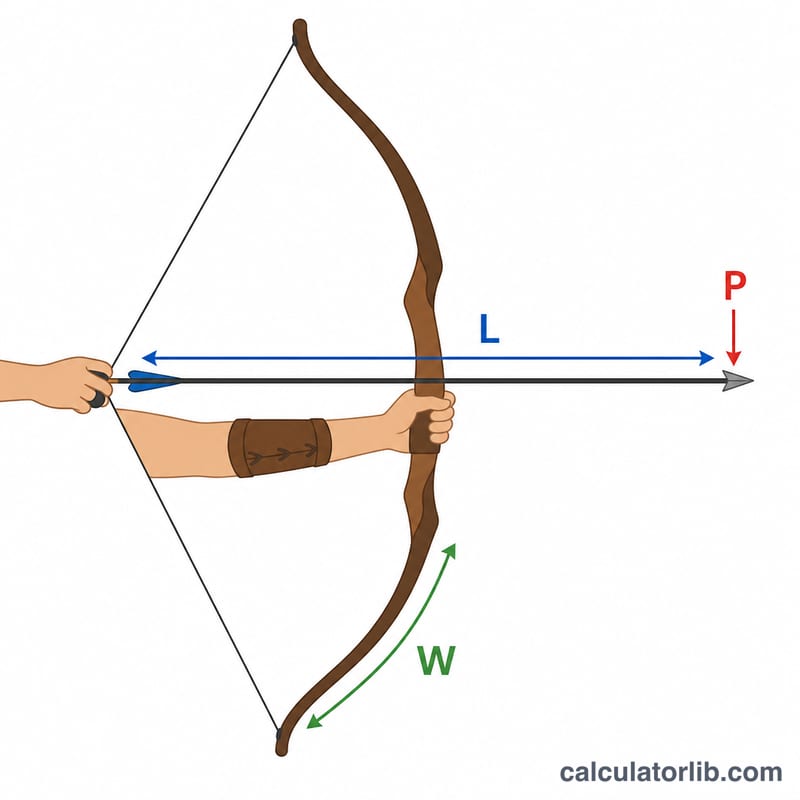
Worked Example
A 60 lb compound, 29 inch arrow, 125 grain point: base 600, minus \((60-26)\times 12.5 = 425\) removed → 175... adjusted by length \(+25\) and point \(-16\) and a compound factor. The calculator handles all of this and outputs a target spine you can match to a chart.
Common Arrow Spine Values by Draw Weight
Arrow spine is a measure of an arrow shaft's stiffness, expressed as deflection: the number of thousandths of an inch a shaft bends when a 1.94 lb (880 g) weight is hung at the center of a 28 inch span supported at two points 28 inches apart (the AMO/ATA standard). A lower number means a stiffer shaft — a 340 spine is much stiffer than a 600 spine.
Manufacturers do not make arrows in every value; they produce a handful of standard increments. The most common carbon spine sizes are 250, 300, 340, 400, 500, 600, and 700. The table below gives typical recommended spine for a mid-range setup (28–29 in arrow, 100–125 gr point). Heavier points, longer arrows, and higher draw weights all push you toward a stiffer (lower-number) shaft.
| Draw weight (lb) | Typical recommended spine | Relative stiffness |
|---|---|---|
| 30–40 | 600–700 | Most flexible |
| 40–50 | 500–600 | Light |
| 50–60 | 400–500 | Medium |
| 60–70 | 340–400 | Stiff |
| 70+ | 250–340 | Stiffest |
These are starting points for a standard 28 in arrow at 100 gr point weight. Always confirm against the specific arrow model's published chart before purchasing, since shaft families differ in their tolerances and labeling.
Practical Next Steps for Tuning
The calculator gives a target deflection, but final arrow selection should always be verified before you commit to a full set. Use this checklist:
- Cross-check the maker's chart. Every manufacturer (Easton, Gold Tip, Victory, Carbon Express, etc.) publishes its own spine selection chart indexed by draw weight, arrow length, and point weight. Find your row on the chart for the exact shaft model you intend to buy — charts vary between shaft families even from the same brand.
- Choose the nearest available spine. Since shafts come only in standard increments (e.g. 340, 400, 500, 600), pick the closest value to your target. When you fall between two sizes, lean toward the stiffer (lower-number) shaft if you shoot a heavy point or a long draw, and toward the weaker shaft for lighter points.
- Account for cut length and components. Cutting a shaft shorter makes it effectively stiffer; leaving it long makes it weaker. Heavier inserts, points, or broadheads add front weight and weaken dynamic spine, so re-run the calculator with your actual planned point weight. Check the finished balance with an FOC calculation — most target arrows aim for 7–12% front-of-center, hunting arrows often 10–15%.
- Confirm your draw length first. If you are unsure of your draw length, measure it (the arm-span method divides wingspan by 2.5) before estimating arrow length, since the two are closely related.
- Test before buying a dozen. Buy two or three shafts and bare-shaft tune or paper tune them. A bullet hole through paper and matched bare-shaft/fletched impact confirm the spine is correct for your specific bow, release, and form before you invest in a full dozen.
This is general archery setup guidance. Equipment behavior varies with individual form, bow tune, and components, so treat the calculator result as a starting point and confirm with on-target tuning.
FAQ
What does a 400 spine mean? The shaft deflects 0.400 inches under a standard 1.94 lb load over a 28 inch span. Smaller = stiffer.
Does point weight matter? Yes — heavier points make an arrow behave weaker, so you need a stiffer shaft to compensate.
Is this exact? It is an estimate. Always verify with the arrow maker spine chart and tune with bare-shaft testing.