
What is the Tile Grout Calculator?
The Tile Grout Calculator estimates how much grout you need to fill the joints between tiles. It works for floor and wall tiling and reports the result as both a volume in litres and a dry weight in kilograms, so you can buy the right number of grout bags. The tool is universal and uses metric units (millimetres, square metres and kilograms).
How to use it
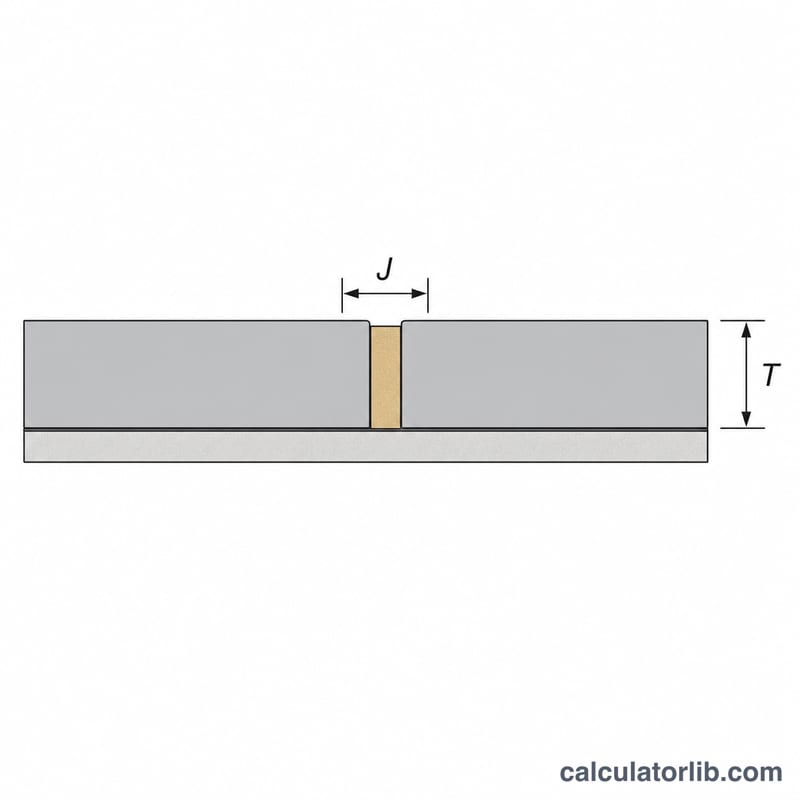
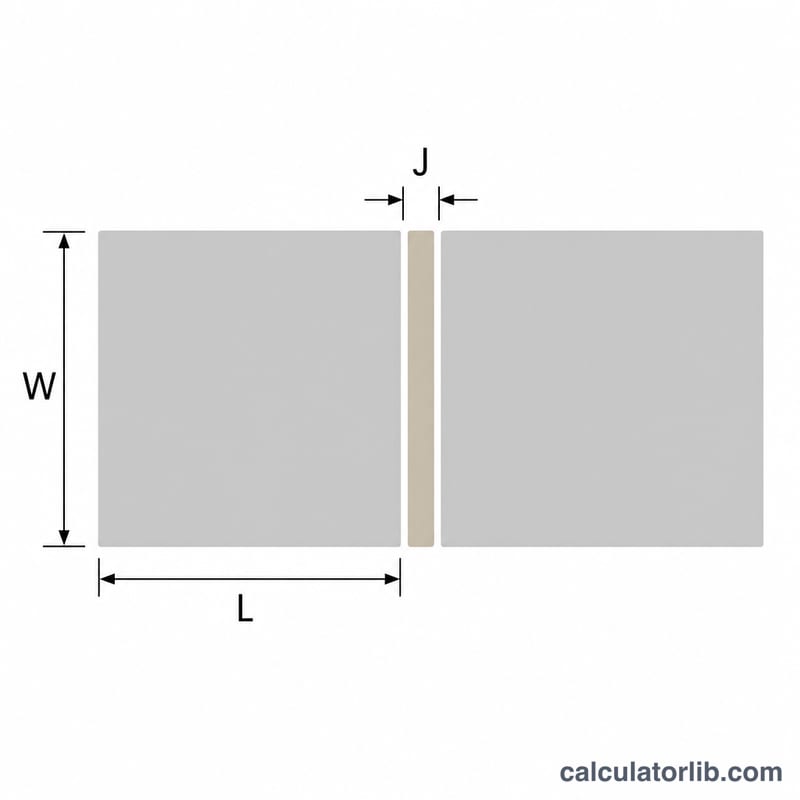
Enter the tile length and width (in mm), the tile thickness (the depth of the grout joint, in mm), the grout joint width (the gap between tiles, in mm), the total tiling area (m²) and the dry grout density (typically 1.5–1.7 kg/L). The calculator returns grout volume per square metre, total volume and total weight.
The formula explained
Each tile contributes grout along its perimeter joints. Accounting for the shared joints between adjacent tiles, the grout volume per square metre is:
$$V_{m^2} = \frac{(L + W)}{L \times W} \times J \times T$$where \(L\) = tile length (mm), \(W\) = tile width (mm), \(J\) = joint width (mm) and \(T\) = tile thickness (mm). The result is converted to litres per m². Multiply by area \(A\) and density \(\rho\) to get total weight: \(M = V_{m^2} \times A \times \rho\).
Worked example
For 300 mm × 300 mm tiles, 8 mm thick, with a 3 mm joint, over 10 m² at 1.6 kg/L:
$$V_{m^2} = \frac{(300 + 300)}{300 \times 300} \times 3 \times 8 = 0.16\,\text{L/m}^2$$ $$M = 0.16 \times 10 \times 1.6 = 2.56\,\text{kg}$$FAQ
What grout density should I use? Most cement-based grouts are around 1.5–1.7 kg/L. Check the product bag for the exact figure.
Should I add extra for waste? Yes — add roughly 10% for spillage, uneven joints and partial bags.
Does tile thickness matter? Yes, the joint is filled to the full tile depth, so thicker tiles use more grout per metre of joint.