
What is the Sealant Calculator?
The Sealant Calculator estimates how many cartridges of silicone, caulk, polyurethane or other sealant you need to fill a joint or gap. It works from the joint's total length and its cross-section (width and depth), then divides the cartridge volume to find the coverage per tube. This helps you buy the right amount in one trip and avoid running short mid-job.
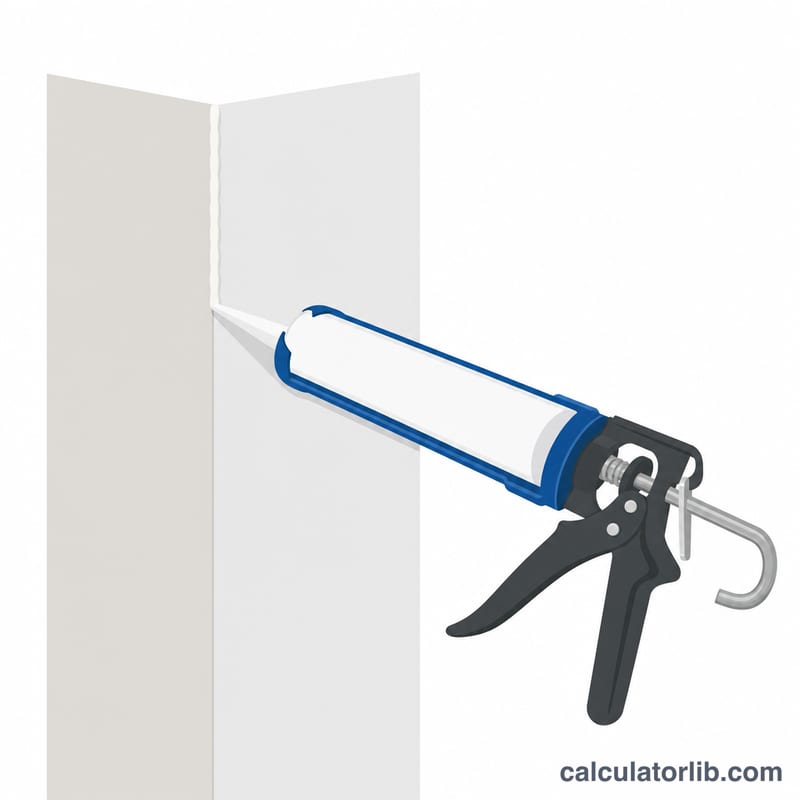
How to use it
Enter the total length of joint to be sealed in metres, the joint width and depth in millimetres, and the volume of one cartridge in millilitres (standard cartridges are typically 300 ml; sausage packs are 400–600 ml). Add a waste allowance (10% is a sensible default) to cover tooling-off, partly used tubes and trimming. The calculator returns the coverage per cartridge in metres and the total number of cartridges, rounded up to whole tubes.
The formula explained
The joint cross-sectional area is width × depth (mm²). One cartridge of volume V (ml = cm³ = 1000 mm³) fills a length of V / (width × depth). Dividing the total joint length by this coverage gives the raw cartridge count, which is multiplied by (1 + waste) and rounded up.
$$\text{Cartridges} = \left\lceil \frac{\text{Length (m)} \times \text{Width (mm)} \times \text{Depth (mm)}}{\text{Cartridge (ml)}} \times \left(1 + \frac{\text{Waste (\%)}}{100}\right) \right\rceil$$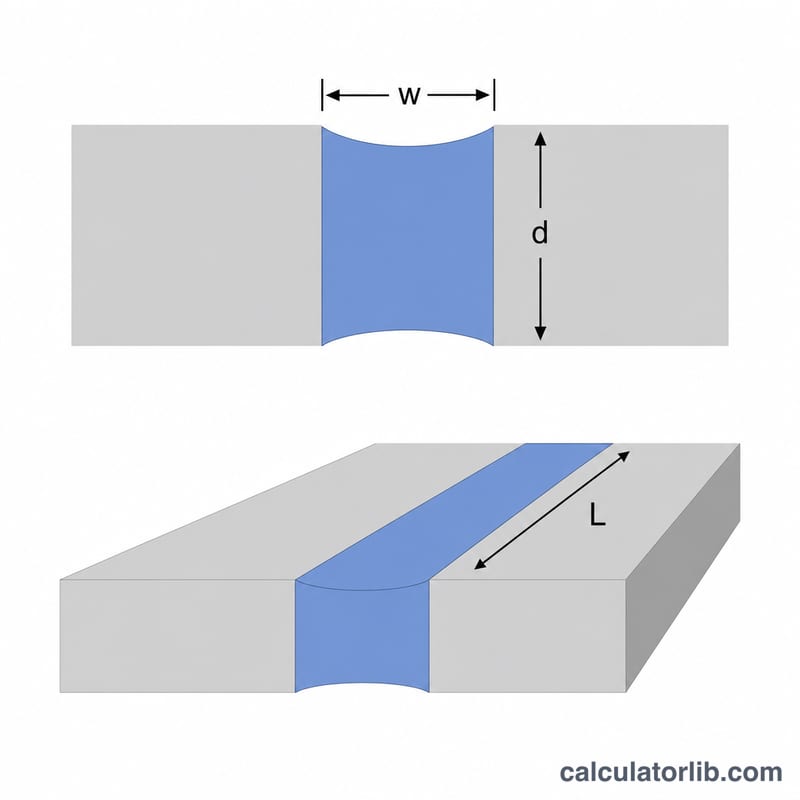
Worked example
For a 10 m joint that is 6 mm wide and 6 mm deep using a 300 ml cartridge: area = \(36 \text{ mm}^2\), cartridge = \(300{,}000 \text{ mm}^3\), so coverage = \(300{,}000 / 36 \approx 8{,}333 \text{ mm} \approx 8.33 \text{ m}\) per cartridge. Raw count = \(10 / 8.33 \approx 1.2\). With 10% waste that is \(\approx 1.32\), rounded up to 2 cartridges.
FAQ
Why round up? You cannot buy a fraction of a cartridge, so the result is rounded to the next whole tube.
What waste allowance should I use? 5–15% is typical. Use more for many short joints, awkward access, or inexperienced applicators.
Does this work for backer rod joints? Use the actual sealant depth above the backer rod, not the full joint depth, for an accurate estimate.