
What is the Grams to Calories Calculator?
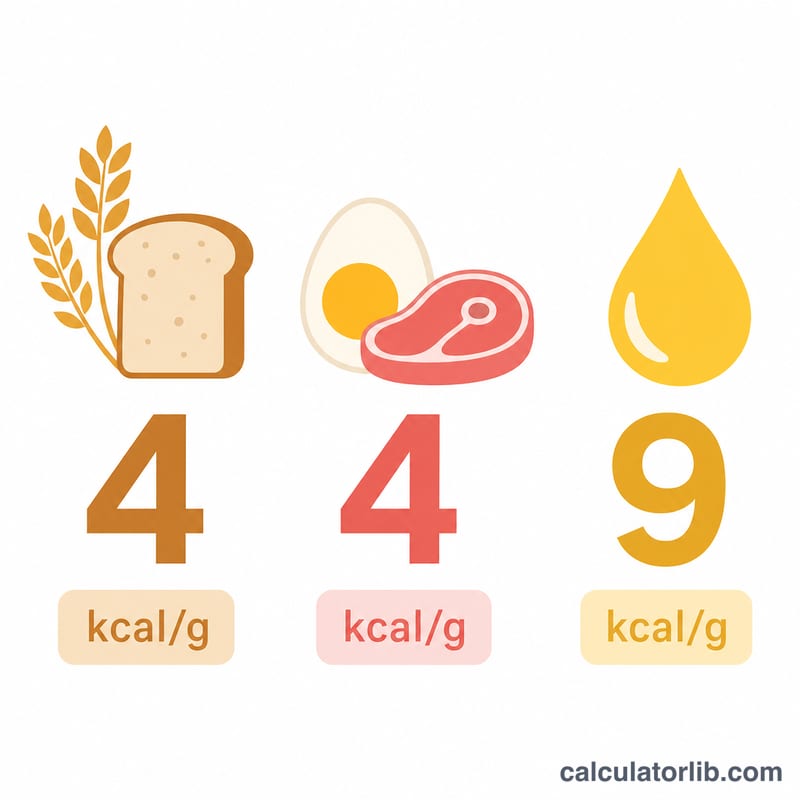
This tool converts the weight (in grams) of the three energy-providing macronutrients — carbohydrates, protein and fat — into total food energy measured in calories (kilocalories, kcal). It uses the widely accepted Atwater general factors: each gram of carbohydrate and protein supplies about 4 calories, while each gram of fat supplies about 9 calories. These are the same factors used on nutrition labels around the world.
How to use it
Enter the grams of carbohydrate, protein and fat for a single food or for a whole meal. The calculator multiplies each amount by its factor and adds them together, then shows the total energy plus a breakdown of how many calories come from each macronutrient. Leave a field at 0 if a nutrient is not present.
The formula explained
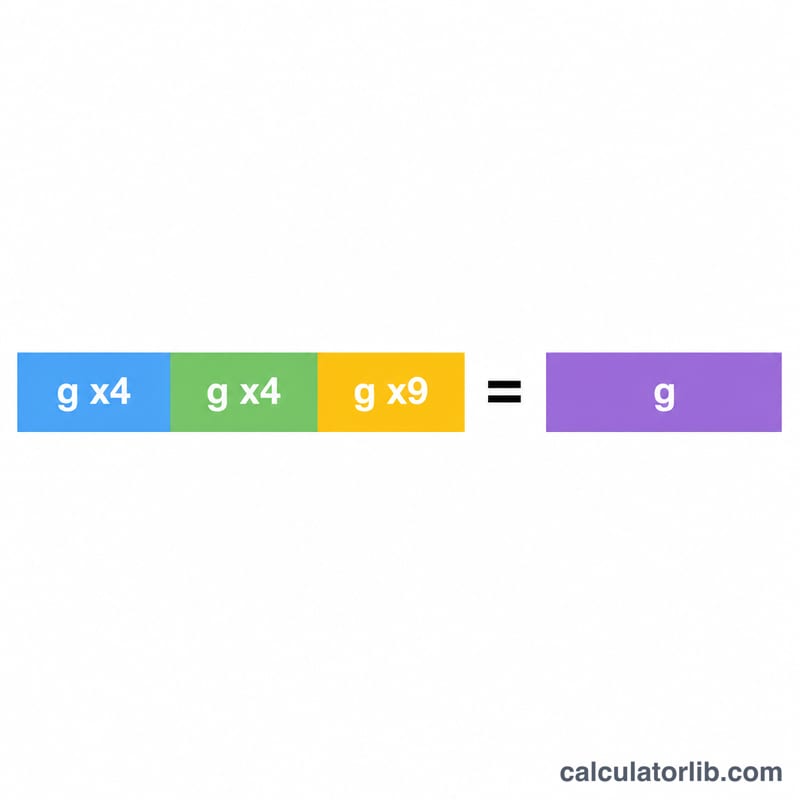
The equation is simply $$\text{Calories} = (\text{Carbs} \times 4) + (\text{Protein} \times 4) + (\text{Fat} \times 9)$$ Fat is the most energy-dense macronutrient, packing more than double the calories per gram of carbs or protein, which is why high-fat foods feel calorie-heavy. Alcohol (7 kcal/g) and fiber are not included in this simplified version.
Worked example
Suppose a snack contains 50 g of carbs, 30 g of protein and 10 g of fat. Carbs give \(50 \times 4 = 200\) kcal, protein gives \(30 \times 4 = 120\) kcal, and fat gives \(10 \times 9 = 90\) kcal. The total is $$200 + 120 + 90 = 410 \text{ calories}$$
FAQ
Are these calories exact? No — they are estimates based on average Atwater factors. Actual digestible energy varies slightly by food.
What about fiber and alcohol? This calculator counts only carbs, protein and fat. Fiber contributes roughly 2 kcal/g and alcohol about 7 kcal/g if you want a more detailed estimate.
Are calories and kilocalories the same? In everyday nutrition, the "calories" on a food label are kilocalories (kcal). This tool reports kcal.