What Is the Calories to Kilojoules Calculator?
This calculator converts energy measured in calories (more precisely, kilocalories or kcal, the unit printed on food labels) into kilojoules (kJ). Many countries — including the UK, Australia, and across the EU — list food energy in kilojoules, while others use calories. This tool bridges the two using the standard thermochemical conversion.
How to Use It
Type the number of calories (kcal) you want to convert into the input box and read the kilojoule result instantly. For example, a snack bar listed as 250 calories converts to just over 1,000 kJ. You can enter whole numbers or decimals.
The Formula Explained
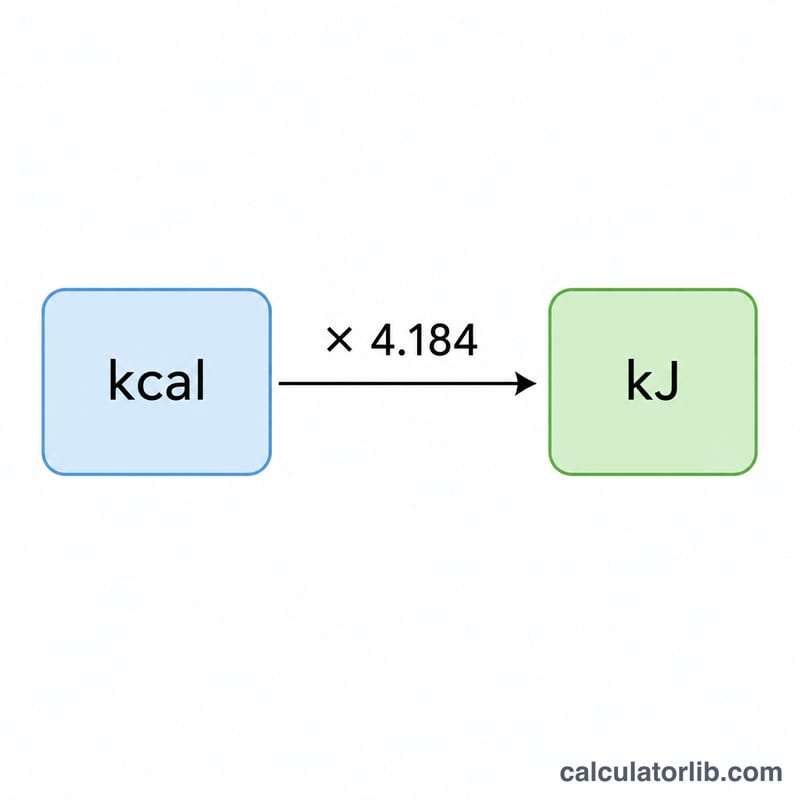
The conversion is a simple multiplication:
$$\text{kJ} = \text{kcal} \times 4.184$$
One kilocalorie (the "Calorie" on nutrition labels) equals exactly 4.184 kilojoules under the thermochemical definition. So to go from calories to kilojoules you multiply by 4.184; to reverse it, divide kilojoules by 4.184.
Worked Example
Suppose a meal contains 500 kcal. Multiply: $$500 \times 4.184 = 2{,}092 \text{ kJ}$$ That meal therefore provides 2,092 kilojoules of food energy.
Common kcal to kJ Conversion Table
Food energy in kilocalories (kcal, often just called "calories") converts to kilojoules (kJ) with \(\text{kJ} = \text{kcal} \times 4.184\). To go the other way, use \(\text{kcal} = \text{kJ} \div 4.184\).
kcal to kJ
| Energy (kcal) | Energy (kJ) = kcal × 4.184 |
|---|---|
| 10 | 41.84 |
| 50 | 209.2 |
| 100 | 418.4 |
| 150 | 627.6 |
| 200 | 836.8 |
| 250 | 1,046 |
| 500 | 2,092 |
| 1000 | 4,184 |
| 2000 | 8,368 |
kJ to kcal (reverse)
| Energy (kJ) | Energy (kcal) = kJ ÷ 4.184 |
|---|---|
| 100 | 23.90 |
| 500 | 119.50 |
| 1,000 | 239.01 |
| 2,000 | 478.01 |
| 5,000 | 1,195.03 |
| 8,000 | 1,912.05 |
| 10,000 | 2,390.06 |
Reverse values are rounded to two decimal places.
Typical Foods: Calories vs Kilojoules
The energy values below are rough, commonly quoted figures for typical servings. Real values vary by size, brand and recipe, so always check the product label. Kilojoules are calculated as kcal × 4.184 and rounded to the nearest whole number.
| Item (approximate) | Energy (kcal) | Energy (kJ) |
|---|---|---|
| Egg, large | 70 | 293 |
| Slice of bread | 80 | 335 |
| Medium apple | 95 | 397 |
| Medium banana | 105 | 439 |
| Can of cola (330 ml) | 140 | 586 |
| Glass of whole milk (250 ml) | 150 | 628 |
| Snack bar | 250 | 1,046 |
| Typical meal | 500 | 2092 |
Worked example: a 500 kcal meal is \(500 \times 4.184 = 2092\) kJ.
Energy Units and Conversion Constants
- 1 kcal = 4.184 kJ (thermochemical calorie) = 4,184 J.
- 1 cal (small calorie) = 4.184 J.
- 1 kcal = 1,000 cal.
- 1 kJ ≈ 0.239 kcal (exactly \(1 \div 4.184 \approx 0.23901\)).
- Alternative definition: the International Table (IT) calorie is 4.1868 J, so 1 kcal(IT) = 4.1868 kJ. The difference from 4.184 is about 0.07%, which is negligible for food labelling.
- On food labels, "Calories" with a capital C means kilocalories (kcal). Many countries, including those in the EU and Australia/New Zealand, show energy in both kJ and kcal, while others list only kcal.
This calculator uses the factor 4.184:
$$\text{kJ} = \text{kcal} \times 4.184$$
FAQ
Is a calorie the same as a kilocalorie? On food labels, "Calorie" (capital C) means kilocalorie. This calculator treats your input as kilocalories, which is what nutrition labels use.
Why 4.184 and not 4.2? \(4.184\) is the precise thermochemical conversion factor. Some sources round to \(4.2\) for quick estimates, but \(4.184\) is more accurate.
How do I convert kilojoules back to calories? Divide the kilojoule value by 4.184. For example, \(2{,}092 \div 4.184 = 500\) kcal.