
What Is the Calories In vs Out Calculator?
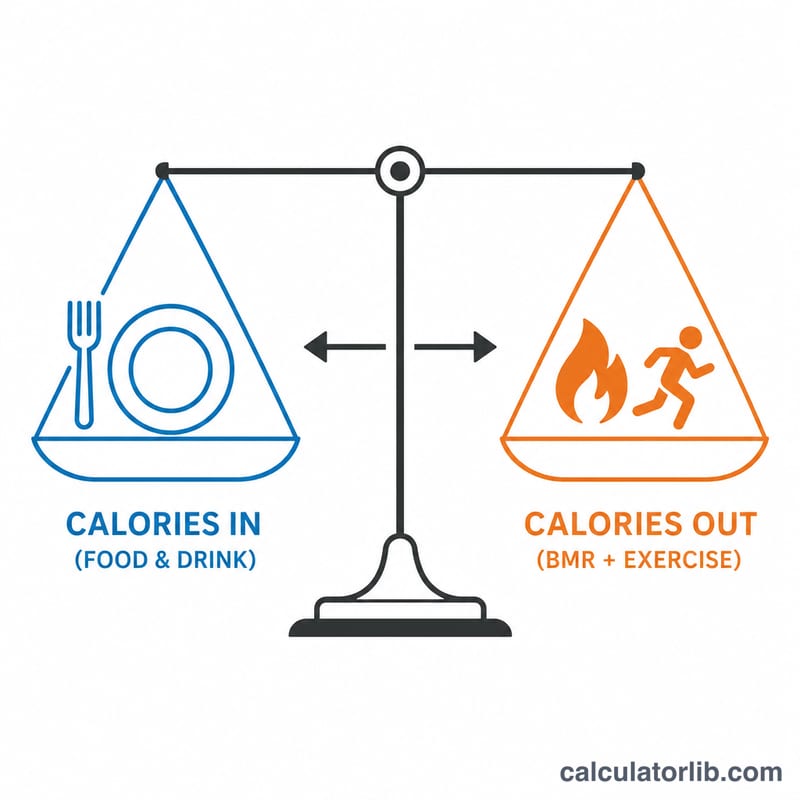
This tool applies the energy-balance principle of weight management: the calories you eat (in) versus the calories your body burns (out). When intake exceeds expenditure you store the surplus; when expenditure exceeds intake you draw on stored energy. The calculator combines your daily calorie intake with your Basal Metabolic Rate (BMR) and exercise burn to show your net balance and an estimated rate of weight change.
How to Use It
Enter the calories you consume in a typical day, your estimated BMR (the energy your body uses at rest — find it with a BMR calculator), and the calories you burn through exercise and daily activity. The result shows whether you are in a surplus (gaining) or deficit (losing), along with an estimated daily and weekly weight change.
The Formula Explained
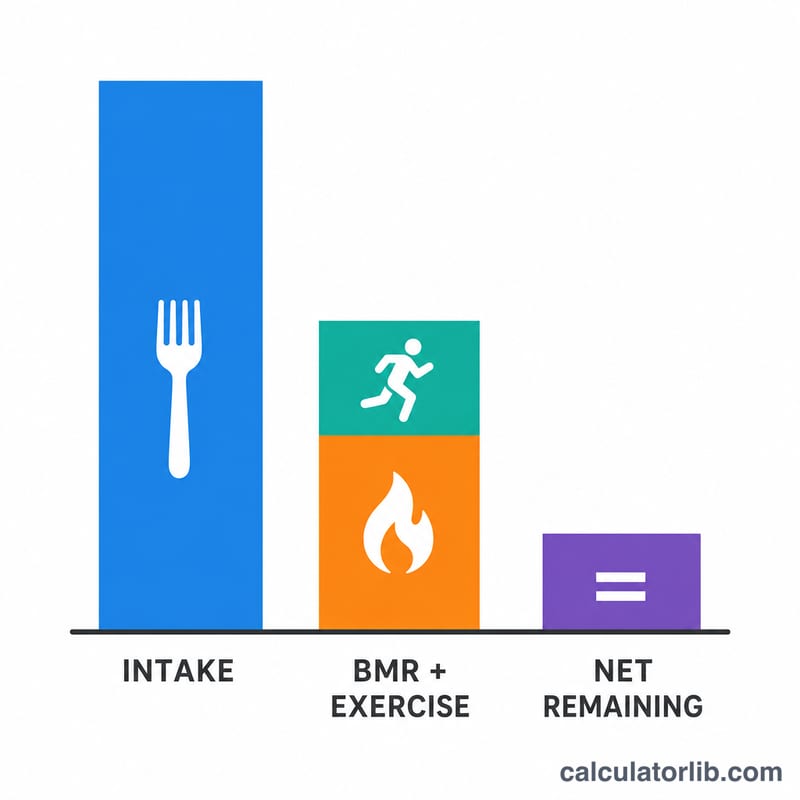
First, total calories burned = \(\text{BMR} + \text{Exercise}\). Then $$\text{Net} = \text{Consumed} - (\text{BMR} + \text{Exercise})$$ A common estimate holds that roughly 7,700 kcal equals about 1 kg of body fat, so daily weight change $$\Delta w = \frac{\text{Net}}{7700}$$ and weekly change is that figure multiplied by 7.
Worked Example
Suppose you eat 2,200 kcal, have a BMR of 1,600 kcal, and burn 400 kcal in exercise. Total burned \(= 1{,}600 + 400 = 2{,}000\) kcal. Net \(= 2{,}200 - 2{,}000 = +200\) kcal (a surplus). Daily weight change \(= 200 \div 7{,}700 \approx 0.026\) kg, or about 0.182 kg per week of slow gain.
FAQ
Is the 7,700 kcal per kg exact? No. It's a widely used approximation for body fat. Real-world changes also involve water, muscle and metabolic adaptation, so treat the weight estimate as a guide.
What counts as "calories out"? Here it is BMR plus exercise. For a fuller picture, your total daily energy expenditure (TDEE) also includes the thermic effect of food and non-exercise activity.
How do I create a deficit? Eat fewer calories than you burn, move more, or both. A modest deficit of 300–500 kcal/day is a sustainable target for most people.