What is the Kilojoules to Calories Calculator?
This tool converts energy measured in kilojoules (kJ) into calories (kcal), the "Calories" shown on food and nutrition labels. Many countries — including Australia, the UK and most of Europe — list food energy in kilojoules, while the United States and fitness apps often use Calories. This converter bridges the two so you can compare values at a glance.
How to use it
Enter the energy value in kilojoules and read the result in kcal. For example, a snack labelled 836 kJ converts to about 200 Calories. The calculation is universal and applies regardless of country.
The formula explained
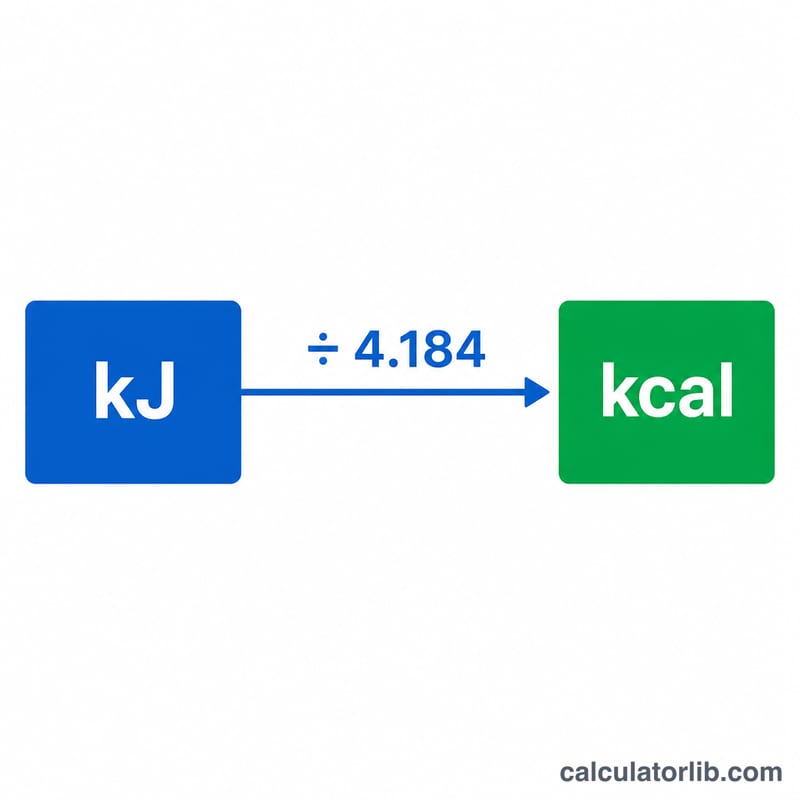
One food Calorie (kilocalorie) equals 4.184 kilojoules — the thermochemical calorie definition. To go from kJ to kcal you simply divide:
$$\text{kcal} = \frac{\text{Energy (kJ)}}{4.184}$$
Conversely, to convert Calories back to kilojoules, multiply by 4.184.
Worked example
Suppose a meal provides 2,000 kJ. Dividing by 4.184 gives $$2000 \div 4.184 \approx 478.01 \text{ kcal}.$$ So the meal contains roughly 478 food Calories.
Common kJ to kcal Conversion Table
To convert kilojoules to food Calories (kilocalories), divide by 4.184: \(\text{kcal} = \frac{\text{kJ}}{4.184}\). Results below are rounded to the nearest whole number.
| Energy (kJ) | Energy (kcal) |
|---|---|
| 100 | 24 |
| 250 | 60 |
| 500 | 120 |
| 750 | 179 |
| 1000 | 239 |
| 1500 | 359 |
| 2000 | 478 |
| 2500 | 598 |
| 3000 | 717 |
| 8700 | 2079 |
Reverse: kcal to kJ
To go the other way, multiply by 4.184: \(\text{kJ} = \text{kcal} \times 4.184\).
| Energy (kcal) | Energy (kJ) |
|---|---|
| 50 | 209.2 |
| 100 | 418.4 |
| 250 | 1046 |
| 500 | 2092 |
| 1000 | 4184 |
| 2000 | 8368 |
| 2500 | 10,460 |
Typical Food Energy Examples in kJ and kcal
The values below are approximate. Real energy content varies with size, variety, brand and preparation, so always check the nutrition label on your product. The kcal figures are the kJ values divided by 4.184 and rounded.
| Food (approximate portion) | Approx. kJ | Approx. kcal |
|---|---|---|
| Medium apple | 400 | 96 |
| Medium banana | 450 | 108 |
| Slice of bread | 450 | 108 |
| Large egg | 300 | 72 |
| Can of soft drink (330 ml) | 600 | 143 |
| Glass of whole milk (250 ml) | 650 | 155 |
| Tablespoon of olive oil | 500 | 120 |
| Cup of cooked rice | 900 | 215 |
| Chocolate bar | 1000 | 239 |
Example: a chocolate bar listed at 1000 kJ contains \(\frac{1000}{4.184} \approx 239\) kcal.
Energy Unit Constants and Definitions
- 1 kcal = 4.184 kJ (thermochemical definition).
- 1 cal = 4.184 J (thermochemical calorie).
- 1 kJ = 1000 J.
- 1 kJ ≈ 0.239 kcal (that is, \(1 \div 4.184 \approx 0.239006\)).
- The International Table (IT) calorie is defined as 4.1868 J. Using it instead of 4.184 changes results by only about 0.07%, which is negligible for food labeling.
- The food Calorie (capital C) is the same as a kilocalorie (kcal), which equals 1000 small calories (cal). Nutrition labels that say "Calories" mean kcal.
Many countries, including those in the EU, Australia and New Zealand, show energy in kJ, often with kcal alongside. The US typically shows only Calories (kcal).
FAQ
Are calories and kilocalories the same? On food labels, "Calorie" (capital C) means kilocalorie (kcal). This calculator returns kcal.
Why 4.184? That is the number of joules in one thermochemical calorie; one kilocalorie therefore equals 4.184 kJ.
How do I reverse the conversion? Multiply the calorie value by 4.184 to get kilojoules.