
What is an annulus?
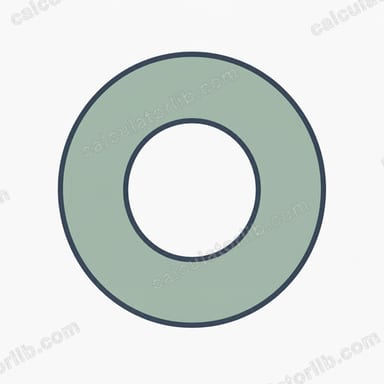
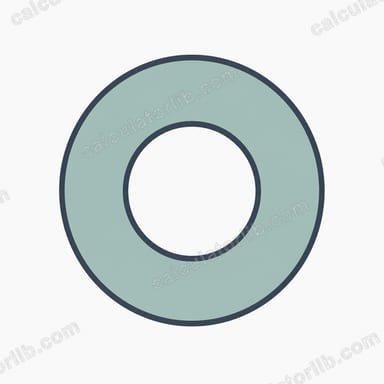
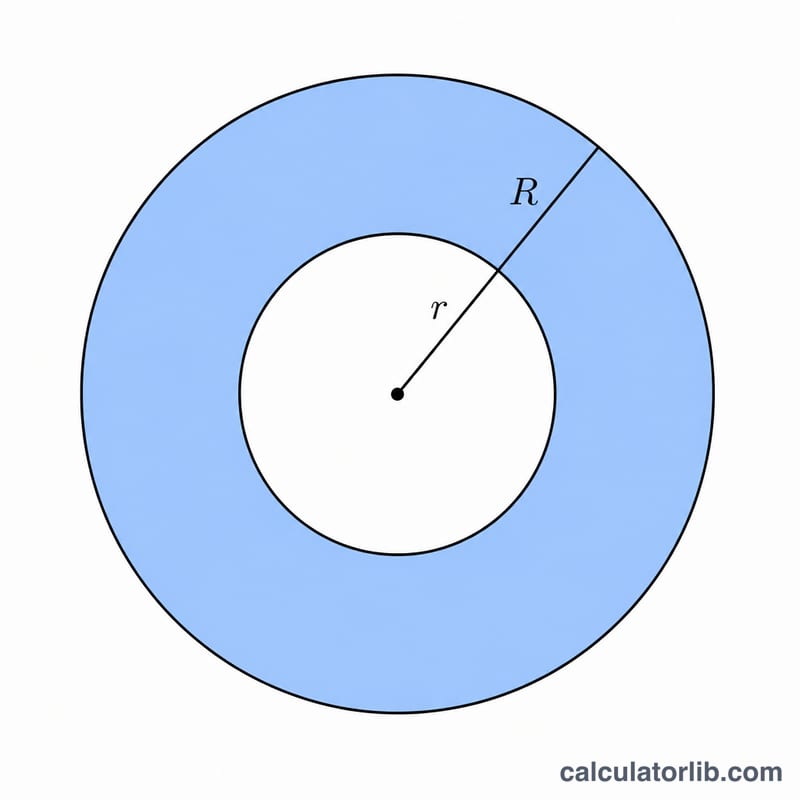
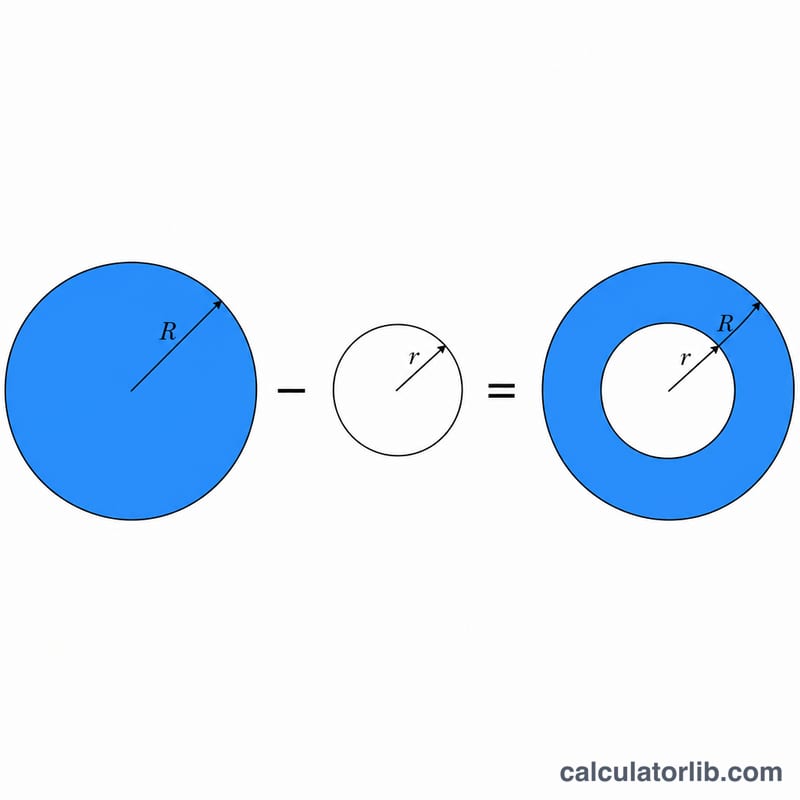
An annulus is the flat ring-shaped region bounded by two concentric circles — a larger outer circle of radius R and a smaller inner circle of radius r. Think of a washer, a CD, a pipe cross-section, or a circular running track. The area of the annulus is simply the area of the big disk minus the area of the small disk.
How to use this calculator
Enter the outer radius (R) and the inner radius (r) in the same units. The calculator instantly returns the ring area in square units, along with the ring width (R − r) and the inner and outer circumferences. Make sure R is greater than or equal to r — if r exceeds R the area is reported as zero.
The formula explained
The area of a full circle is π·radius². The outer disk has area πR² and the inner disk has area πr². Subtracting the inner from the outer gives the area of the ring:
$$A = \pi R^{2} - \pi r^{2} = \pi\left(R^{2} - r^{2}\right)$$
Factoring out π keeps the arithmetic compact and reduces rounding error.
Worked example
Suppose a metal washer has an outer radius of 5 cm and an inner hole radius of 3 cm. Then $$A = \pi\left(5^{2} - 3^{2}\right) = \pi\left(25 - 9\right) = \pi \times 16 \approx 50.27 \text{ cm}^{2}.$$ The ring width is \(5 - 3 = 2\) cm.
How to Calculate Annulus Area by Hand
The annulus area is the area of the large circle minus the area of the small circle. Follow these steps with the outer radius \(R\) and inner radius \(r\) (both in the same units).
- Convert diameters to radii if needed. If you measured diameters, halve them first: \(R = D_{\text{outer}}/2\) and \(r = D_{\text{inner}}/2\). For example, a 10 cm outer diameter gives \(R = 5\) cm.
- Square the outer radius. Compute \(R^2\). Using \(R = 5\) cm: \(R^2 = 25\) cm².
- Square the inner radius. Compute \(r^2\). Using \(r = 4.5\) cm: \(r^2 = 20.25\) cm².
- Subtract. Find \(R^2 - r^2 = 25 - 20.25 = 4.75\) cm². Always subtract the smaller squared radius from the larger.
- Multiply by \(\pi\). \(A = \pi \times 4.75 \approx 3.14159 \times 4.75 = 14.92\) cm². This is the ring area.
Putting it together for this pipe-wall example:
$$A = \pi\left(5^{2} - 4.5^{2}\right) = \pi\left(25 - 20.25\right) = \pi \times 4.75 \approx 14.92\ \text{cm}^2$$Unit-squaring note: because you square the radii, the resulting area carries squared units (cm², m², in²). Make sure both radii share the same unit before squaring — mixing centimeters and meters will produce a wrong answer. If you started from a diameter and want a quick check, halving a 9 cm diameter gives a radius of 4.5 cm, which matches the inner radius used above.
FAQ
What if I only know the diameters? Divide each diameter by 2 to get the radii first, then enter them.
Can R equal r? Yes — then the ring has zero width and the area is 0.
What units does the result use? Whatever unit you input for the radii, squared. If R and r are in inches, the area is in square inches.