
What Is the Tile Area Calculator?
This tool tells you exactly how many tiles you need to cover a floor or wall. You enter the room dimensions in metres and the tile size in centimetres, and it divides the surface area by the area of a single tile. Because you can never use a fraction of a tile, the total is rounded up, and an optional wastage allowance covers cuts, breakages and offcuts.
How to Use It
Measure the length and width of the surface you want to tile and enter them in metres. Enter the tile length and width in centimetres (a common size is 30 \(\times\) 30 cm). Add a wastage percentage — 10% is a typical starting point, but use 15–20% for diagonal layouts or rooms with many cuts. The calculator returns the whole number of tiles to buy.
The Formula Explained
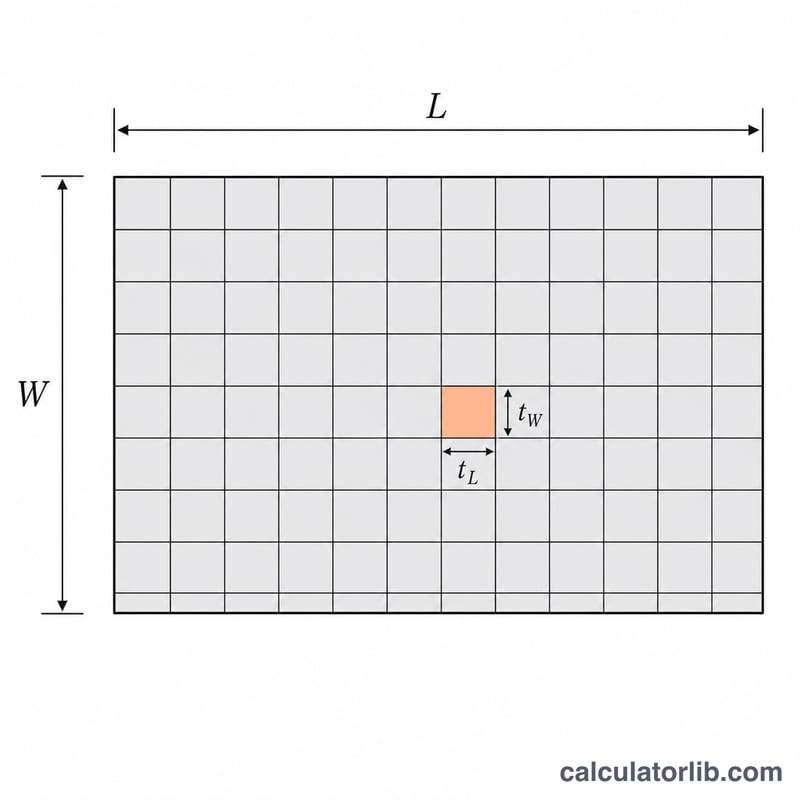
The core formula is $$\text{Tiles} = \left\lceil \frac{\text{Length (m)} \times \text{Width (m)}}{\left(\frac{\text{Tile L (cm)}}{100}\right)\left(\frac{\text{Tile W (cm)}}{100}\right)} \times \left(1 + \frac{\text{Wastage (\%)}}{100}\right) \right\rceil$$ The room area \(L \cdot W\) (in m²) is divided by the area of one tile (converted from cm to m²). Multiplying by \((1 + \text{wastage})\) adds your safety margin, and the ceiling function rounds up to whole tiles.
Worked Example
A 4 m \(\times\) 3 m floor = 12 m². With 30 cm \(\times\) 30 cm tiles, each tile covers \(0.3 \times 0.3 = 0.09\) m². That needs \(12 / 0.09 = 133.33\) tiles before wastage. Adding 10% gives 146.67, which rounds up to 147 tiles.
FAQ
Should I round up? Yes — you can only buy whole tiles, and the calculator rounds up automatically.
How much wastage should I add? 10% for a standard straight layout, 15–20% for diagonal or complex patterns and small rooms with many cuts.
Does it work for walls? Yes. The math is identical for any flat rectangular surface — just enter the wall's height and width.