
What this tile calculator does
This tool tells you how many individual tiles — and how many full boxes — you need to cover a floor or wall. It works for any rectangular area and any rectangular tile, and it automatically adds a waste allowance for cuts, breakages and future repairs. Measurements are universal: rooms in metres, tiles in centimetres.
How to use it
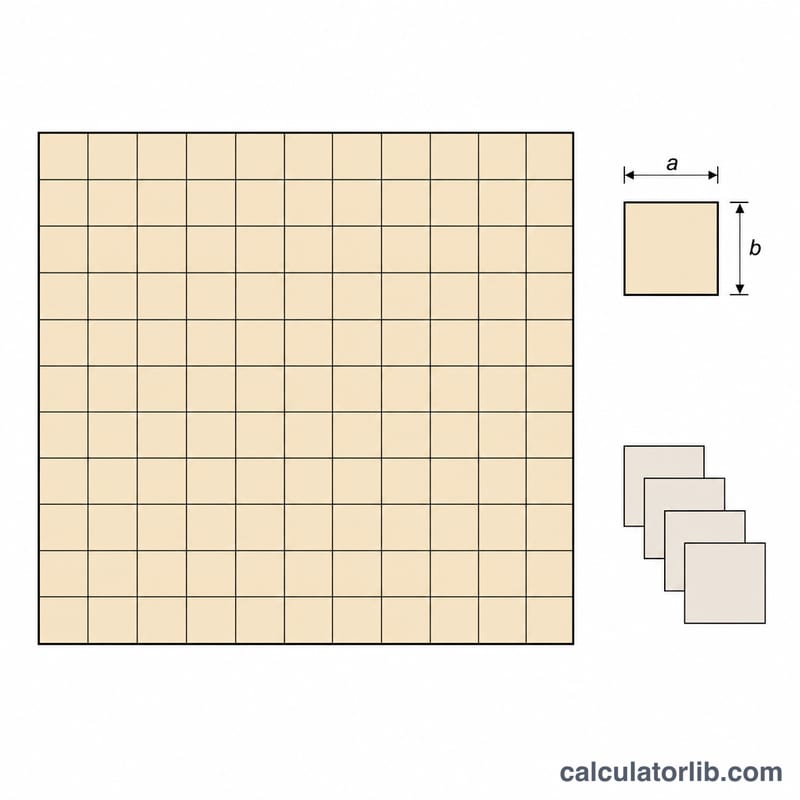
Measure the room length and width in metres and the tile length and width in centimetres. Choose a waste percentage (10% is a common starting point; use 15% for diagonal layouts or busy patterns), and enter how many tiles come in a box. The calculator returns the exact tile count rounded up to a whole tile, plus the number of full boxes to purchase.
The formula explained
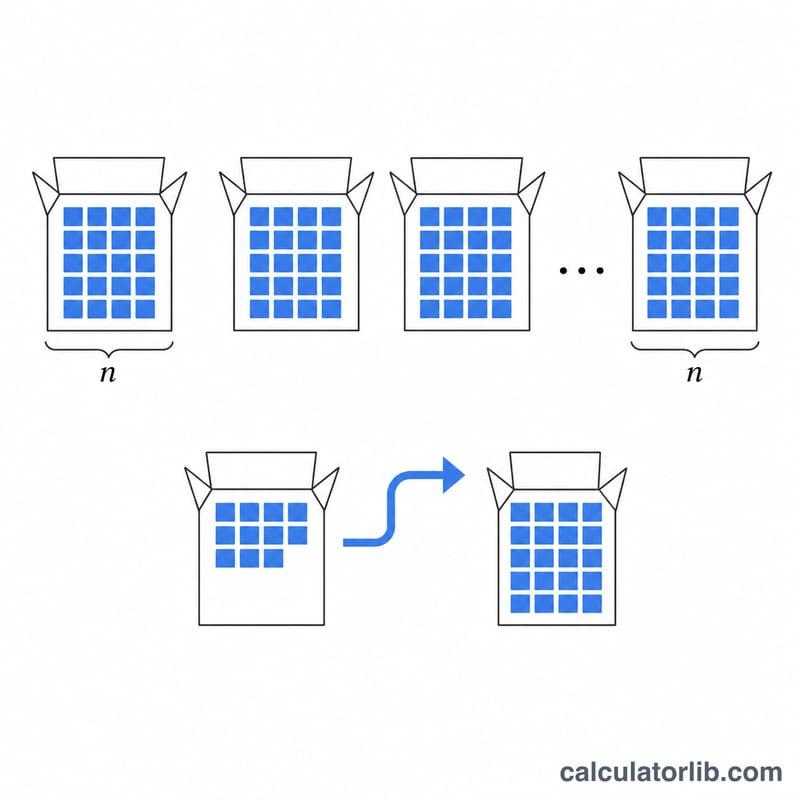
First the floor area is found: $$A = \text{length} \times \text{width}$$ The area of one tile is converted to square metres: $$a_t = \left(\frac{\text{tile length}}{100}\right) \times \left(\frac{\text{tile width}}{100}\right)$$ The raw tile count is the padded area divided by the tile area, $$\frac{A \times (1 + w)}{a_t}$$ rounded up so you never come up short. Boxes are tiles ÷ per-box, also rounded up.
Worked example
A 4 m × 3 m room (12 m²) tiled with 30 cm × 30 cm tiles (0.09 m² each) at 10% waste: $$12 \times 1.10 = 13.2 \text{ m}^2$$ of coverage. $$13.2 \div 0.09 = 146.67$$ rounded up to 147 tiles. At 10 tiles per box, $$147 \div 10 = 14.7$$ rounded up to 15 boxes.
FAQ
How much waste should I add? 10% is typical for straight layouts, 15% for diagonal or herringbone patterns, and a little more for very intricate spaces.
Why round boxes up? Tiles are sold by the box, so you always buy whole boxes. Leftovers are useful for future repairs.
Does it work for walls too? Yes — just treat the wall height and width as the "room" dimensions in metres.