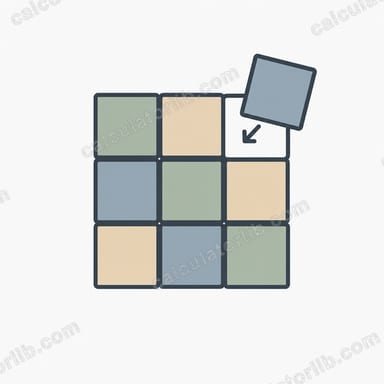

What This Calculator Does
Estimate exactly how many tiles you need for a floor, wall, backsplash, or shower — including the grout-gap allowance, boxes to buy, and a recommended overage range to cover cuts, breakage, and future repairs. Enter the tile size, the surface dimensions (or its total area), the grout gap, and the box quantity; the calculator does the unit math and rounds up to whole boxes.
The Formula
Each tile occupies its physical size plus half a grout gap on every side — effectively a full grout gap added to length and width:
$$\text{tiles} = \left\lceil \frac{\text{surfaceArea}}{(\text{tileLength} + \text{gap}) \times (\text{tileWidth} + \text{gap})} \right\rceil$$
$$\text{boxes} = \left\lceil \frac{\text{tiles}}{\text{boxSize}} \right\rceil$$
The ceiling functions reflect the practical reality: you can't buy 1,665.7 boxes — round up to the next whole unit.
Worked Example
12 cm × 12 cm tiles with 0.25 cm grout gaps, covering a 20 m × 15 m floor (300 m²), in boxes of 12:
- Effective tile slot = \((12 + 0.25) \times (12 + 0.25) = 150.0625\) cm² each
- Surface area = 300 m² = 3,000,000 cm²
- Tiles = \(\left\lceil 3{,}000{,}000 / 150.0625 \right\rceil =\) 19,992 tiles
- Boxes = \(\left\lceil 19{,}992 / 12 \right\rceil =\) 1,666 boxes
- Buy 5–10% extra: 20,992–21,991 tiles, or 1,750–1,833 boxes.
Why You Should Buy Extra
Tile installations almost always need 5–15% more material than the bare math suggests. Reasons:
- Cuts at edges and corners. Rectangular tiles don't divide perfectly into rectangular rooms; cut pieces are usually unrecoverable from their cut neighbour.
- Diagonal or pattern layouts. Adding 10–15% is standard for diagonal patterns, even more for herringbone or chevron.
- Breakage. Brittle tiles snap during cuts, transport, and installation. Even careful pros lose 1–3%.
- Future repairs. Tile lots vary slightly in shade between production runs. Saving a few extra tiles from the original lot lets you patch chips or breaks years later without a colour mismatch.
A few extra dollars upfront beats a rush trip to a discontinued tile.
Picking the Grout Gap
Grout-joint width is both an aesthetic and a structural choice:
- 1–3 mm (1/16–1/8 in) — Thin grout lines for rectified porcelain or natural stone with crisp edges. Modern, seamless look but unforgiving of tile-size variation.
- 3–5 mm (1/8–3/16 in) — Standard for most ceramic and porcelain floor tiles.
- 5–10 mm (3/16–3/8 in) — Wider joints for handmade, terracotta, or rustic tiles where size is irregular.
- ≥10 mm — Special applications (slate, large-format outdoor tile). Requires sanded grout.
Wider gaps let you mask uneven walls, but use more grout and need cleaning more often.
Mixing Imperial and Metric Units
This calculator handles independent units for the tile, the surface, and the grout gap. Common combinations:
- U.S. residential: tiles in inches, room in feet, grout in inches. (e.g., 12 in × 12 in tile, 15 ft × 18 ft floor, 1/8 in gap)
- European residential: tiles in cm, room in meters, grout in mm.
- Pre-calculated area: use the "Total Area" mode if you already know the square footage from a contractor's quote or a measurement app.
Tips
- Subtract major obstructions. If your room has a built-in tub or kitchen island, subtract its footprint from the surface area first.
- Measure twice. Tape-measure errors of even 1% on a 30 m² area mean 30 extra tiles needed (or wasted).
- Check the box weight. 12×12 in porcelain weighs ~50 lbs/box; ordering 100 boxes means planning a delivery and storage area.
- Tile-direction matters. If using rectangular tiles in a brick or running-bond pattern, the layout affects waste differently than this calc assumes — bump overage to 12–15%.