
What is the Metal Weight Calculator?
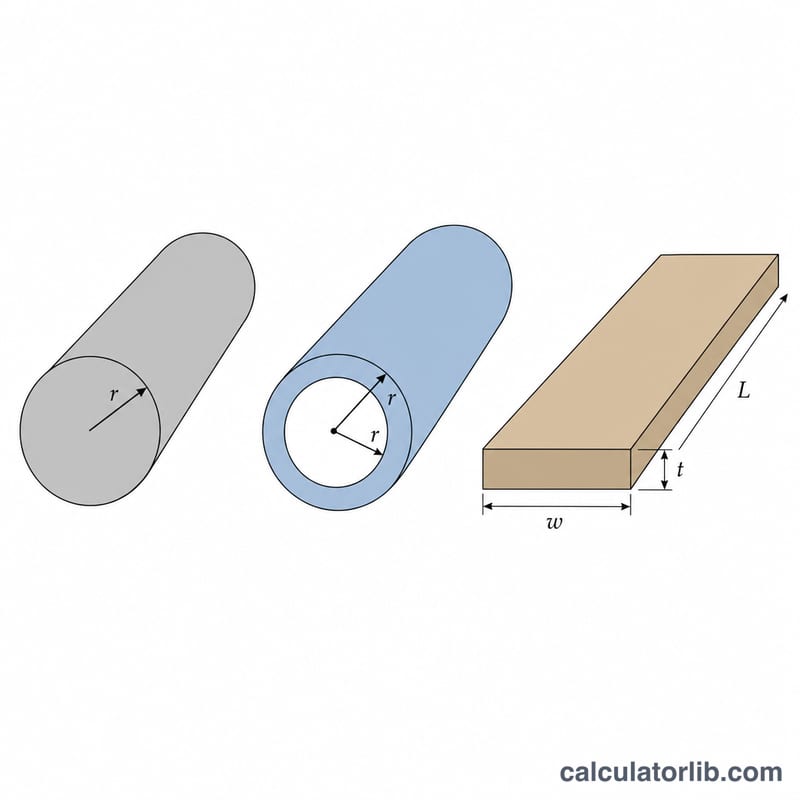
The Metal Weight Calculator estimates how much a piece of metal stock weighs based on its shape, dimensions and the density of the material. It works for round bars, square bars, flat bars/plates and round tubes in common engineering metals such as steel, aluminium, copper, brass and stainless steel. This is a universal physics-based tool — it applies anywhere, with no country-specific assumptions.
How to use it
Pick the shape and material, then enter the required dimensions in millimetres. For a round bar you only need the diameter and length; for a flat bar enter width and thickness; for a tube enter the outside diameter and wall thickness. The calculator computes the cross-sectional area, multiplies by the length to get volume, and multiplies volume by the material density to get the weight in kilograms.
The formula explained
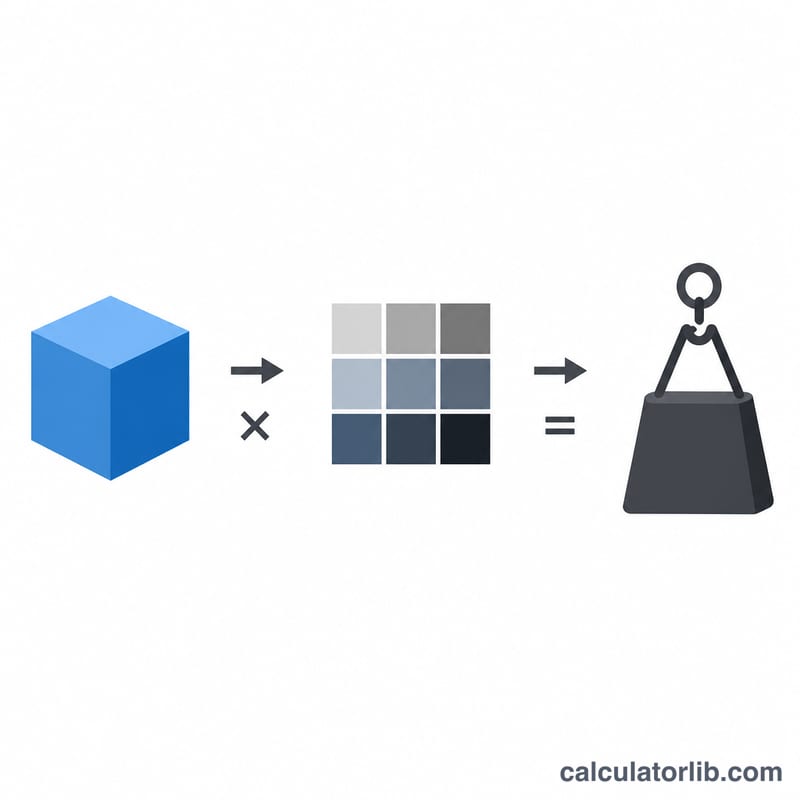
The core relationship is Weight = Volume × Density. Volume equals the cross-sectional area times the length. Because dimensions are entered in millimetres, the volume in mm³ is divided by 1,000,000,000 to convert to cubic metres, which pairs with density expressed in kg/m³ to yield kilograms.
$$W = \frac{\frac{\pi}{4}\,\text{Dia}^{2} \cdot \text{Length}}{10^{9}} \cdot \text{Density}$$\(\text{(all lengths in mm, weight in kg)}\)
Worked example
Consider a steel round bar (density 7850 kg/m³) with a 20 mm diameter and 1000 mm length. The area is \(\pi \times 10^{2} = 314.159 \text{ mm}^{2}\). Volume = \(314.159 \times 1000 = 314{,}159 \text{ mm}^{3} = 0.000314159 \text{ m}^{3}\). Weight = \(0.000314159 \times 7850 \approx\) 2.466 kg.
FAQ
Which density should I use? The dropdown values are typical room-temperature densities. For precision use your supplier's certified density.
Why is the answer slightly off from a chart? Standard charts may use rounded densities or nominal dimensions; small differences are normal.
Can I get weight per metre? Yes — enter a length of 1000 mm and the result is the weight per metre of that profile.