
What is the Plate Weight Calculator?
This tool estimates the weight of a flat rectangular metal plate or sheet from its length, width, thickness and material density. It is widely used by fabricators, engineers, scrap dealers and DIY metalworkers to estimate shipping costs, material cost and load-bearing requirements before cutting or ordering steel, aluminum, copper and other materials.
How to use it
Enter the plate length, width and thickness in millimetres. Choose a material from the list to load its standard density, or pick "Custom" and type your own density in g/cm³. Set the quantity if you are weighing more than one identical plate. The calculator returns the weight per piece and the total weight in kilograms, along with the volume and density used.
The formula explained
The weight of a plate equals its volume times its density. The volume of a rectangular plate is simply length × width × thickness. Because the dimensions are entered in millimetres and density in grams per cubic centimetre, each dimension is divided by 10 to convert to centimetres, the three are multiplied for cm³, multiplied by density for grams, then divided by 1000 to get kilograms.
$$W = \frac{\text{Length} \times \text{Width} \times \text{Thickness}}{1000} \times \frac{\rho}{1000} \times \text{Qty}$$ $$\text{where}\quad \rho = \text{Material density (g/cm}^3\text{)}$$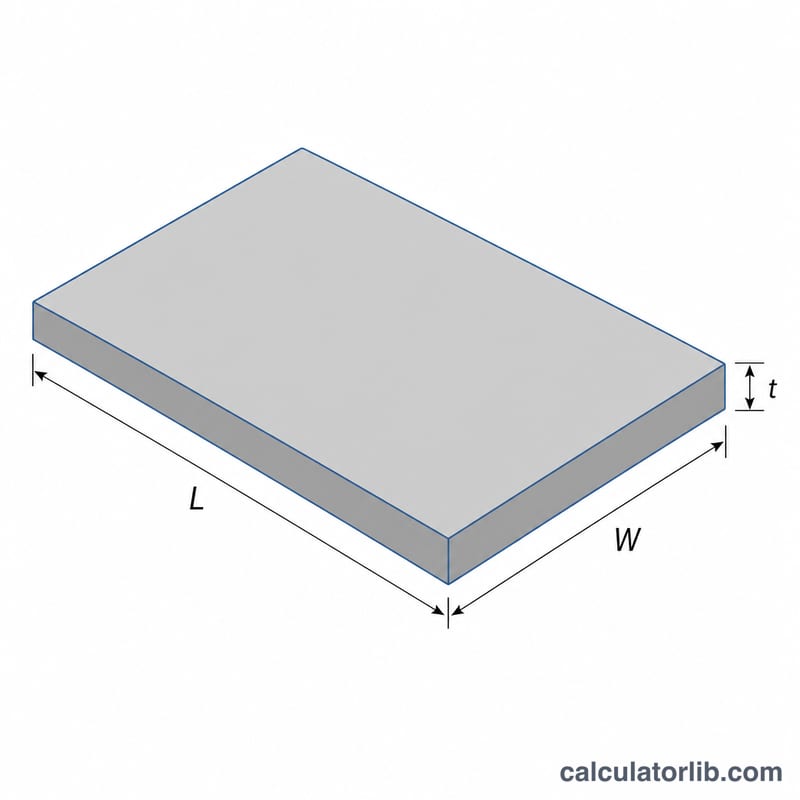
Worked example
Take a steel plate 1000 mm long, 500 mm wide and 10 mm thick (density 7.85 g/cm³). Convert dimensions: \(100\,\text{cm} \times 50\,\text{cm} \times 1\,\text{cm} = 5000\,\text{cm}^3\). Multiply by density:
$$5000 \times 7.85 = 39{,}250\ \text{g} = 39.25\ \text{kg}$$per plate. Ten such plates weigh 392.5 kg.
FAQ
Which densities are used? Steel 7.85, stainless steel 8.0, aluminum 2.70 and copper 8.96 g/cm³. These are typical reference values; alloys vary slightly.
Can I use inches? This version expects millimetres. Convert inches to mm by multiplying by 25.4 first.
Does it work for non-rectangular shapes? No — the formula assumes a flat rectangular plate. For circles or rings, use the area of that shape times thickness times density instead.