
What is a Rolling Offset?
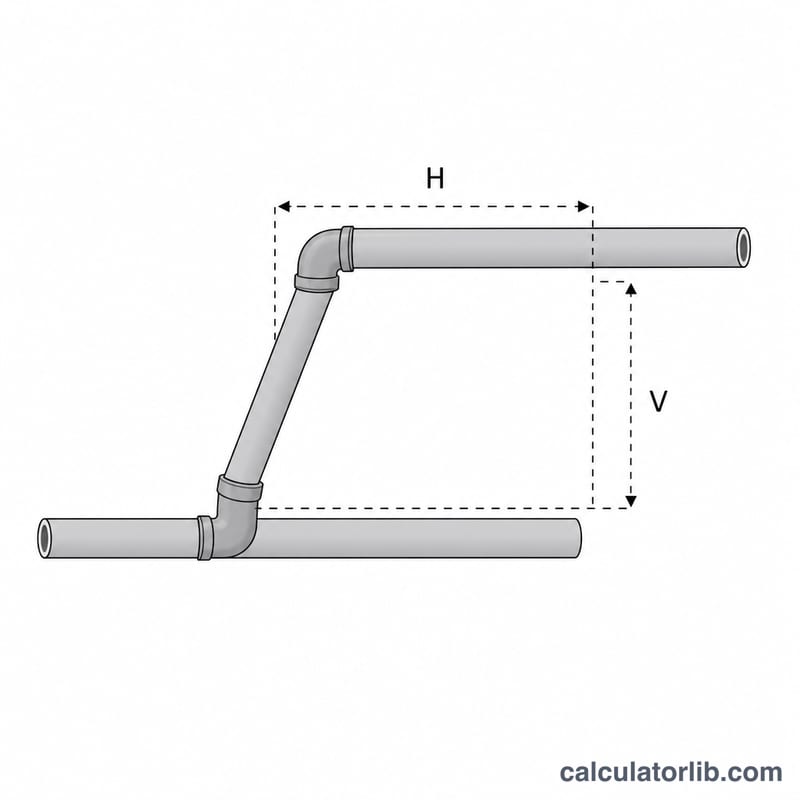
A rolling offset is a piping run that changes direction in two planes at once — it moves both sideways (horizontal) and up or down (vertical) between two points. Because the displacement happens diagonally, you cannot read the pipe length directly off a tape measure. This calculator finds the true offset (the real diagonal distance) and the travel (the center-to-center pipe length you must cut between the two fittings).
How to Use It
Measure the horizontal offset and the vertical offset between the two pipe centerlines. Enter both values in inches, then choose the angle of the fittings you are using — 45° is most common, but 22.5°, 11.25°, 60° and 90° are also available. The calculator returns the true offset, the travel, and the run (how far the pipe advances along the original direction).
The Formula Explained
First the true offset is found with the Pythagorean theorem: \(\text{Offset} = \sqrt{H^{2} + V^{2}}\). Then the travel is the offset divided by the sine of the fitting angle: \(\text{Travel} = \text{Offset} \div \sin(\theta)\). The run equals \(\text{Travel} \times \cos(\theta)\). For 45° fittings, \(\sin(45°) \approx 0.7071\), so travel is the offset multiplied by about 1.4142.
$$\text{Travel} = \frac{\sqrt{\text{Horizontal}^{2} + \text{Vertical}^{2}}}{\sin\left(\text{Angle}\right)}$$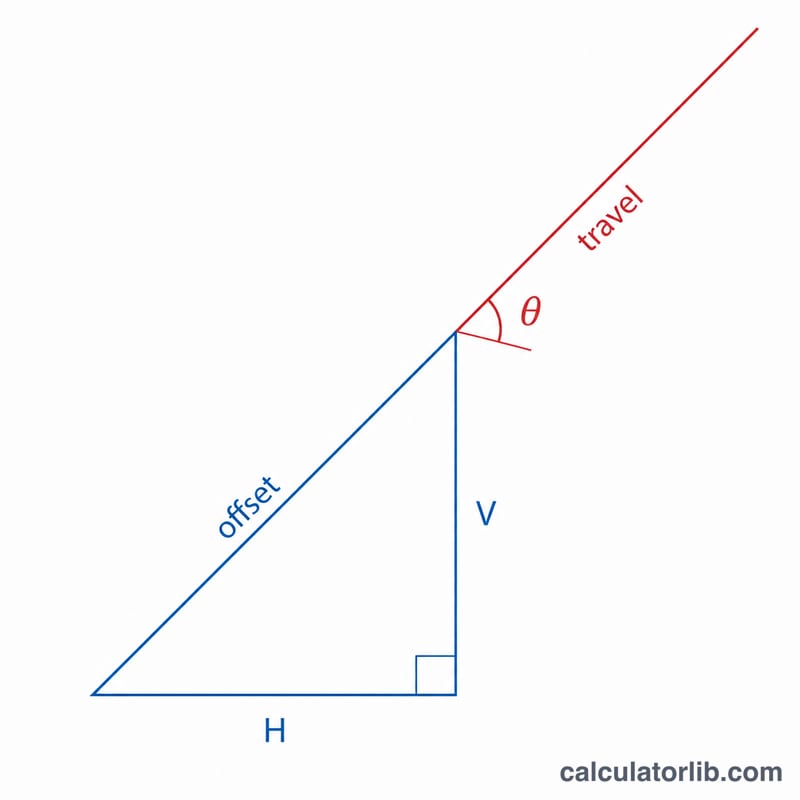
Worked Example
Suppose the horizontal offset is 12 in and the vertical offset is 16 in, using 45° fittings. The true offset is
$$\sqrt{12^{2} + 16^{2}} = \sqrt{144 + 256} = \sqrt{400} = 20 \text{ in}$$The travel is
$$20 \div \sin(45°) = 20 \div 0.7071 \approx 28.28 \text{ in}$$The run is
$$28.28 \times \cos(45°) = 20 \text{ in}$$FAQ
What is "travel"? Travel is the center-to-center length of pipe between the two fittings — the diagonal piece you actually cut.
Why use 45° fittings? They are the standard for offsets because they keep flow smooth and make the math simple (travel = offset × 1.414).
Do units matter? No — use any consistent unit (inches, mm, cm). All outputs are in the same unit you enter.