
What Is Rolling Resistance?
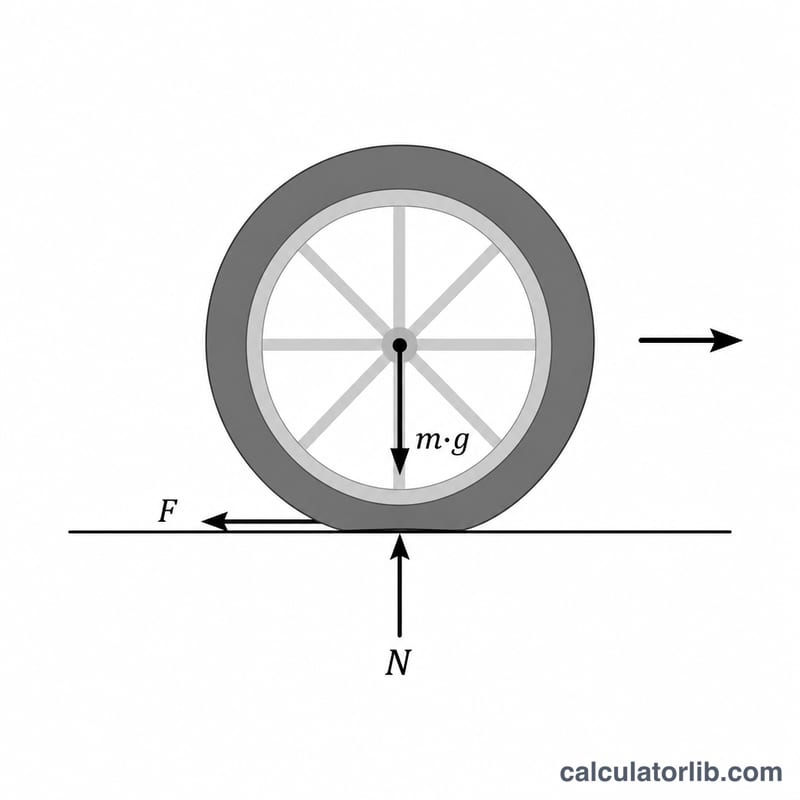
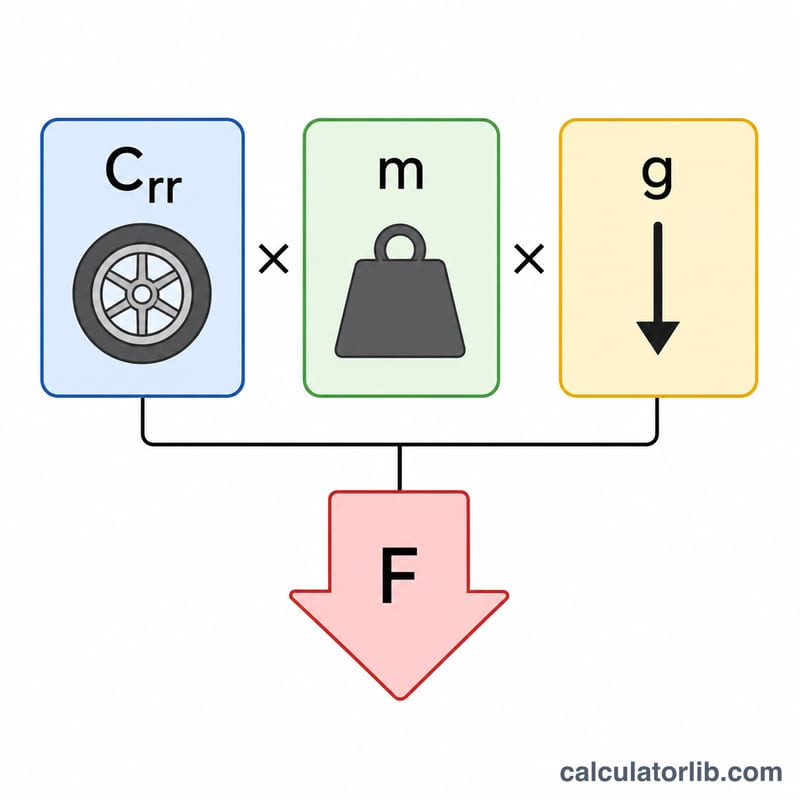
Rolling resistance is the force that resists the motion of a body (such as a tire, wheel, or ball) as it rolls over a surface. It arises mainly from deformation of the rolling object and the surface, internal friction, and small slippages. This calculator finds the rolling resistance force using the standard relation \(F = C_{rr} \cdot N = C_{rr} \cdot m \cdot g\), where \(C_{rr}\) is the dimensionless rolling resistance coefficient, \(N\) is the normal force, \(m\) is mass, and \(g\) is gravitational acceleration.
How to Use It
Enter the rolling resistance coefficient (\(C_{rr}\)) for your tire and surface combination, the total mass supported in kilograms, and gravity (9.81 m/s² on Earth). The calculator multiplies mass by gravity to get the normal force, then multiplies by \(C_{rr}\) to give the resisting force in newtons. Typical \(C_{rr}\) values range from about 0.001 for railroad steel wheels, ~0.01–0.015 for car tires on asphalt, up to 0.3 or more on soft sand.
The Formula Explained
On level ground the normal force equals the weight, \(N = m \cdot g\). The empirical model assumes the resisting force is proportional to that normal force:
$$F = C_{rr} \cdot N$$The coefficient bundles together tire material, pressure, temperature, and surface effects into one number, making the equation simple yet broadly useful for vehicle dynamics, energy and fuel-economy estimates, and engineering design.
Worked Example
Consider a 1500 kg car with car-tire coefficient \(C_{rr} = 0.015\) on Earth (\(g = 9.81\,\text{m/s}^2\)). The normal force is
$$N = 1500 \times 9.81 = 14{,}715\ \text{N}$$The rolling resistance force is
$$F = 0.015 \times 14{,}715 = 220.725\ \text{N}$$To keep the car moving at constant speed against rolling resistance alone, the drivetrain must supply about 221 N of force.
FAQ
Is rolling resistance the same as friction? No. Static and kinetic friction prevent or resist sliding; rolling resistance arises from deformation and hysteresis during rolling and is usually much smaller.
Does speed affect rolling resistance? The simple model ignores speed, but in reality \(C_{rr}\) rises slightly with speed and with lower tire pressure.
What gravity value should I use? Use 9.81 m/s² on Earth at sea level. On an incline, replace \(g\) with \(g \cdot \cos(\theta)\) for the component perpendicular to the slope.