
What This Calculator Does
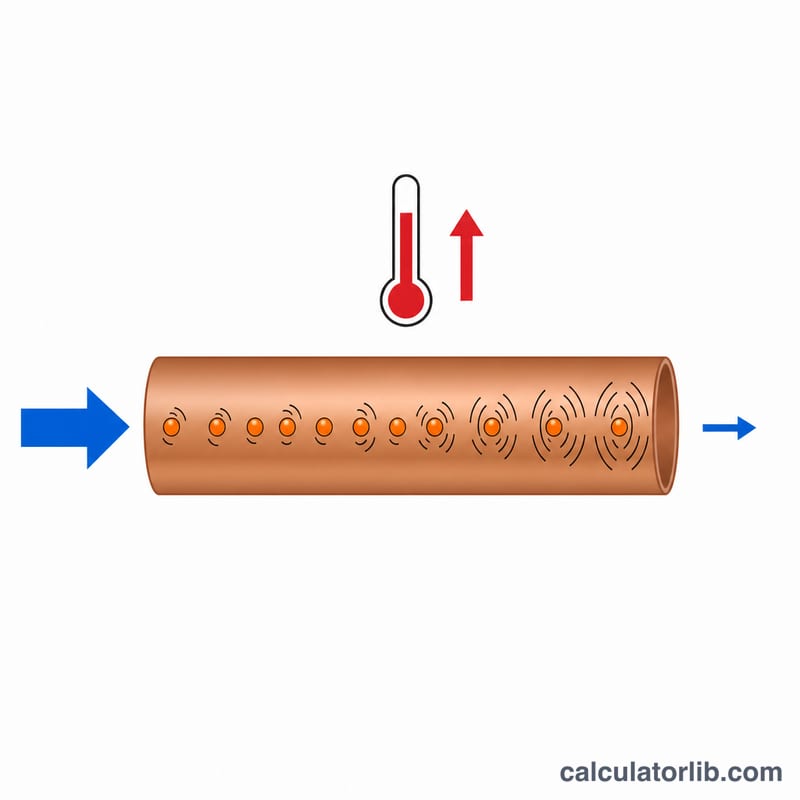
The resistance of most metals rises as they heat up. This calculator predicts a conductor's resistance at any operating temperature using the standard linear temperature-coefficient model. Enter the resistance measured at a known reference temperature, the material's temperature coefficient of resistance (\(\alpha\)), and the two temperatures, and it returns the new resistance along with the absolute and percentage change.
The Formula
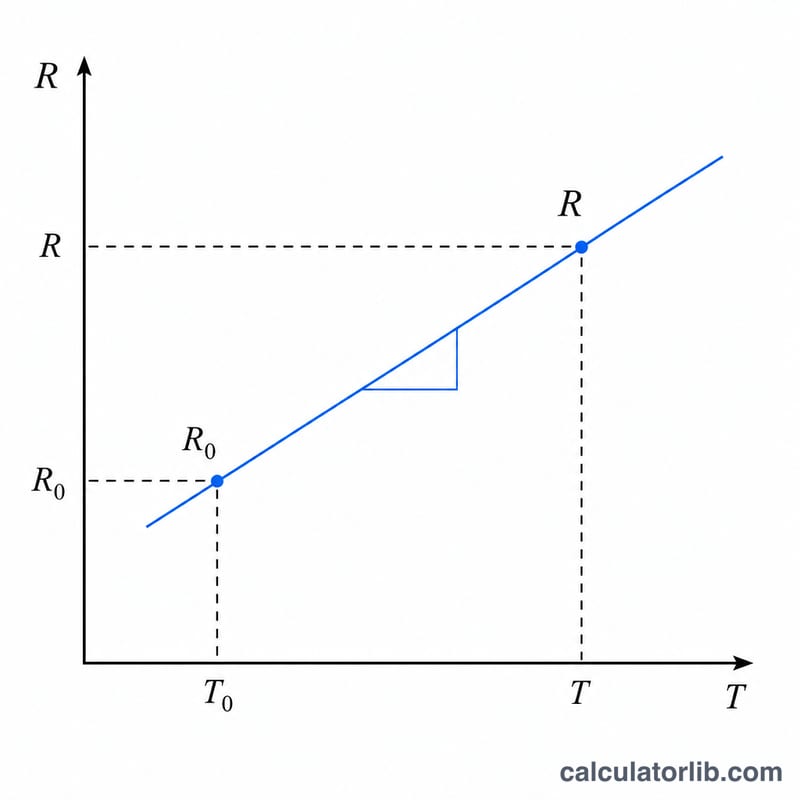
The model is $$R = \text{R}_0\left[1 + \alpha\left(\text{T} - \text{T}_0\right)\right]$$ where \(\text{R}_0\) is the resistance at the reference temperature \(\text{T}_0\), \(\alpha\) is the temperature coefficient (per °C), \(\text{T}\) is the operating temperature, and \(R\) is the resulting resistance. The term \(\alpha\left(\text{T} - \text{T}_0\right)\) is the fractional change in resistance per the temperature swing \(\Delta\text{T} = \text{T} - \text{T}_0\). Typical \(\alpha\) values near 20 °C are about 0.00393 for copper, 0.00403 for aluminium and 0.0039 for platinum.
How To Use It
1. Enter \(\text{R}_0\), the resistance at your reference temperature (often 20 °C). 2. Enter the temperature coefficient \(\alpha\) for your material. 3. Enter the reference temperature \(\text{T}_0\) and the operating temperature \(\text{T}\). The tool computes the resistance \(R\) and how much it changed.
Worked Example
A copper coil reads 100 Ω at 20 °C with \(\alpha = 0.00393\) /°C. At 80 °C, \(\Delta\text{T} = 60\) °C, so $$R = 100 \times (1 + 0.00393 \times 60) = 100 \times 1.2358 = 123.58\ \Omega$$ — a 23.58% increase.
FAQ
Is this valid for any temperature? The linear model works well over moderate ranges. For very wide ranges a quadratic term may be needed.
What if resistance decreases with temperature? Use a negative \(\alpha\) — common for thermistors (NTC) and some semiconductors.
Where do I find \(\alpha\)? Material datasheets list it, usually referenced to 20 °C or 0 °C; make sure your \(\text{T}_0\) matches that reference.