
What is NPSH Available?
Net Positive Suction Head available (NPSHa) is the absolute pressure energy, expressed in metres of liquid, present at a pump suction inlet above the liquid's vapor pressure. It is a property of the suction system, not the pump. To avoid cavitation, NPSHa must always exceed the pump's NPSH required (NPSHr) with a safety margin. This calculator works in SI units and applies universally to any liquid pumping system.
How to use it
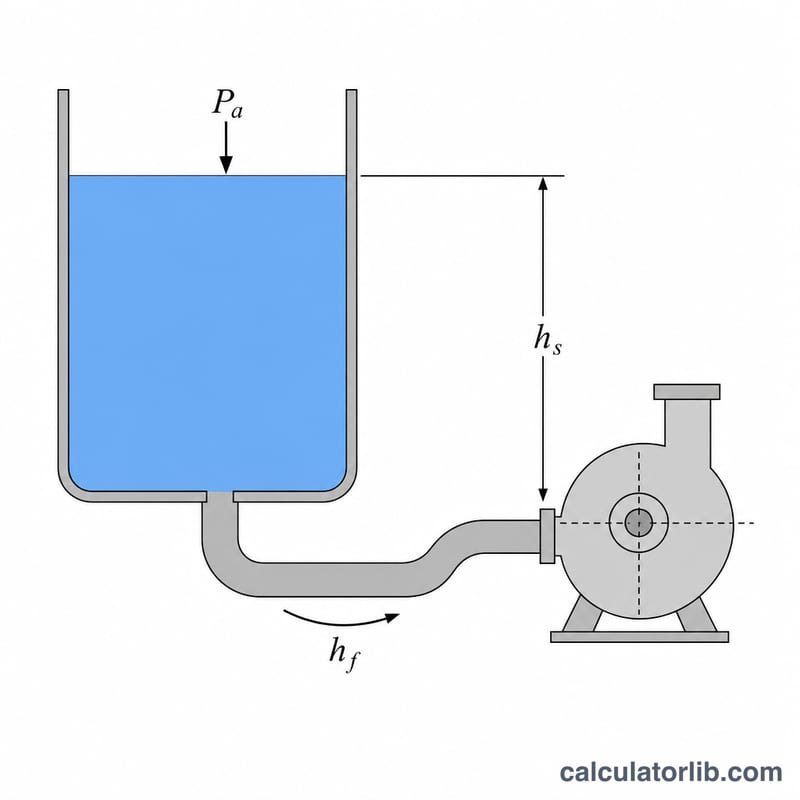
Enter the absolute pressure at the liquid surface (Pa) — for an open tank at sea level this is about 101325 Pa. Enter the vapor pressure of the liquid at the pumping temperature (Pv), the liquid density (rho), gravity (g, normally 9.81 m/s²), the static suction head (hs, positive when the liquid level is above the pump centreline, negative for a suction lift), and the total friction and fitting losses in the suction line (hf). The tool returns NPSHa in metres.
The formula explained
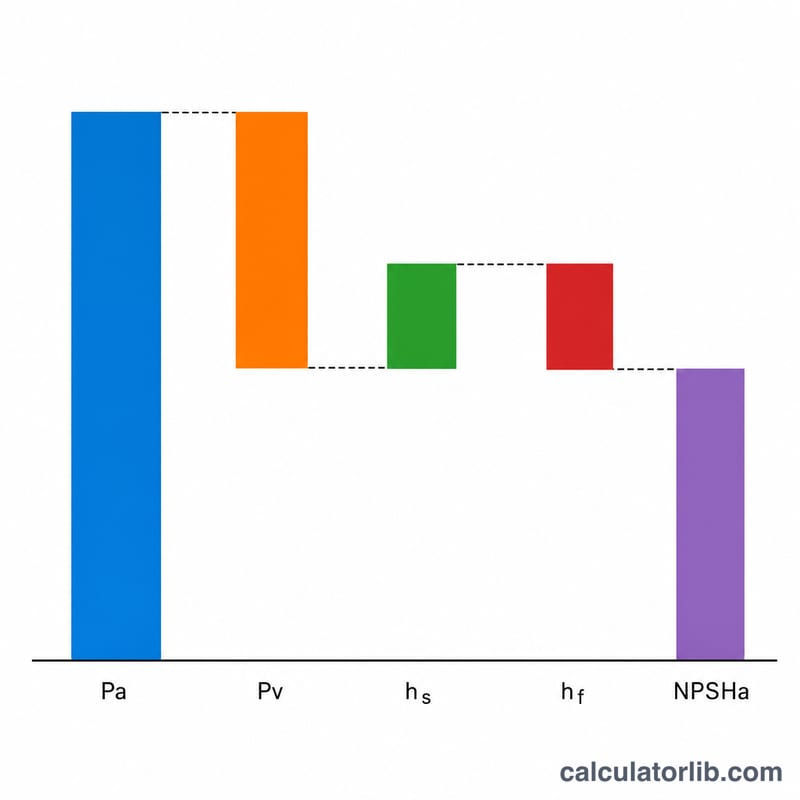
$$\text{NPSH}_a = \frac{\text{P}_a - \text{P}_v}{\rho \cdot g} + \text{h}_s - \text{h}_f$$ The first term converts the net pressure above vapor pressure into head. Adding the static suction head accounts for elevation, and subtracting friction losses accounts for energy dissipated in the suction piping. The result is the available head that resists vaporization at the impeller eye.
Worked example
For water at 20 °C in an open tank: \(P_a = 101325 \text{ Pa}\), \(P_v = 2339 \text{ Pa}\), \(\rho = 998 \text{ kg/m}^3\), \(g = 9.81 \text{ m/s}^2\), \(h_s = 2 \text{ m}\), \(h_f = 1.5 \text{ m}\). Pressure head $$\frac{101325 - 2339}{998 \times 9.81} = \frac{98986}{9790.38} \approx 10.110 \text{ m}$$ $$\text{NPSH}_a = 10.110 + 2 - 1.5 \approx 10.610 \text{ m}$$
FAQ
What units should I use? SI units: pressures in pascals, density in kg/m³, gravity in m/s², heads in metres. The answer is in metres of liquid.
Is the static head negative for a lift? Yes. If the pump is above the liquid source, enter hs as a negative number.
How do I avoid cavitation? Ensure NPSHa is greater than the pump's NPSHr, typically by a margin of 0.5–1 m or more.