What this calculator does
The Order Fractions Least to Greatest Calculator takes any list of fractions you enter and sorts them by value. You can choose ascending order (least to greatest) or descending order (greatest to least). It also shows the decimal value of each fraction so you can see exactly how the comparison was made.
How to use it
Type your fractions into the box, separated by commas, spaces, or new lines — for example 1/2, 3/4, 2/3, 5/8. Whole numbers like 2 are treated as 2/1. Pick whether you want them sorted least to greatest or greatest to least, then read the ordered list and the table of decimal values.
The formula explained
To order fractions you need a fair way to compare them. The classic method is to find a common denominator, but an equivalent and faster approach is cross-multiplication: to compare \(\frac{a}{b}\) and \(\frac{c}{d}\) (with positive denominators), compare \(a\times d\) with \(c\times b\). If \(a\times d\) is smaller, then \(\frac{a}{b}\) is the smaller fraction. This calculator converts each fraction to its decimal value \(v = \frac{a}{b}\) and sorts on that value, which gives the same ordering.
$$\text{Sort}\left(\text{Fractions}\right)\ \text{by}\ \frac{a}{b}\ \text{ascending} \;\Rightarrow\; v_1 \le v_2 \le \cdots \le v_n$$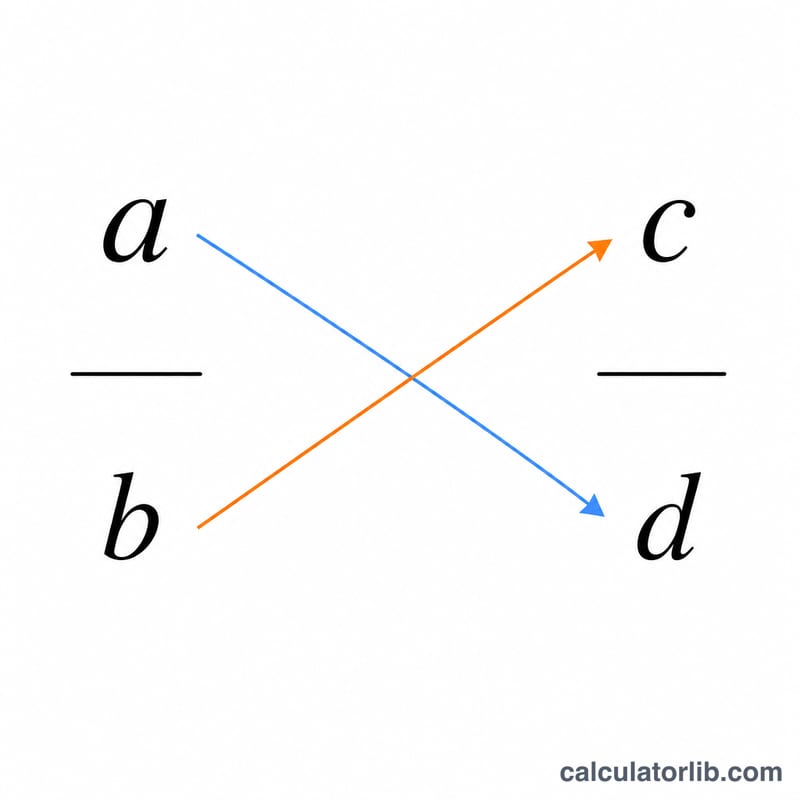
Worked example
Order 1/2, 3/4, 2/3, 5/8 from least to greatest. The decimals are 0.5, 0.75, 0.6667, and 0.625. Sorting them gives $$0.5 < 0.625 < 0.6667 < 0.75,$$ so the ordered list is 1/2, 5/8, 2/3, 3/4. The smallest value is 0.5 and the largest is 0.75.
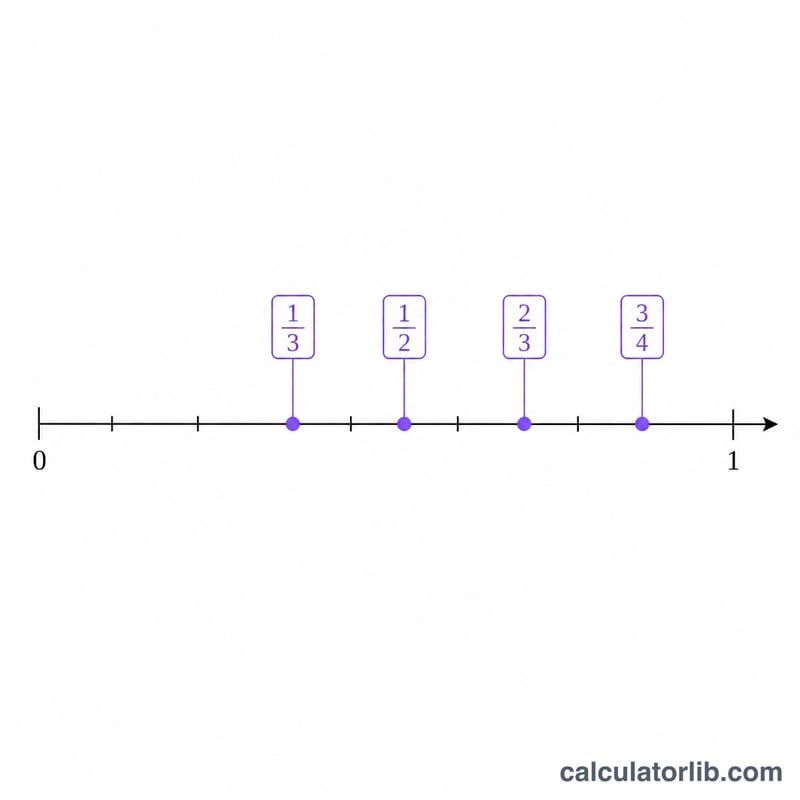
How to Order Fractions by Hand
To sort fractions from least to greatest, put them over a common denominator so only the numerators need to be compared. Follow these steps:
- Standardize each fraction. Write any whole number n as n/1. If a denominator is negative, move the sign to the numerator (for example, 3/−4 becomes −3/4).
- Find the LCD. The least common denominator is the least common multiple (LCM) of all the denominators.
- Rewrite each fraction with the LCD. Multiply the numerator and denominator of each fraction by the same factor, which is the LCD divided by its original denominator.
- Compare the numerators. With equal denominators, the fraction with the larger numerator is the larger fraction.
- Arrange in order. List the fractions from smallest to largest numerator, then convert back to the original fractions (for example, 8/12 goes back to 2/3).
Example: 2/3, 3/4, 5/6
The denominators are 3, 4 and 6, so the LCD is \(\operatorname{lcm}(3,4,6)=12\).
$$\frac{2}{3}=\frac{2\times 4}{3\times 4}=\frac{8}{12},\quad \frac{3}{4}=\frac{3\times 3}{4\times 3}=\frac{9}{12},\quad \frac{5}{6}=\frac{5\times 2}{6\times 2}=\frac{10}{12}$$
Since 8 < 9 < 10, the order from least to greatest is 2/3, 3/4, 5/6. For greatest to least, reverse it: 5/6, 3/4, 2/3.
Shortcuts
- Decimals: For unlike denominators, divide each numerator by its denominator and compare the decimals. Here 2/3 ≈ 0.6667, 3/4 = 0.75 and 5/6 ≈ 0.8333, which gives the same order. Repeating decimals may need several digits to separate close values.
- Equal numerators: If two fractions have the same numerator, the one with the larger denominator is the smaller fraction. For example, 3/8 < 3/5, because the whole is cut into more pieces.
- Equal denominators: Simply compare the numerators.
FAQ
Can I mix fractions and whole numbers? Yes. A number without a slash is read as that number over 1.
What about negative fractions? Negative numerators are supported and sort below positive values as expected.
Does it simplify the fractions? No — it keeps your original form for display but compares them by their true value.