
What is the Comparing Fractions Calculator?
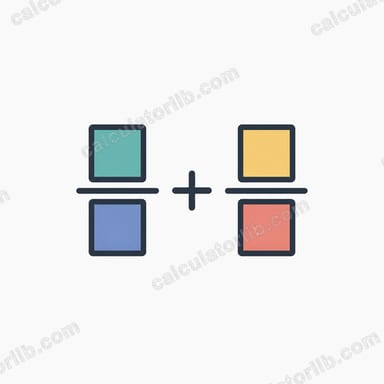
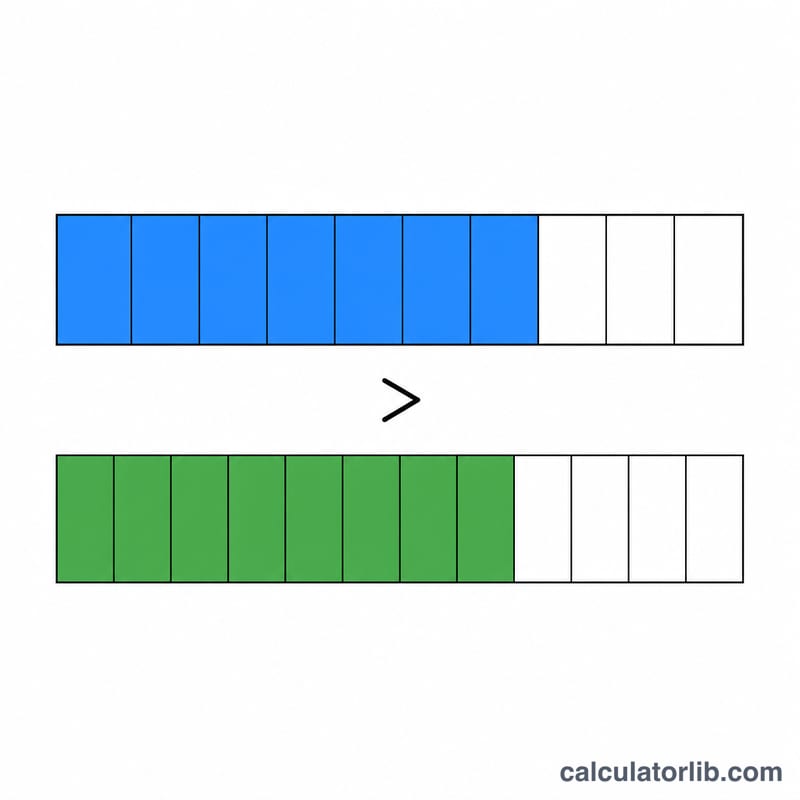
This calculator tells you which of two fractions is larger — or whether they are equal — without having to find a common denominator by hand. Enter the numerator and denominator of each fraction and it instantly compares a/b against c/d using cross-multiplication, the fastest reliable method.
How to use it
Type the first fraction's numerator (a) and denominator (b), then the second fraction's numerator (c) and denominator (d). The result shows whether the first fraction is greater than, less than, or equal to the second, along with each fraction's decimal value and the cross product used in the decision.
The formula explained
To compare \(\frac{a}{b}\) and \(\frac{c}{d}\) you can scale both to the common denominator \(b\cdot d\). The numerators then become \(a\cdot d\) and \(c\cdot b\). So the comparison reduces to checking the sign of \(a\cdot d - c\cdot b\):
$$\frac{a}{b} \;?\; \frac{c}{d} \iff \operatorname{sign}(a\cdot d - c\cdot b)$$positive means \(\frac{a}{b}\) is larger, negative means \(\frac{c}{d}\) is larger, and zero means they are equal. The calculator also accounts for negative denominators by adjusting the sign.
$$\frac{a}{b} > \frac{c}{d} \iff a\cdot d > c\cdot b$$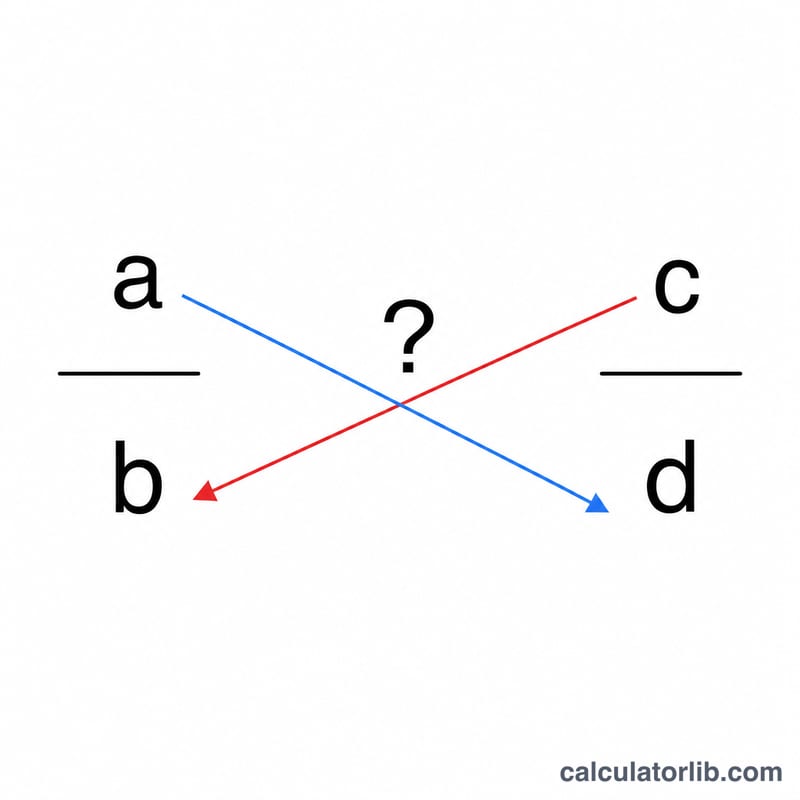
Worked example
Compare \(\frac{1}{2}\) and \(\frac{2}{3}\). Cross-multiply: \(a\cdot d = 1\times 3 = 3\) and \(c\cdot b = 2\times 2 = 4\). Since
$$3 - 4 = -1$$is negative, \(\frac{1}{2} < \frac{2}{3}\). As decimals, \(0.5 < 0.6667\) — confirmed.
FAQ
Why cross-multiply instead of finding a common denominator? Cross-multiplication is equivalent but requires only two products, making it quicker and less error-prone.
Can it handle negative fractions? Yes. The calculator adjusts the comparison sign when a denominator is negative so the result stays correct.
What if the fractions are equal? When \(a\cdot d - c\cdot b\) equals zero, the fractions represent the same value and the result reports "First = Second".