
What is a cube?
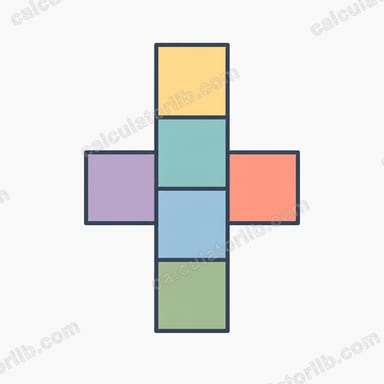
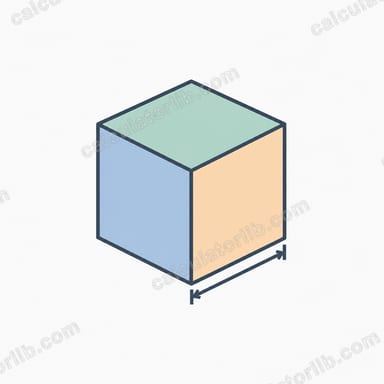
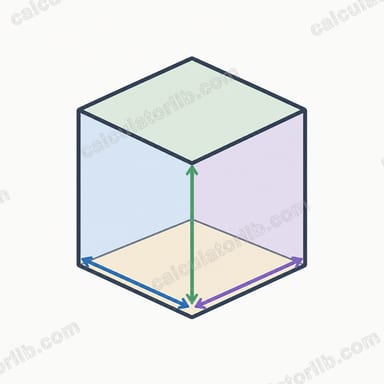
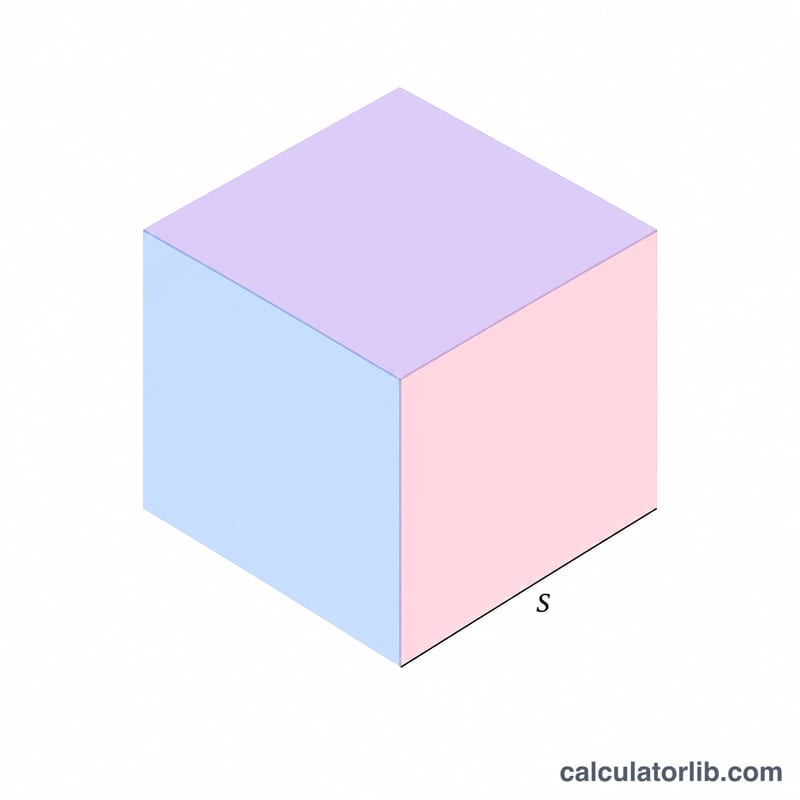
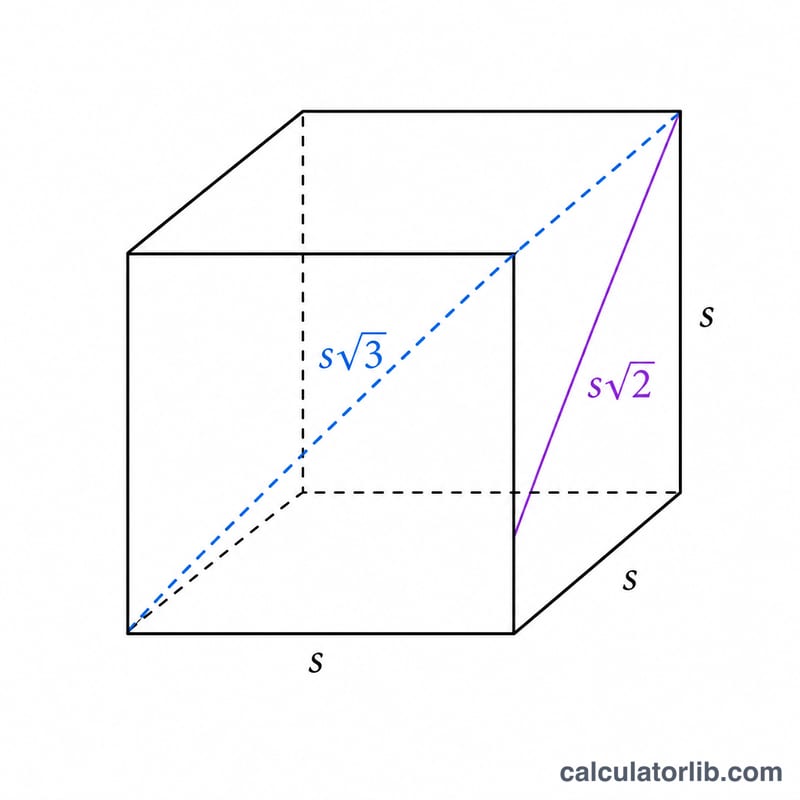
A cube is a three-dimensional solid bounded by six identical square faces meeting at right angles. Because every edge has the same length s, every measurable property of a cube can be derived from that single value. This calculator takes the side length and instantly returns the volume, surface area, total edge length, and both the face and space diagonals.
How to use this calculator
Enter the side length s in any unit you like — centimeters, inches, meters. The results follow the same unit system: volume comes out in cubic units, surface area in square units, and the diagonals in linear units. There is no unit conversion, so simply keep your input consistent.
The formulas explained
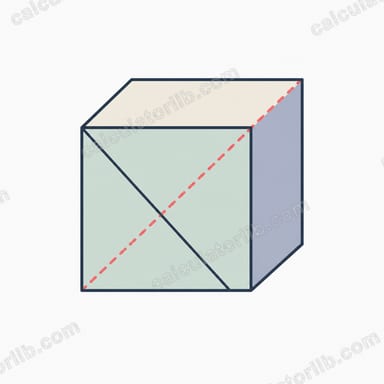
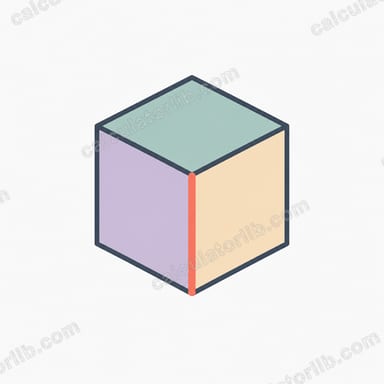
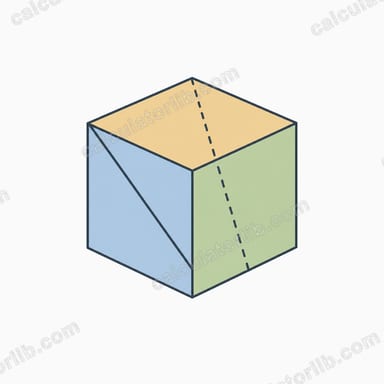
The volume is the space inside the cube: \(V = s^3\). The surface area sums the area of all six faces, each \(s^2\), giving \(A = 6s^2\). The face diagonal crosses one square face and follows the Pythagorean theorem: \(s\sqrt{2}\). The space diagonal runs corner to opposite corner through the interior: \(s\sqrt{3}\). The total edge length adds all twelve equal edges: \(12s\).
Worked example
Take a cube with side \(s = 5\). $$V = 5^3 = 125 \text{ cubic units}$$ $$A = 6 \times 5^2 = 6 \times 25 = 150 \text{ square units}$$ $$\text{Total edge length} = 12 \times 5 = 60 \text{ units}$$ $$\text{Face diagonal} = 5 \times \sqrt{2} \approx 7.071 \text{ units}$$ $$\text{Space diagonal} = 5 \times \sqrt{3} \approx 8.660 \text{ units}$$
FAQ
What is the difference between the face and space diagonal? The face diagonal \((s\sqrt{2})\) lies flat on a single square face, while the space diagonal \((s\sqrt{3})\) cuts through the cube's interior between opposite corners.
Can I use this for a rectangular box? No — a cube requires all sides equal. For a box with different length, width and height, use a rectangular prism calculator.
How do I find the side from the volume? Take the cube root: \(s = V^{1/3}\). For a volume of 125, the side is 5.