What Is the Cubic Feet Calculator?
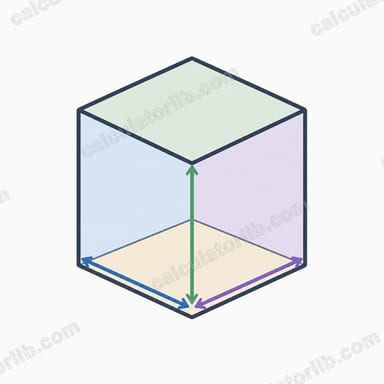
The Cubic Feet Calculator finds the volume of any rectangular or box-shaped space by multiplying its length, width and height. Cubic feet (ft³) is the standard unit for measuring storage space, shipping containers, freezers, refrigerators, garden materials and air volume for HVAC sizing. This tool also converts the result into cubic inches, cubic yards and US gallons so you can use whichever unit your project needs.
How to Use It
Measure the length, width and height of the space in feet and enter each value. If your measurements are in inches, divide by 12 first. Press calculate to see the total cubic feet plus equivalent volumes. All inputs must be the same unit (feet) for an accurate result.
The Formula Explained
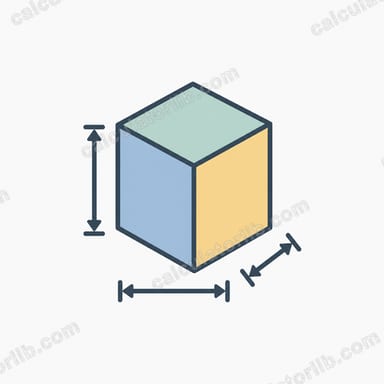
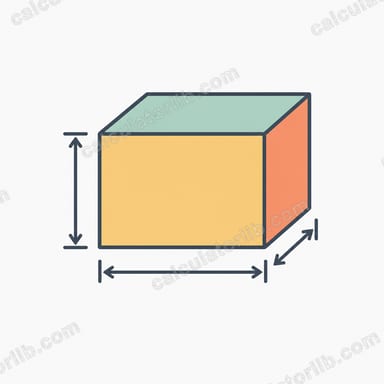
The volume of a box is simply the product of its three dimensions: \(\text{Cubic Feet} = L \times W \times H\).
$$\text{Cubic Feet} = L \times W \times H$$
Because each dimension is in feet, the result is in feet cubed. To convert, multiply cubic feet by 1,728 for cubic inches, divide by 27 for cubic yards, or multiply by 7.48052 for US gallons.
$$1\,\text{ft}^3 = 1728\,\text{in}^3 = \tfrac{1}{27}\,\text{yd}^3 \approx 7.48\,\text{gal}$$

Worked Example
Suppose a storage unit is 10 ft long, 5 ft wide and 4 ft high. Volume = \(10 \times 5 \times 4 = 200\) cubic feet.
$$V = 10 \times 5 \times 4 = 200\,\text{ft}^3$$
That equals \(200 \times 1728 = 345{,}600\) cubic inches, \(200 \div 27 \approx 7.41\) cubic yards, and \(200 \times 7.48052 \approx 1{,}496\) US gallons.

Typical Cubic Feet of Common Spaces and Containers
The figures below are nominal, typical values used for planning, not exact measurements. For shipping containers and self-storage units they describe usable interior capacity (or marketed capacity), not the exterior footprint — the walls, corner posts and doors of a container take up space, so the inside is always smaller than the outside dimensions suggest. Container sizes follow the ISO standard series used internationally; self-storage unit sizes and the appliance capacities shown are the ones commonly advertised in the United States and Canada, and may differ elsewhere. Always re-measure your own interior with the calculator above before committing to a size.
| Space or container | Approximate dimensions | Volume (ft³) | Notes |
|---|---|---|---|
| 20 ft shipping container | ≈ 19.4 × 7.8 × 7.9 ft interior | ≈ 1,170 | Usable interior capacity (ISO 1C) |
| 40 ft shipping container | ≈ 39.5 × 7.8 × 7.9 ft interior | ≈ 2,390 | Usable interior capacity (ISO 1A) |
| 40 ft high-cube container | ≈ 39.5 × 7.8 × 8.9 ft interior | ≈ 2,694 | About 1 ft taller than standard |
| Self-storage locker, 5 × 5 ft | 5 × 5 × 8 ft | 200 | Closet-sized; 8 ft usable height assumed |
| Self-storage unit, 5 × 10 ft | 5 × 10 × 8 ft | 400 | Roughly a small bedroom's contents |
| Self-storage unit, 10 × 10 ft | 10 × 10 × 8 ft | 800 | Common mid-size unit |
| Self-storage unit, 10 × 20 ft | 10 × 20 × 8 ft | 1,600 | Garage-sized unit |
| Small moving box | ≈ 16 × 12 × 12 in | ≈ 1.5 | Books, tools, dense items |
| Medium moving box | ≈ 18 × 18 × 16 in | ≈ 3.0 | General household goods |
| Large moving box | ≈ 18 × 18 × 24 in | ≈ 4.5 | Bedding, lampshades, bulky light items |
| Apartment refrigerator | Interior capacity | 10–14 | Manufacturer-rated interior volume |
| Full-size refrigerator | Interior capacity | 18–26 | Fresh-food plus freezer compartments |
| Chest freezer | Interior capacity | 5–22 | Compact to large family models |
| Pickup truck bed | Short to long bed, level load | ≈ 50–65 | Below the rail line; wheel wells reduce it |
| Room, 12 × 12 ft with 8 ft ceiling | 12 × 12 × 8 ft | 1,152 | Air volume, before furniture |
Appliance capacities are the values printed on the spec sheet, which measure the inside of the cabinet — the box it ships in is larger. Moving-box volumes vary a little between suppliers, so treat them as planning estimates rather than exact figures.
Practical Tips for Using Your Cubic Feet Result
- Measure the smallest usable interior dimension, not the outside. For a container, closet, cabinet or truck bed, measure between the narrowest obstructions — door frames, corner posts, trim, the rail line of a bed. Multiply those interior numbers, not the exterior ones, or you will plan for space that does not exist.
- Round up to the next whole unit. Suppliers sell soil, mulch and gravel in fixed bag or load sizes and rent storage in fixed unit sizes, so a result of 2.3 yd³ means ordering 3 yd³ (or the next bag count up). Rounding down leaves you short mid-job.
- Convert to cubic yards for bulk garden materials. Divide cubic feet by 27, because 1 yd³ = 3 × 3 × 3 ft. Then add roughly 5–10% for settling, compaction and spillage — loose mulch and screened topsoil both lose volume once raked and watered in.
- Subtract what is already in the space. Shelves, uprights, wheel wells, water heaters, HVAC ducts and sloping ceilings all eat into a theoretical rectangle. Compute each obstruction as its own small box and deduct it to get realistic usable storage.
- Split irregular rooms into rectangular blocks. Treat an L-shaped room, a bay window or a stepped basement as two or three separate boxes, calculate each one, and add the results. This is far more accurate than averaging an "overall" length and width.
- Check the weight limit as well as the volume. Dense cargo — tile, soil, books, paving stone — reaches a vehicle's or container's rated payload long before it fills the available cubic feet, so always confirm both numbers against the carrier's or supplier's stated limits.
Worked example: mulch for a raised bed
A raised bed measures 20 ft long by 4 ft wide, and you want a 6 in (0.5 ft) layer of mulch:
$$V = 20\ \text{ft} \times 4\ \text{ft} \times 0.5\ \text{ft} = 40\ \text{ft}^3$$That is 40 ft³. Converting to cubic yards:
$$\frac{40\ \text{ft}^3}{27} = 1.48\ \text{yd}^3$$Adding 10% for settling gives about 1.63 yd³, so you would order 2 cubic yards from a bulk supplier — or, in 2 ft³ bags, \(40 \div 2 = 20\) bags plus two spare, i.e. 22 bags. Measure once more before ordering; these are general material-planning estimates, and the supplier's own coverage guidance for the specific product should take precedence.
FAQ
What if my measurements are in inches? Divide each measurement by 12 to convert to feet before entering, or measure in feet directly.
How do I find cubic feet of a cylinder? This tool is for box shapes. For a cylinder use \(\pi \times r^2 \times h\) instead.
How many cubic feet is a cubic yard? One cubic yard equals 27 cubic feet.