
What This Calculator Does
The Currency Appreciation and Depreciation Calculator measures how much an exchange rate has risen or fallen between two points in time. A positive result means the rate has appreciated (gained value), while a negative result means it has depreciated (lost value). This works for any pair of exchange rates and is useful for traders, importers, exporters, travelers, and students of economics.
How to Use It
Enter the old exchange rate (the earlier value) and the new exchange rate (the current or later value). The calculator returns the percentage change, the absolute difference, and tells you whether the movement is an appreciation or a depreciation. Make sure both rates are quoted the same way (for example, units of the second currency per one unit of the first).
The Formula Explained
The percent change is calculated as:
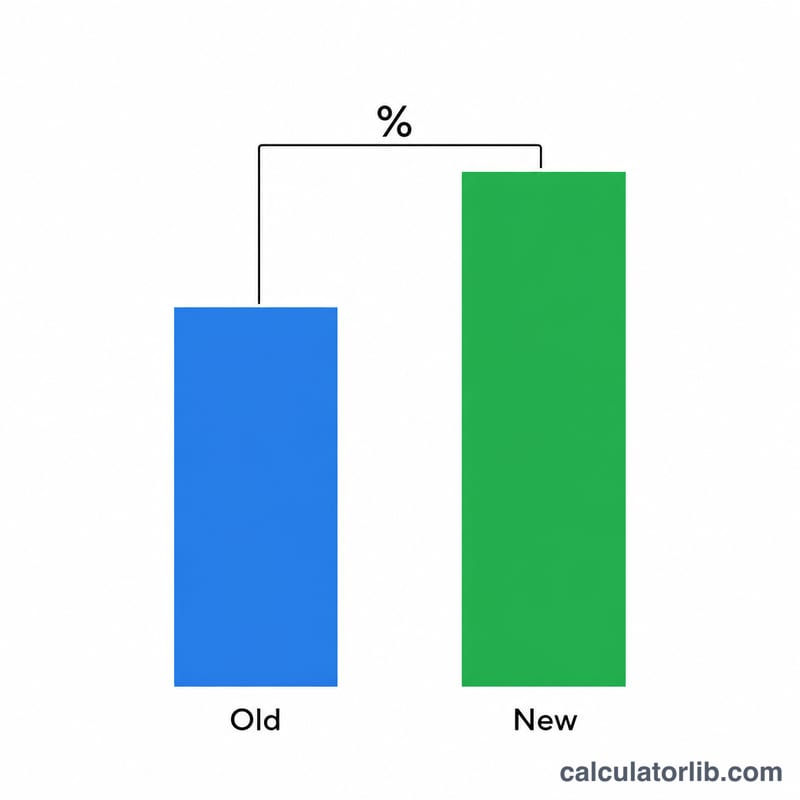
$$\text{Change\%} = \frac{\text{New Rate} - \text{Old Rate}}{\text{Old Rate}} \times 100$$
Subtract the old rate from the new rate to get the absolute movement, divide by the old rate to make it relative, then multiply by 100 to express it as a percentage. A positive number indicates appreciation; a negative number indicates depreciation.
Worked Example
Suppose the EUR/USD rate moves from 1.10 to 1.25. The change is $$(1.25 - 1.10) \div 1.10 \times 100 = 0.15 \div 1.10 \times 100 \approx 13.64\%$$ The euro has appreciated about 13.64% against the dollar.
FAQ
What's the difference between appreciation and depreciation? Appreciation means the currency increased in value (positive change); depreciation means it lost value (negative change).
Does the quote direction matter? Yes. If you quote rates as USD per EUR, a rising number means the EUR is appreciating. Always keep both rates in the same direction.
Can I use this for any two numbers? Absolutely — it's a general percent-change formula, so it also works for prices, indices, and other rates.