
What Is Periodic Compound Interest?
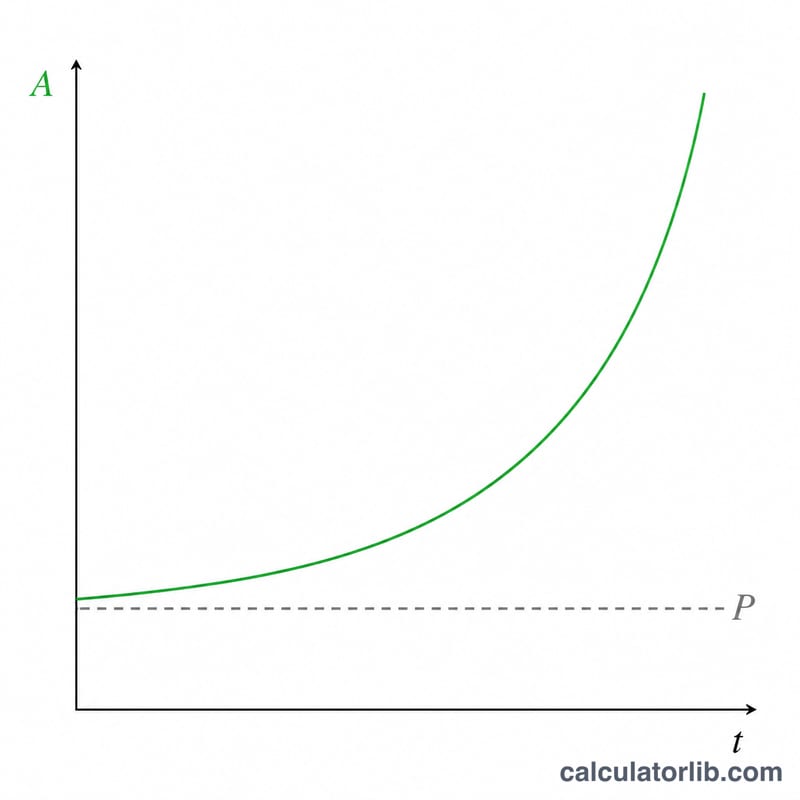
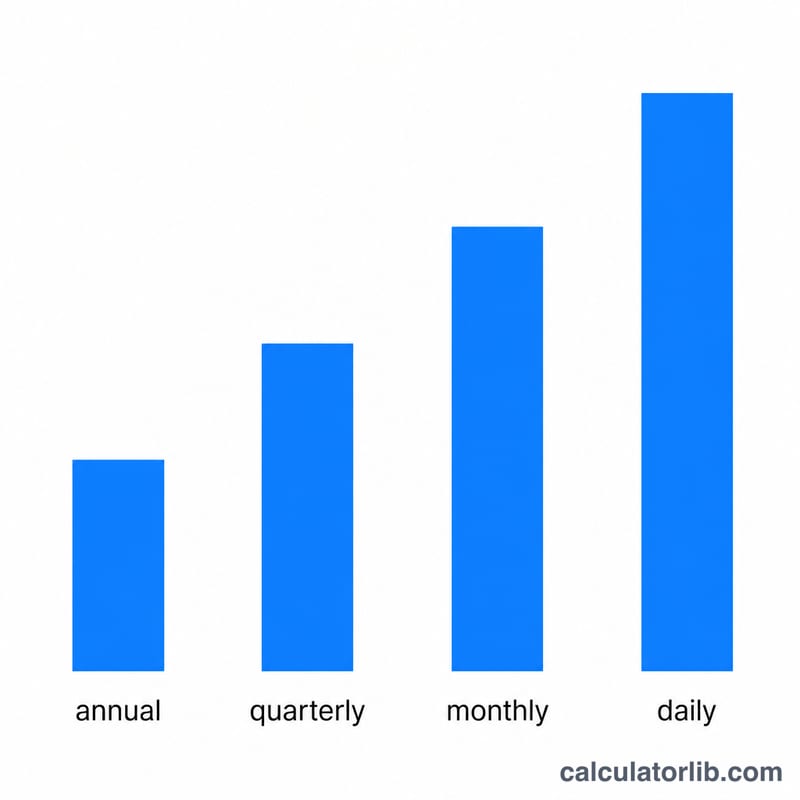
Compound interest is interest earned not only on your original deposit (the principal) but also on the interest already accumulated. With periodic compounding, interest is added a fixed number of times per year — for example monthly, quarterly, or daily. The more frequently interest compounds, the faster your balance grows. This calculator works for any currency since it deals only with numbers.
How to Use It
Enter your principal (starting amount), the annual interest rate as a percentage, the number of years you plan to invest, and how often interest compounds each year. The calculator returns the future value of your investment and the total interest earned.
The Formula Explained
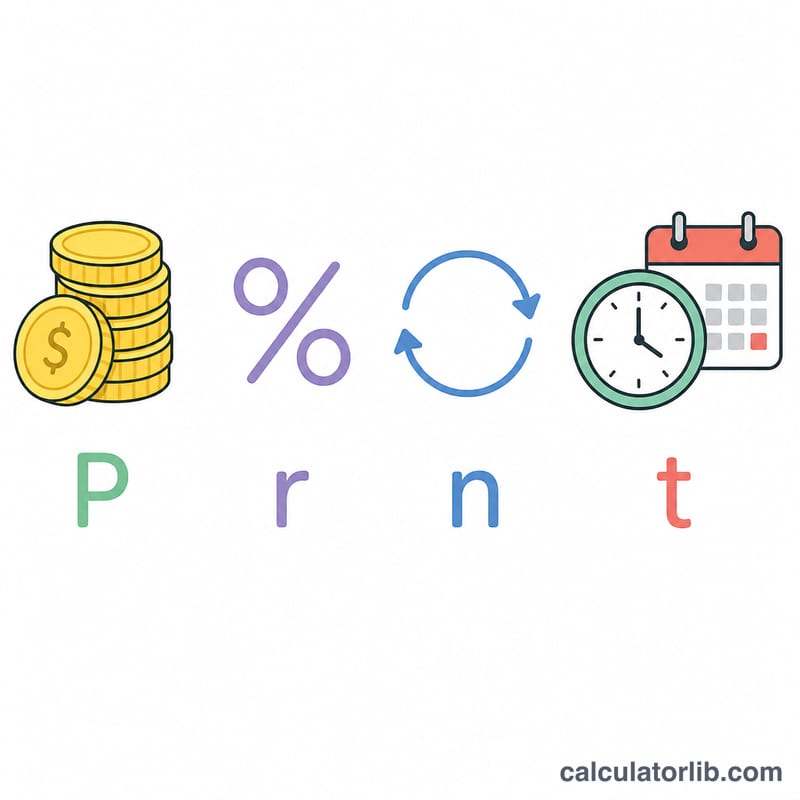
The core equation is $$A = P\left(1 + \frac{r}{n}\right)^{nt}$$ where A is the final amount, P is the principal, r is the annual rate written as a decimal (5% = 0.05), n is the number of compounding periods per year, and t is the number of years. Each period the balance is multiplied by \(\left(1 + \frac{r}{n}\right)\), and over t years there are \(n \times t\) such periods, hence the exponent.
Worked Example
Suppose you deposit $1,000 at a 5% annual rate, compounded monthly (n = 12) for 10 years. Then \(r/n = 0.05/12 \approx 0.0041667\) and \(nt = 120\). So $$A = 1000 \times (1.0041667)^{120} \approx \$1{,}647.01$$ The total interest earned is about $647.01 — far more than the $500 you'd get from simple interest.
FAQ
Does more frequent compounding always help? Yes, but with diminishing returns. Daily compounding earns only slightly more than monthly at the same rate.
What's the difference between simple and compound interest? Simple interest is calculated only on the principal, while compound interest is calculated on the principal plus accumulated interest.
Can I include regular contributions? This calculator models a single lump-sum deposit. For recurring deposits you'd need an annuity formula.