
What Is Place Value?
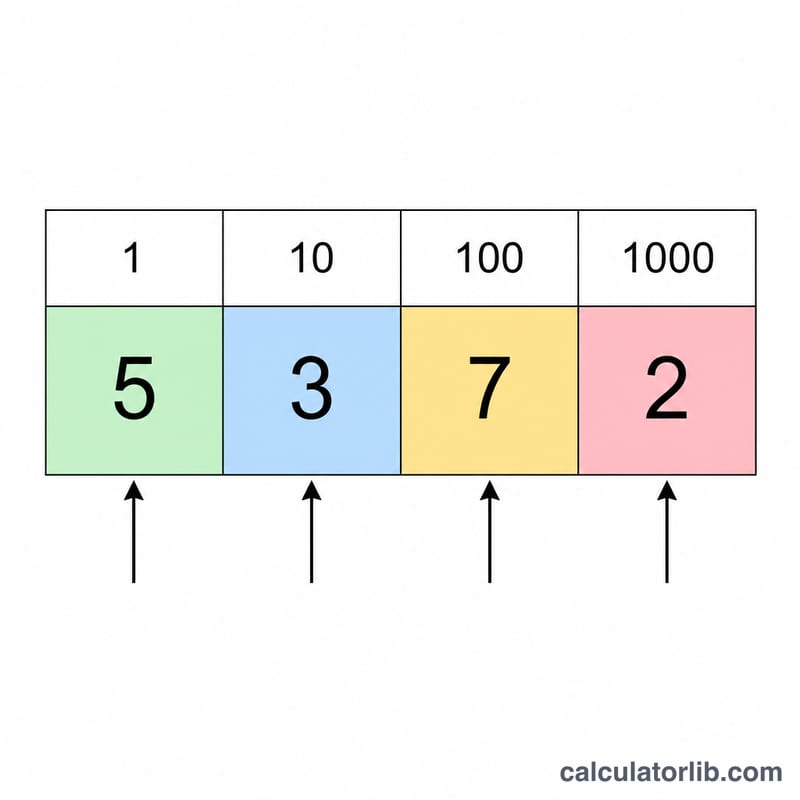
Place value is the value of a digit based on its position within a number. In our base-10 (decimal) system, each position to the left is worth ten times the one to its right. The rightmost digit is the ones place (position 0), then tens (position 1), hundreds (position 2), and so on. This calculator finds the actual value a chosen digit contributes to a whole number.
How to Use This Calculator
Enter a whole number and the position of the digit you want to examine, counting from the right starting at 0. Position 0 is the ones place, position 1 is tens, position 2 is hundreds, and so forth. The calculator identifies the digit at that position and multiplies it by the matching power of ten to reveal its place value.
The Formula Explained
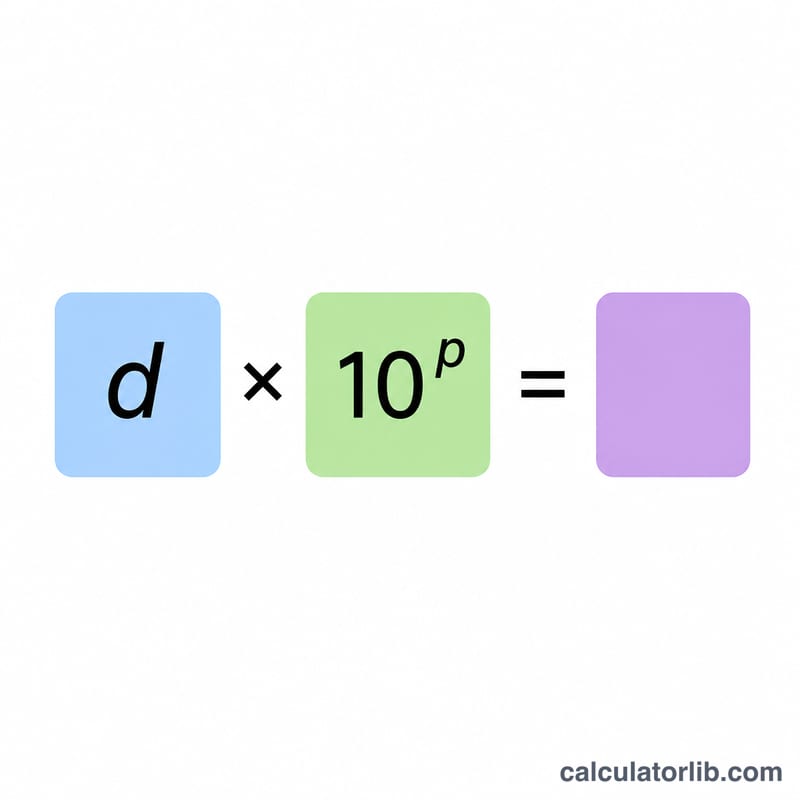
The place value of a digit is given by:
$$\text{place value} = \text{digit} \times 10^{\text{position}}$$
For example, in the number 58,723, the digit in position 2 (the hundreds place) is 7. Its place value is \(7 \times 10^2 = 7 \times 100 = 700\). The position acts as the exponent on 10, so larger positions create much larger place values.
Worked Example
Take the number 58723 and position 2. Counting from the right: position 0 = 3, position 1 = 2, position 2 = 7. The digit is therefore 7. Applying the formula: $$7 \times 10^2 = 7 \times 100 = 700$$ So the digit 7 in 58,723 has a place value of 700.
FAQ
What does position 0 mean? Position 0 is the ones (units) place — the rightmost digit of the whole number.
What if the position is larger than the number's length? There is no digit at that position, so the digit is treated as 0 and the place value is 0.
Does this work for decimals? This tool handles whole numbers. For decimal places (tenths, hundredths), positions would use negative exponents, which are not covered here.