

What Is the Present Value of Cash Flows?
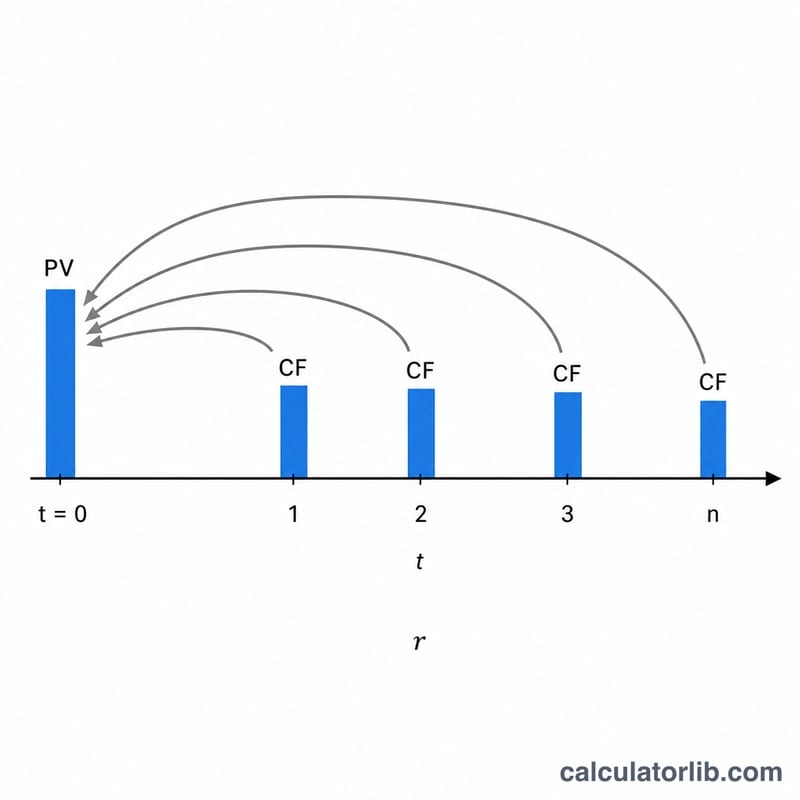
The present value (PV) of cash flows is the worth today of a stream of money you expect to receive in the future. Because a dollar received next year is worth less than a dollar in hand today, future amounts are "discounted" back to the present using a discount rate that reflects opportunity cost, risk, or inflation. This calculator sums the discounted value of each individual cash flow to give you a single, comparable figure.
How to Use This Calculator
Enter your discount rate as a percentage per period (for example, 10 for 10%). Then list your future cash flows separated by commas, in order, starting with period 1. The tool discounts each cash flow by the rate raised to its period number and adds them together. The result shows the total present value, the number of periods, and the raw undiscounted sum for comparison.
The Formula Explained
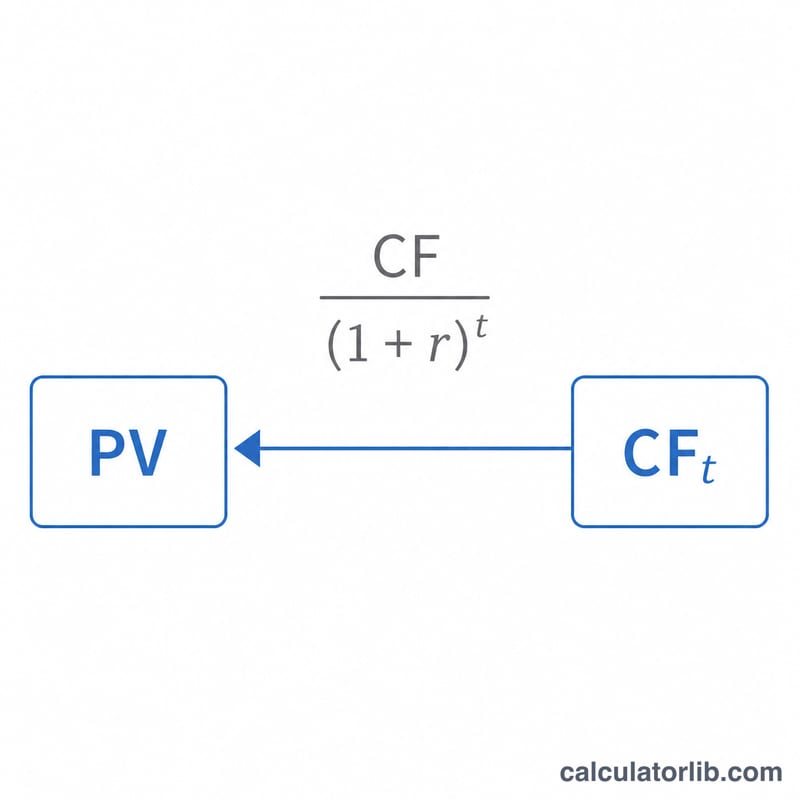
The formula is $$PV = \sum_{t=1}^{n} \frac{CF_t}{(1 + r)^t}$$ summed for each period \(t\) from 1 to \(n\). Here \(CF_t\) is the cash flow in period \(t\), and \(r\) is the per-period discount rate expressed as a decimal. Each term divides a future cash flow by a growing discount factor, so cash flows further in the future contribute less to the total.
Worked Example
Suppose you expect cash flows of 100, 200, and 300 over the next three periods at a 10% discount rate. The PV is $$\frac{100}{1.1} + \frac{200}{1.21} + \frac{300}{1.331} = 90.91 + 165.29 + 225.39 = 481.59$$ Even though the cash flows total 600, their present value is only about 481.59 because of the time value of money.
FAQ
What discount rate should I use? Common choices are your required rate of return, the cost of capital, or a risk-free rate plus a risk premium. Higher rates reduce present value.
Does period 0 count? This tool assumes the first cash flow occurs at the end of period 1. A cash flow today (period 0) would not be discounted; you would add it separately.
How is this different from NPV? Net present value (NPV) subtracts the initial investment from the present value of future cash flows. This calculator computes the PV of the inflows only.