
What Is the Profit Goal Calculator?
The Profit Goal Calculator tells you how much revenue your business must generate to hit a specific profit target. Instead of guessing sales targets, you work backward from the profit you want, accounting for both your fixed costs and the portion of each sale eaten up by variable costs. It is a universal financial planning tool that works for any currency or industry.
How to Use It
Enter three numbers: your fixed costs (rent, salaries, insurance — costs that don't change with sales volume), your target profit (the profit you want left over), and your variable cost ratio (variable costs such as materials and commissions expressed as a percentage of revenue). The calculator returns the total revenue you must achieve, plus your contribution margin and estimated cost breakdown.
The Formula Explained
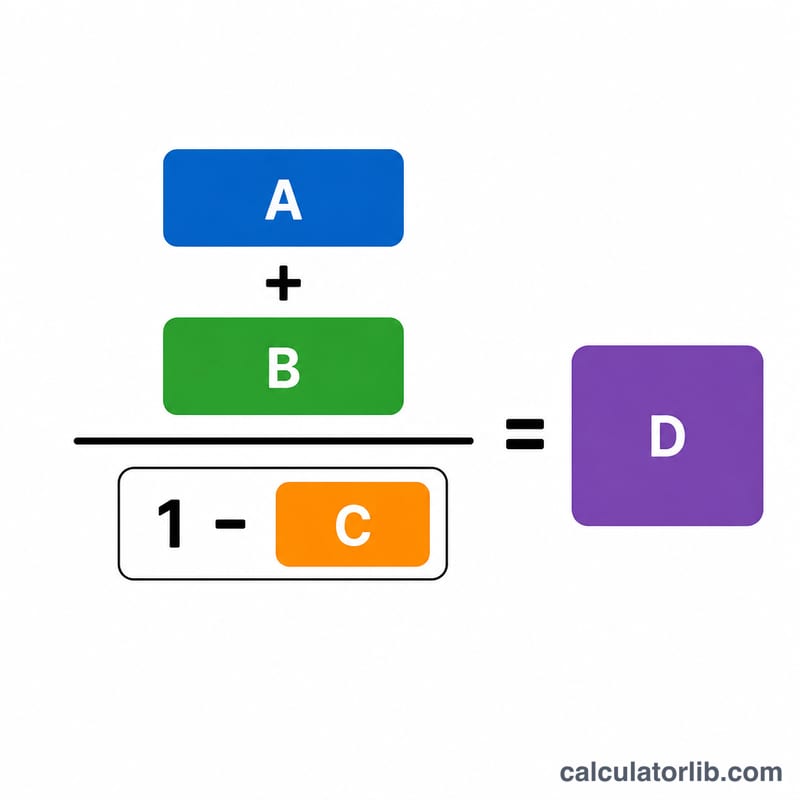
$$\text{Required Revenue} = \dfrac{\text{Fixed Costs} + \text{Target Profit}}{1 - \text{Variable Cost Ratio}}$$ The denominator, \(1\) minus the variable cost ratio, is your contribution margin ratio — the fraction of every sales dollar available to cover fixed costs and profit. Dividing the total amount you need to cover (fixed costs plus profit goal) by this margin gives the sales figure required.
Worked Example
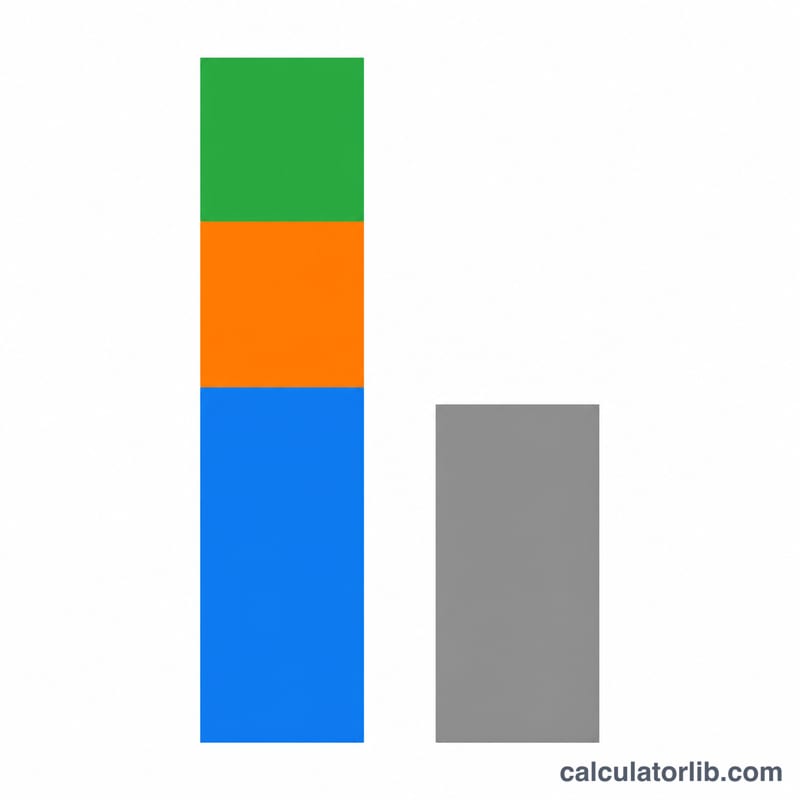
Suppose fixed costs are $20,000, your target profit is $10,000, and variable costs run 40% of revenue. The contribution margin is \(1 - 0.40 = 0.60\). $$\text{Required revenue} = \dfrac{20{,}000 + 10{,}000}{0.60} = \dfrac{30{,}000}{0.60} = \$50{,}000$$ At $50,000 in sales, variable costs are $20,000, leaving $30,000 to cover the $20,000 fixed costs and produce the $10,000 profit.
Required Revenue Across Different Scenarios
The table holds fixed costs at $20,000 and changes the variable cost ratio and the target profit. Contribution margin ratio (CMR) = 1 − variable cost ratio, and required revenue = (Fixed Costs + Target Profit) ÷ CMR.
| Scenario | Variable Cost Ratio | Contribution Margin Ratio | Target Profit | Fixed + Profit | Required Revenue |
|---|---|---|---|---|---|
| A | 30% | 70% | $10,000 | $30,000 | $42,857.14 |
| B | 40% | 60% | $10,000 | $30,000 | $50,000 |
| C | 50% | 50% | $10,000 | $30,000 | $60,000 |
| D | 60% | 40% | $10,000 | $30,000 | $75,000 |
| E | 50% | 50% | $20,000 | $40,000 | $80,000 |
Example for scenario C: \(\dfrac{20{,}000 + 10{,}000}{1 - 0.50} = \dfrac{30{,}000}{0.50} = 60{,}000\). Going from a 30% to a 60% variable cost ratio (A to D) raises required revenue from about $42,857 to $75,000 for the same profit goal.
Interpreting Your Required Revenue
Required revenue is the sales level at which total contribution margin covers fixed costs and leaves your target profit. It can be split into two parts:
$$\text{Required Revenue} = \frac{\text{Fixed Costs}}{\text{CMR}} + \frac{\text{Target Profit}}{\text{CMR}}$$
The first part is break-even revenue, the second is the extra sales needed for profit. In scenario C (CMR 50%), break-even revenue is \(20{,}000 \div 0.50 = 40{,}000\) and the profit portion is \(10{,}000 \div 0.50 = 20{,}000\), totaling $60,000.
- Each extra $1 of profit requires \(1 \div \text{CMR}\) more in sales: $2.00 at a 50% margin, $2.50 at a 40% margin.
- A lower contribution margin sharply increases required revenue. With a 40% margin the same $30,000 (fixed + profit) needs $75,000 in sales, versus $42,857 at 70%.
- Compare with current sales. Subtract your current revenue from the required revenue to see the gap. For example, if current sales are $45,000 and required revenue is $60,000, the gap is $15,000.
Limits: the result is pre-tax operating profit. It assumes fixed costs stay constant and variable costs rise in proportion to sales over the range considered, which may not hold for large changes in volume. This is general information, not financial advice.
Key Terms
- Fixed costs
- Costs that stay the same regardless of sales volume within a normal range, such as rent, salaried wages, insurance and loan payments.
- Variable costs
- Costs that change in proportion to sales or output, such as materials, packaging, sales commissions and payment processing fees.
- Variable cost ratio
- Variable costs as a percentage of revenue (variable costs ÷ revenue × 100).
- Contribution margin
- Revenue minus variable costs; the amount available to cover fixed costs and then generate profit.
- Contribution margin ratio
- Contribution margin divided by revenue, equal to 1 − variable cost ratio (as a decimal).
- Target (operating) profit
- The profit you want to earn before income taxes, after covering both fixed and variable costs.
- Break-even revenue
- The sales level where profit is zero: fixed costs ÷ contribution margin ratio.
- Required revenue
- The sales needed to reach the target profit: (fixed costs + target profit) ÷ contribution margin ratio.
FAQ
What is the variable cost ratio? It is total variable costs divided by revenue, expressed as a percentage. If materials and commissions cost $40 for every $100 of sales, the ratio is 40%.
Why must the ratio be below 100%? If variable costs equal or exceed 100% of revenue, every sale loses money and no revenue level can produce a profit — the contribution margin must be positive.
Does this include taxes? No. The target profit here is operating profit before tax. Set your target profit higher if you need a specific after-tax figure.