
What Is a Pyramid Frustum?
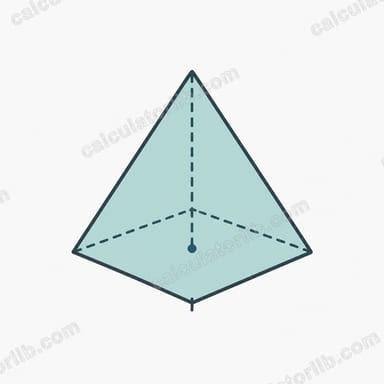
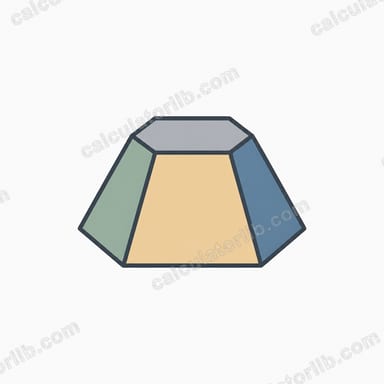
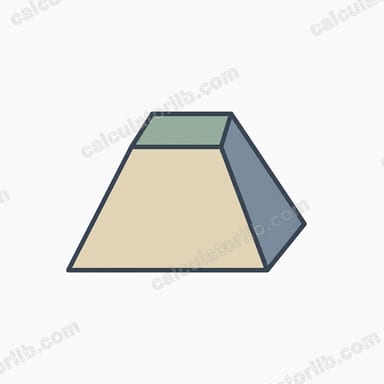
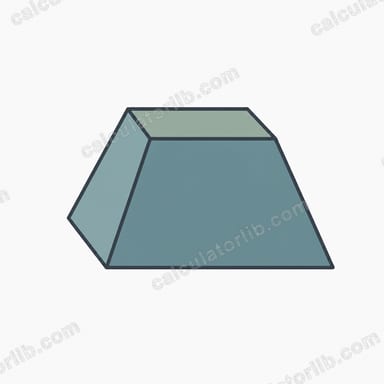
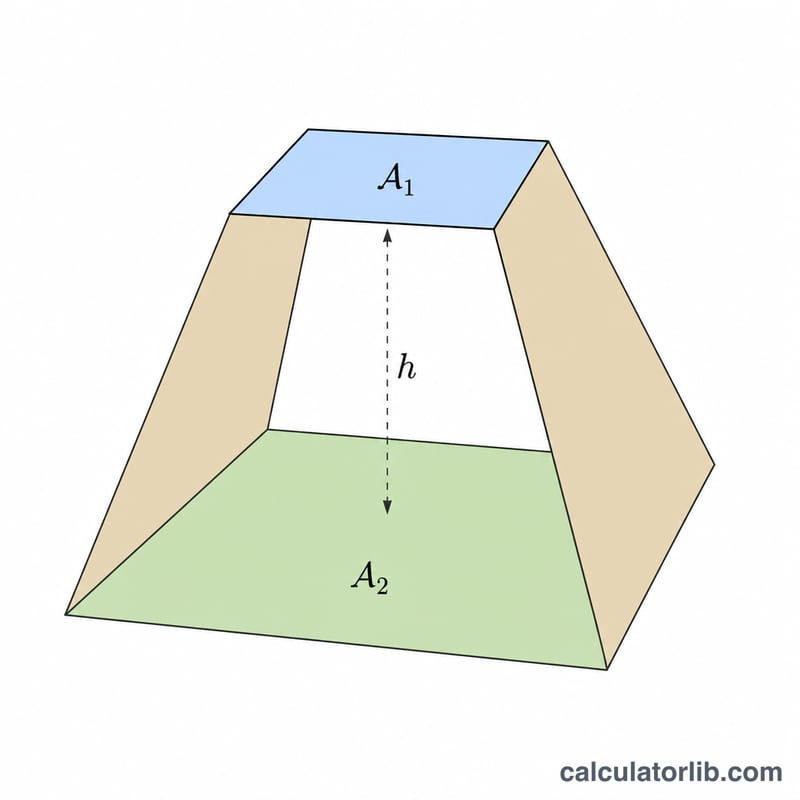
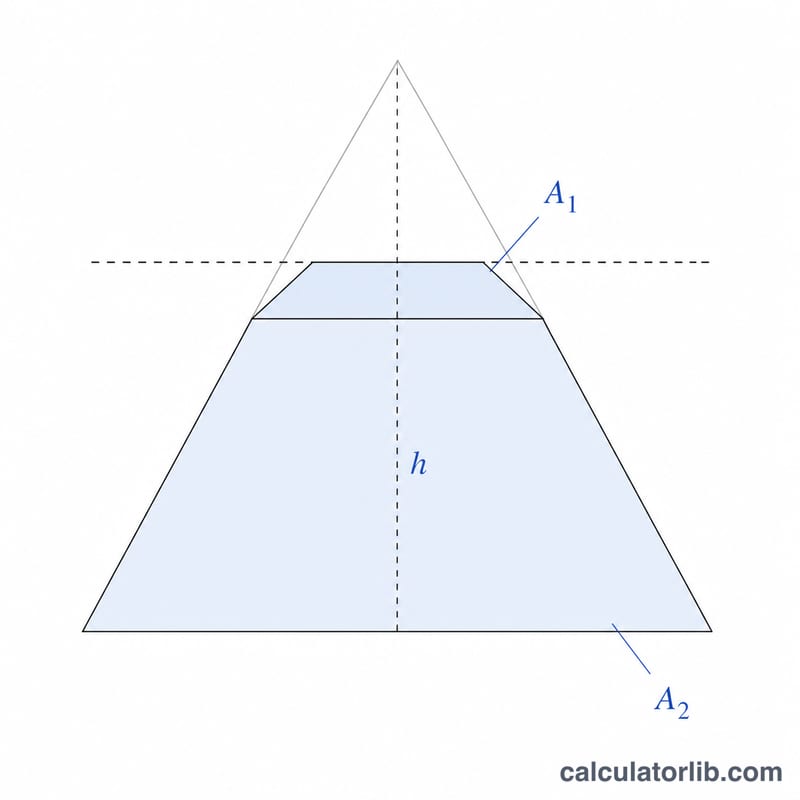
A pyramid frustum is the solid that remains when the top of a pyramid is sliced off by a plane parallel to its base. It has two parallel faces — a larger bottom and a smaller top — connected by sloping sides. This calculator finds the volume of any such frustum directly from the area of its two parallel faces and the perpendicular height between them, so it works for square, rectangular, triangular, or any polygonal cross-section.
How to Use It
Enter the bottom cross-section area (A1), the top cross-section area (A2), and the perpendicular height (h) between the two parallel faces. All values must use the same unit system: if areas are in square metres and height in metres, the result is in cubic metres. Click calculate to get the volume instantly.
The Formula Explained
The volume uses the prismatoid (Simpson-style) relationship:
$$V = \frac{h}{3}\left(A_1 + A_2 + \sqrt{A_1 \cdot A_2}\right)$$
The term \(\sqrt{A_1 \cdot A_2}\) is the geometric mean of the two areas and represents the area of a midway cross-section. This single expression handles every case: when \(A_2 = 0\) it reduces to the volume of a full pyramid, \(V = \frac{h}{3} \cdot A_1\), and when \(A_1 = A_2\) it gives a prism, \(V = h \cdot A\).
Worked Example
Suppose a frustum has a bottom area of 16, a top area of 4, and a height of 6. Then \(\sqrt{16 \cdot 4} = \sqrt{64} = 8\), so $$V = \frac{6}{3} \times (16 + 4 + 8) = 2 \times 28 = 56 \text{ cubic units.}$$
FAQ
Do I enter side lengths or areas? Enter areas. For a square base of side s, the area is \(s^2\). For a rectangle it is length \(\times\) width.
What if the top is a point? Set the top area \(A_2\) to 0 — the formula then gives the full pyramid volume.
Does the shape of the cross-section matter? No. As long as the two faces are parallel and similar, the formula works for any polygon.