
What is a pyramid frustum?
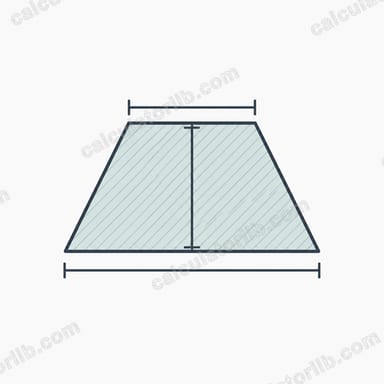
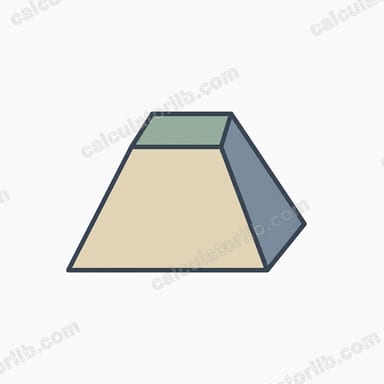
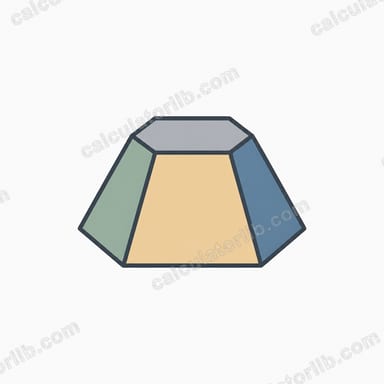
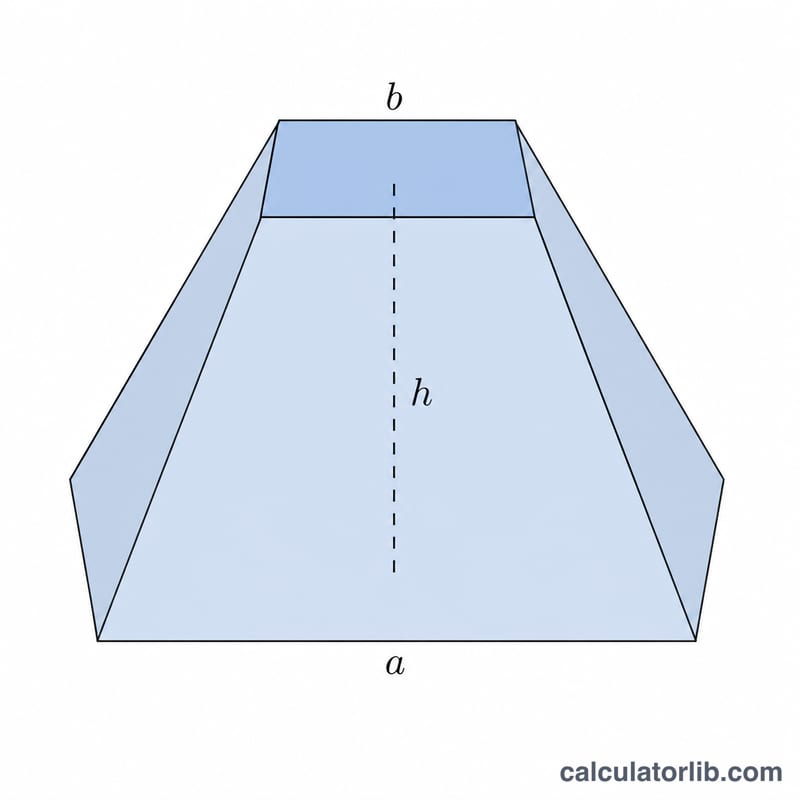
A pyramid frustum is the solid that remains when the top of a pyramid is sliced off by a plane parallel to the base. The result has two parallel, similar faces — a larger bottom base and a smaller top base — connected by trapezoidal sides. This calculator handles the common case of a square frustum, where both bases are squares, and computes its volume from the bottom side, the top side and the perpendicular height.
How to use this calculator
Enter the bottom base side a, the top base side b, and the height h (the straight-line distance between the two parallel faces). Use any consistent unit; the volume will be returned in those cubic units. Set b = 0 to model a complete pyramid, or b = a to model a cube/prism.
The formula explained
The volume uses the prismatoid (Simpson-style) rule:
$$V = \frac{h}{3}\left(A_1 + A_2 + \sqrt{A_1 \cdot A_2}\right)$$
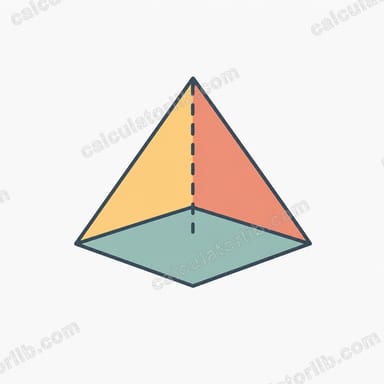
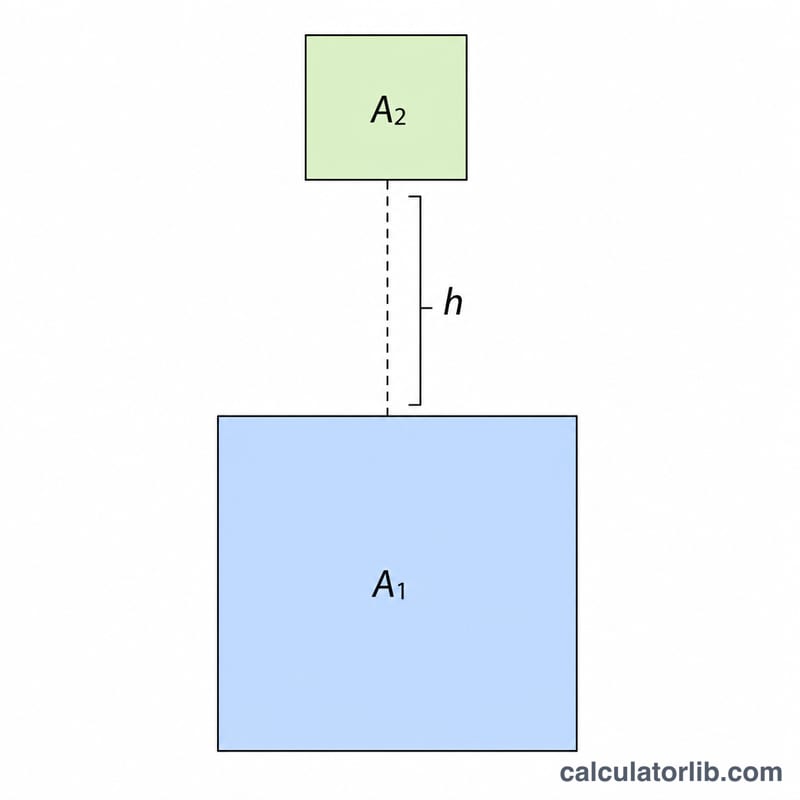
Here \(A_1 = a^2\) is the bottom area and \(A_2 = b^2\) is the top area. The middle term \(\sqrt{A_1 \cdot A_2}\) is the geometric mean of the two areas, which accounts for the gradual taper between them. When the top shrinks to a point (\(b = 0\)) the formula reduces to \(V = h \cdot A_1 / 3\), the familiar pyramid volume.
Worked example
Take a frustum with bottom side \(a = 6\), top side \(b = 3\) and height \(h = 4\). Then \(A_1 = 36\), \(A_2 = 9\), and \(\sqrt{36 \cdot 9} = \sqrt{324} = 18\). So $$V = \frac{4}{3} \cdot (36 + 9 + 18) = \frac{4}{3} \cdot 63 = 84 \text{ cubic units}.$$
FAQ
Does this work for rectangular frustums? This tool assumes square bases. For a rectangular frustum, compute \(A_1\) and \(A_2\) as length \(\times\) width and apply the same formula manually.
What height should I enter? Use the perpendicular (vertical) height between the bases, not the slant height of a side face.
Can I find a full pyramid's volume? Yes — set the top side b to 0.