
What is the Flash Guide Number Aperture Calculator?
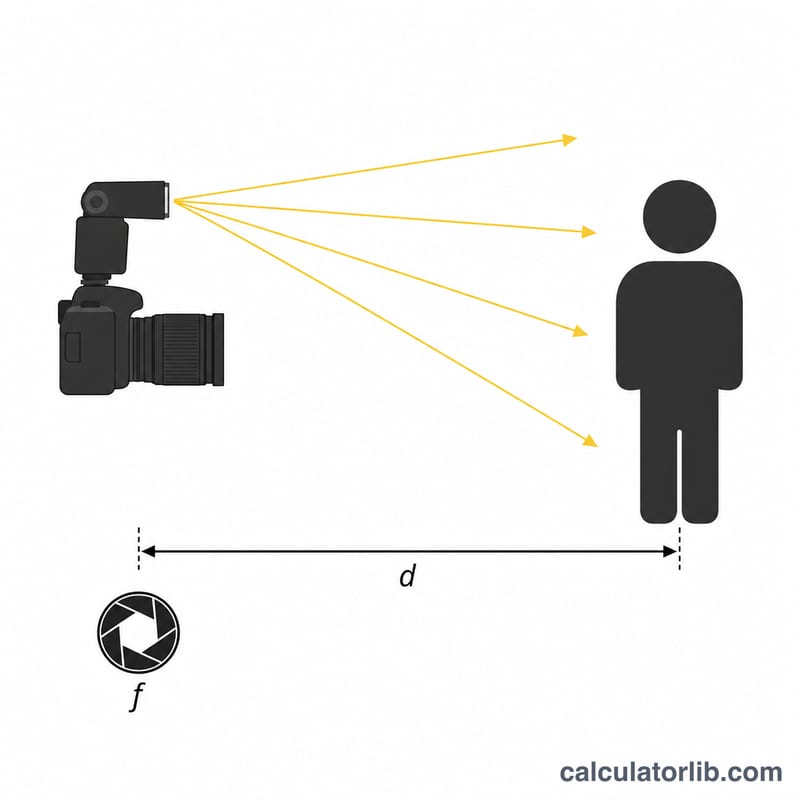
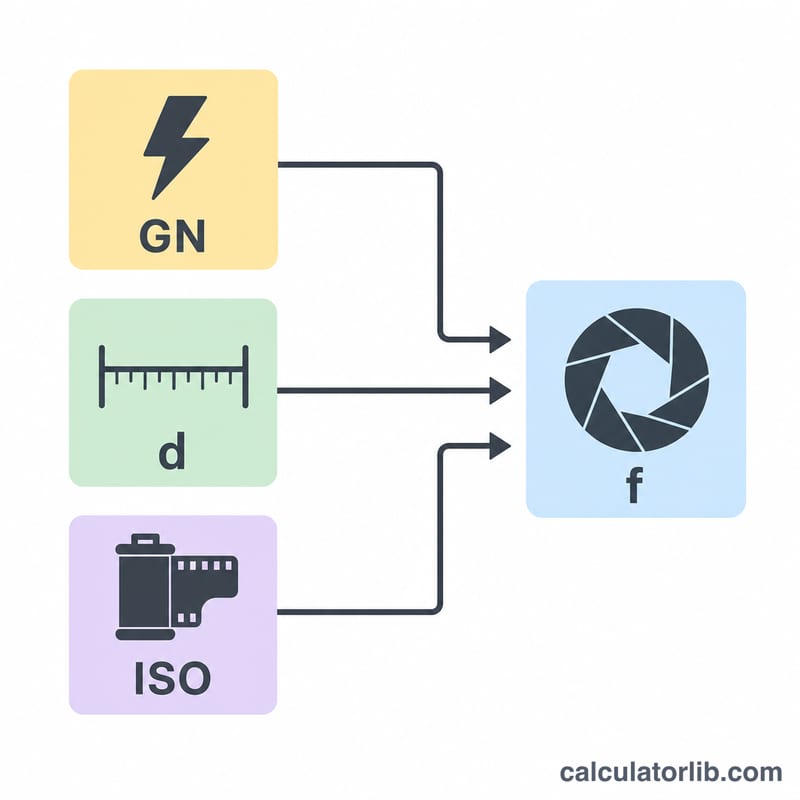
This tool computes the lens aperture (f-number, F) you should set for a flash photograph, given your flash unit's guide number (GN), the distance to your subject, and your camera's ISO sensitivity. The guide number is a measure of a flash's power: it equals the product of the aperture and the distance that produces correct exposure at ISO 100. This is universal photographic optics and applies to any camera or flash, anywhere. It also supports combining up to three flash units fired from the same position into a single effective guide number.
How to use it
Choose how many flash units you are firing (1, 2 or 3). Enter the metric guide number for each active flash (GN at ISO 100, distances in meters). Enter the subject distance in meters and select your ISO from the dropdown. The calculator returns the f-number to dial in. Remember: a smaller f-number means a wider aperture letting in more light.
The formula explained
First, multiple flashes from the same direction are combined by root-sum-of-squares because light energy adds linearly and energy is proportional to GN squared: \(\text{GN}_{\text{eff}} = \sqrt{\text{GN1}^{2} + \text{GN2}^{2} + \text{GN3}^{2}}\). Then the aperture is \(F = \frac{\text{GN}_{\text{eff}}}{d} \times \sqrt{\frac{\text{ISO}}{100}}\). The ISO term scales the ISO-100 reference guide number to your chosen sensitivity; a higher ISO yields a larger f-number, meaning you can stop down further for the same exposure.
Worked example
Two flashes with GN1 = 30 and GN2 = 40, distance d = 5 m, ISO = 400. Combined: $$\text{GN}_{\text{eff}} = \sqrt{900 + 1600} = \sqrt{2500} = 50.$$ Aperture: $$F = \frac{50}{5} \times \sqrt{\frac{400}{100}} = 10 \times 2 = 20,$$ i.e. about f/20.
FAQ
Why does a higher ISO give a larger f-number? Because more sensitivity needs less light, so you can use a smaller aperture (larger f-number) for the same exposure. The \(\sqrt{\text{ISO}/100}\) factor handles this correctly since GN is the ISO-100 reference.
Can I work in feet? Yes — the formula is unit-consistent. Just use the feet-based guide number and enter distance in feet.
When is the multi-flash combination valid? Only when all units illuminate the subject from the same position and direction, so their energies add linearly.