
What this calculator does
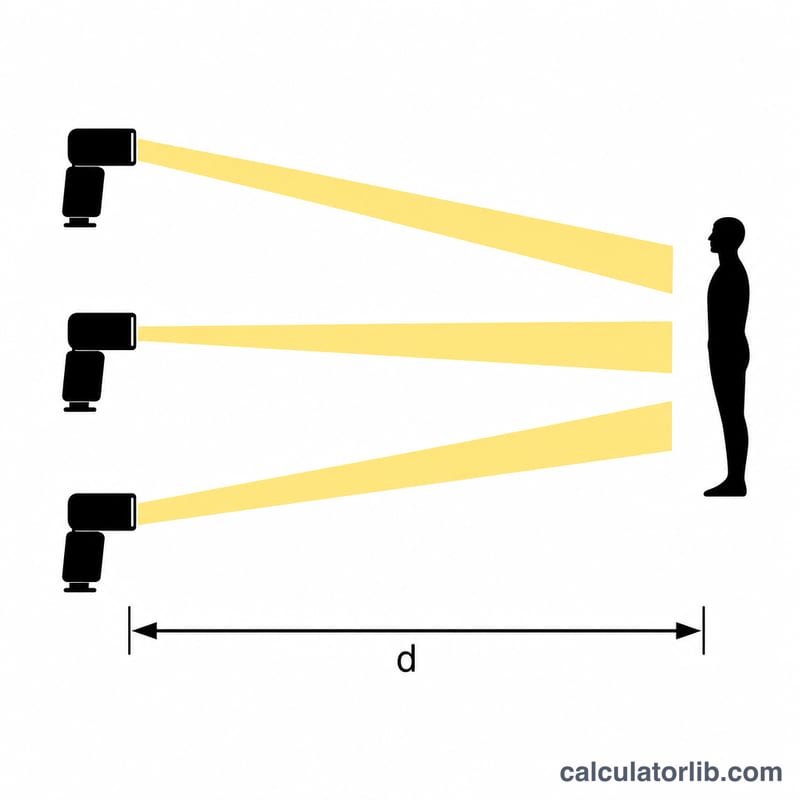
This tool computes the maximum flash-to-subject distance at which a camera flash delivers correct exposure. It uses the flash unit's Guide Number (GN), the lens aperture (f-number) and the film or sensor ISO sensitivity. It also lets you combine up to three flash units fired from the same position and direction (multi-strobe), which raises the effective output. This is universal photographic physics and has no region-specific rules.
Key terms
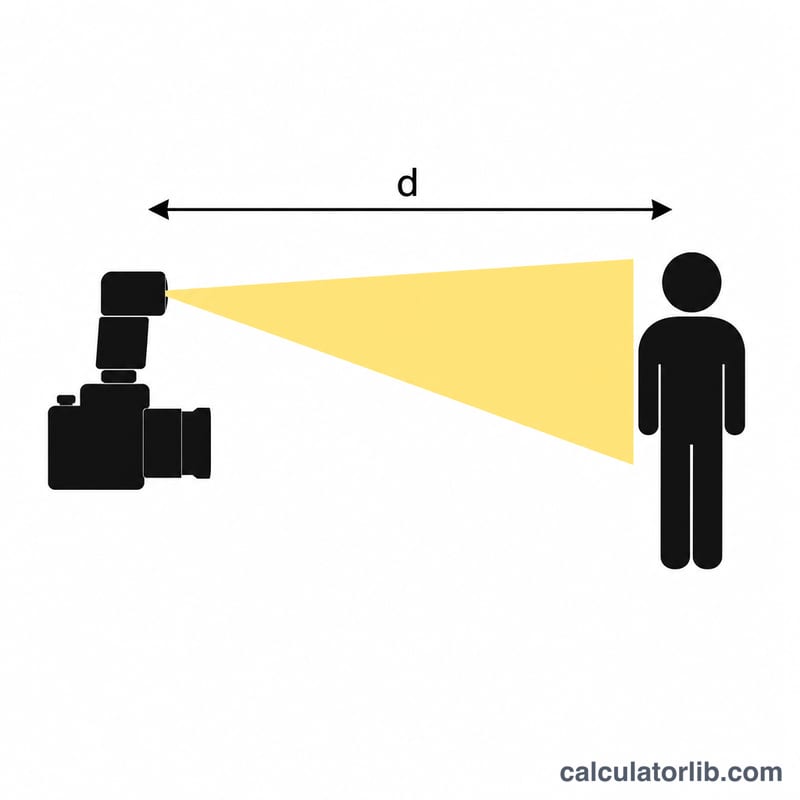
Guide Number (GN) expresses flash power. By convention it is quoted for ISO 100 in meters: \( \text{GN} = \text{f-number} \times \text{distance} \) for correct exposure. f-number is the lens aperture; the smaller the value, the more light is admitted. ISO is sensitivity; doubling ISO is one stop of extra light. ISO 100 is the reference at which a 1 m projection distance gives correct exposure for a given f-number.
How to use it
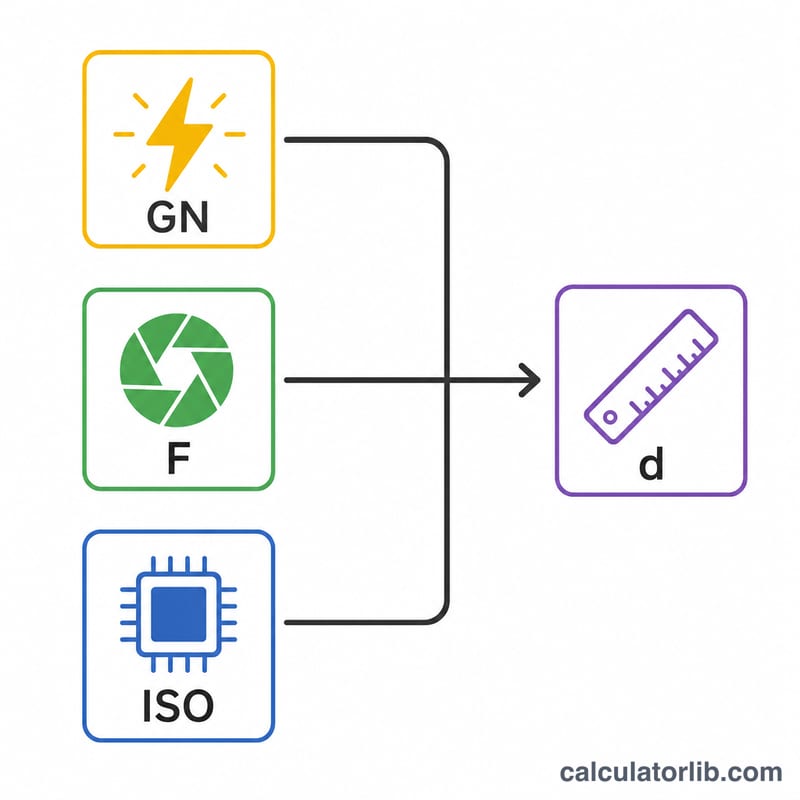
Pick how many flash units you are firing (1-3). Enter each unit's Guide Number, your chosen aperture, and the ISO from the dropdown. The result is the distance in meters at which the flash exposes correctly. Shooting closer than this is fine (you can stop down); shooting farther will under-expose the subject.
The formula explained
The base exposure relation is \( F = (\text{GN} / d) \times \sqrt{\text{ISO}/100} \). Solving for distance gives $$ d = \frac{\text{GN}}{F} \times \sqrt{\frac{\text{ISO}}{100}} $$ The square-root term scales the Guide Number for sensitivity: ISO 400 gives a factor of 2, ISO 1600 a factor of 4. For multiple flashes, the effective Guide Number is the root-sum-of-squares $$ \text{GN}' = \sqrt{\text{GN1}^2 + \text{GN2}^2 + \ldots} $$
Worked example
Two flashes, GN1 = 32 and GN2 = 24, at f/8 and ISO 100: $$ \text{GN}' = \sqrt{32^2 + 24^2} = \sqrt{1600} = 40 $$ Then $$ d = \frac{40}{8} \times \sqrt{1} = 5.0 \text{ m} $$
FAQ
Why root-sum-of-squares for multiple flashes? Light intensity adds linearly, but Guide Number scales with the square root of intensity, so combined GNs add in quadrature.
What if my GN is quoted in feet? The output will then be in feet; this tool assumes the meter convention. Convert GN to meters first if needed.
Does a higher ISO let me shoot farther? Yes. Each doubling of ISO multiplies the usable distance by about 1.41 (\( \sqrt{2} \)).