
What Is Braking Distance?
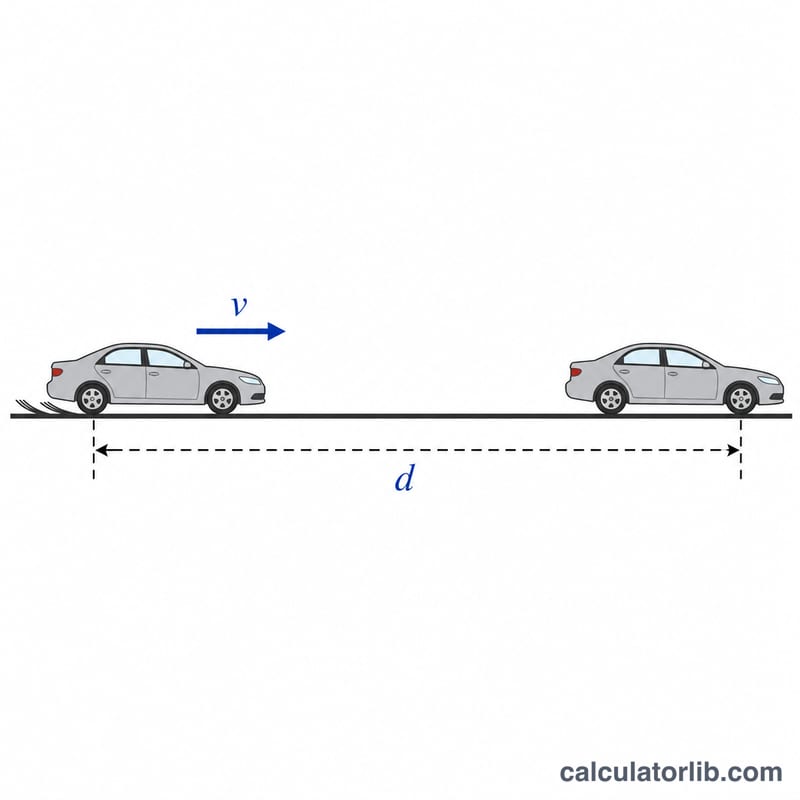
Braking distance is the distance a vehicle travels from the moment the brakes are fully applied until it comes to a complete stop. It does not include reaction distance (the distance covered while the driver reacts before braking). Braking distance depends mainly on the vehicle's speed and the friction between the tires and the road surface.
How to Use This Calculator
Enter your vehicle's speed in km/h, the friction coefficient (\(\mu\)) of the tire–road contact, and the local gravitational acceleration (default 9.81 m/s²). The calculator converts speed to m/s, applies the physics formula, and returns the stopping distance in both meters and feet.
The Formula Explained
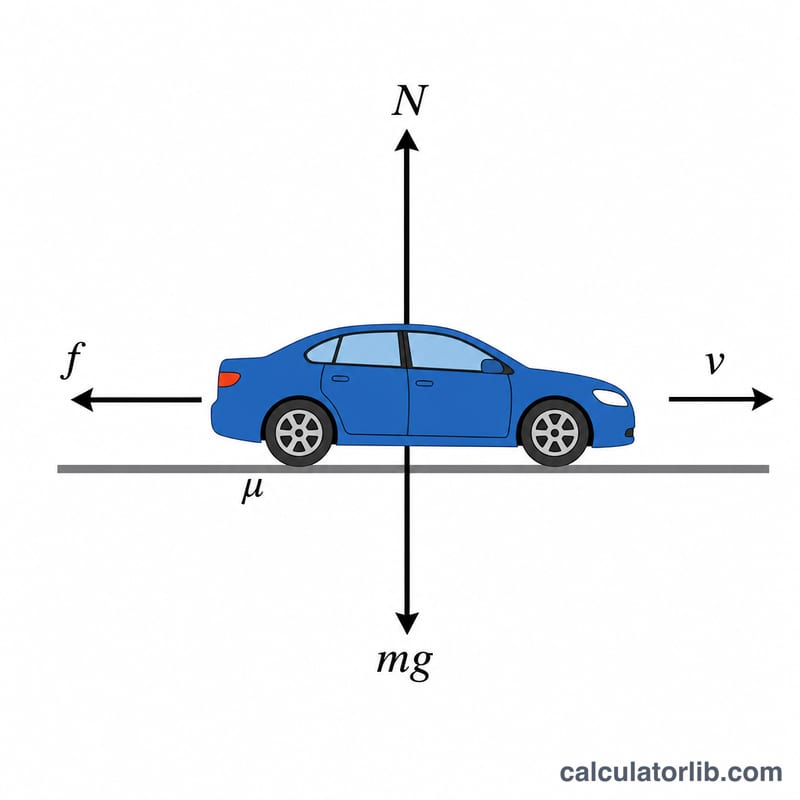
The braking distance is derived from the work–energy principle: the kinetic energy \(\tfrac{1}{2}mv^2\) is dissipated by the friction force \(\mu m g\) acting over the distance \(d\). Setting them equal and canceling mass gives $$d = \frac{v^2}{2 \cdot \mu \cdot g}$$ Notice that distance grows with the square of speed — doubling your speed quadruples the distance needed to stop.
Typical friction coefficients: dry asphalt ≈ 0.7–0.9, wet road ≈ 0.4–0.6, snow ≈ 0.2, ice ≈ 0.1.
Worked Example
A car traveling at 100 km/h on dry asphalt (\(\mu = 0.7\)), with \(g = 9.81 \text{ m/s}^2\). First convert: \(v = 100 / 3.6 = 27.78 \text{ m/s}\). Then $$d = \frac{27.78^2}{2 \times 0.7 \times 9.81} = \frac{771.6}{13.734} \approx 56.2 \text{ meters}.$$ That's roughly 184 feet just to stop after braking begins.
FAQ
Does this include reaction time? No. This is pure braking distance. Total stopping distance also includes the reaction distance you travel before pressing the brake.
Why does wet road need more distance? A lower friction coefficient means less force decelerating the car, so it takes longer (and farther) to stop.
Does weight matter? In this idealized model, mass cancels out, so braking distance is independent of vehicle weight — though real-world factors like tire load and brake fade can change results.