
What is sound distance attenuation?
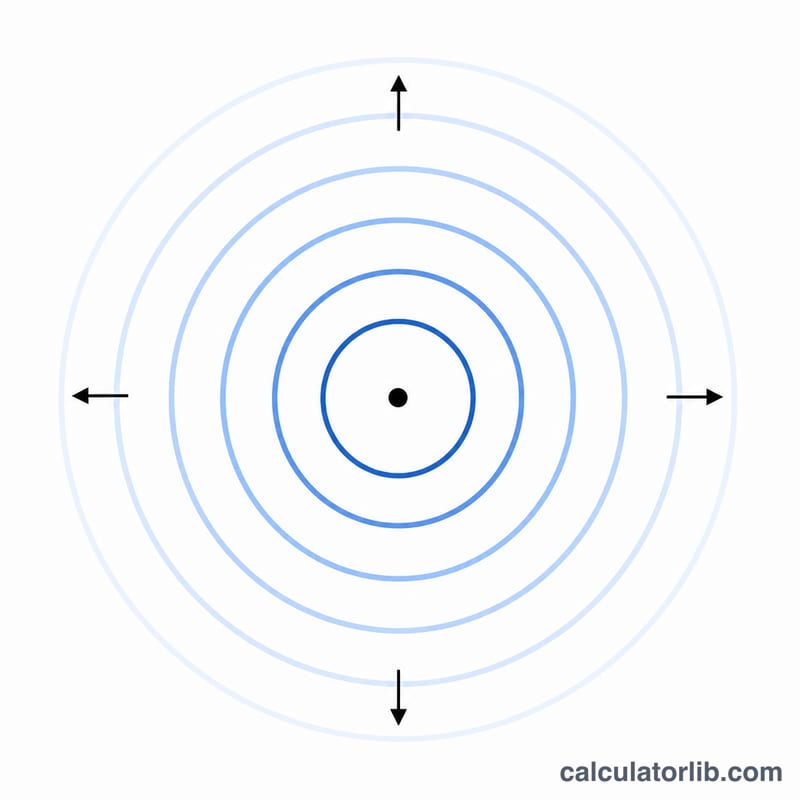
Sound spreads out as it travels away from a source. For an ideal point source radiating into free space, the sound pressure level (SPL) decreases with distance according to the inverse-square law. This calculator tells you the sound level at a new distance when you know the level at a reference distance.
How to use it
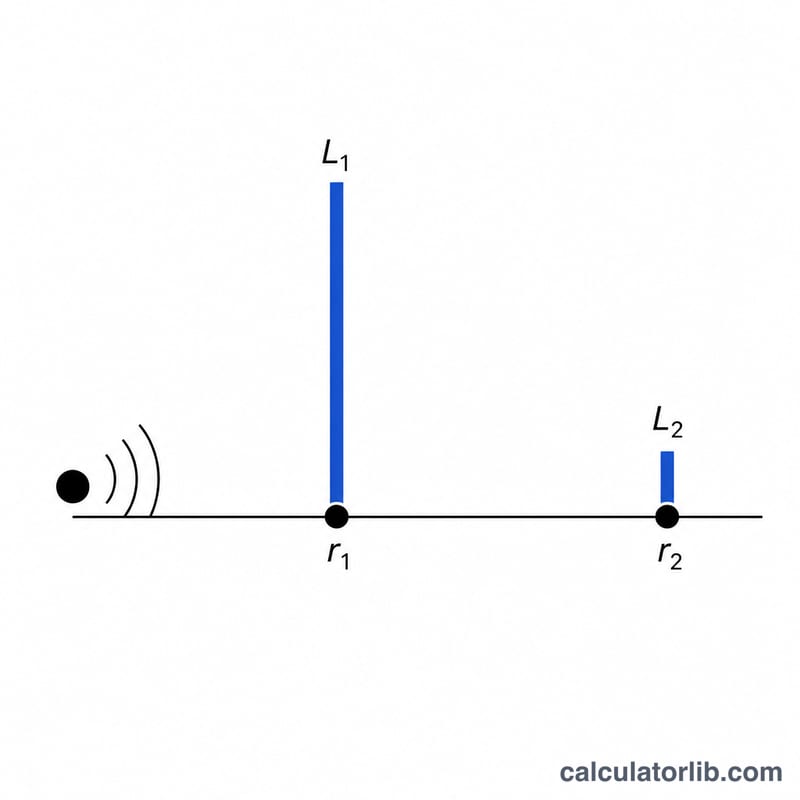
Enter the known sound level L1 in decibels, the distance r1 at which it was measured, and the new distance r2 where you want to know the level. The calculator returns the predicted level L2 and the total attenuation (drop) in dB.
The formula explained
The governing equation is $$L_2 = \text{L1 (dB)} - 20 \cdot \log_{10}\!\left(\frac{\text{r2 (m)}}{\text{r1 (m)}}\right)$$. Because intensity falls with the square of distance but SPL is measured logarithmically, the factor is 20 (not 10). A handy consequence: every time you double the distance, the level falls by \(20 \cdot \log_{10}(2) \approx 6\) dB.
Worked example
Suppose a machine produces 90 dB at 1 m. At 10 m the attenuation is \(20 \cdot \log_{10}(10/1) = 20 \cdot 1 = 20\) dB, so \(L_2 = 90 - 20 = \mathbf{70}\) dB. Moving from 1 m to 2 m gives \(20 \cdot \log_{10}(2) \approx 6\) dB of drop, landing at about 84 dB.
FAQ
Does this work indoors? The formula assumes free-field (no reflections). Indoors, reflections and reverberation reduce the actual drop, so real levels are often higher than predicted.
Why 20·log10 and not 10·log10? Sound pressure is proportional to \(1/r\), and SPL in dB uses \(20 \cdot \log_{10}\) of a pressure ratio, giving the −6 dB per doubling rule.
Can r2 be smaller than r1? Yes. If you move closer (r2 < r1) the attenuation is negative, meaning the level increases.