
What Is the Doppler Effect?
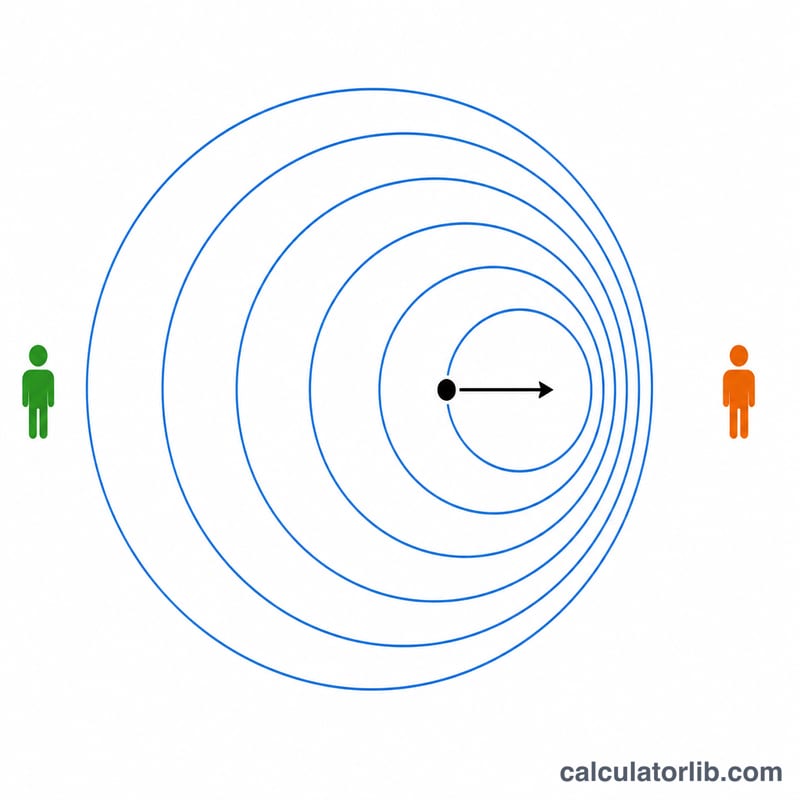
The Doppler effect is the change in the observed frequency of a wave when the source, the observer, or both are moving relative to the medium that carries the wave. It is why an ambulance siren sounds higher in pitch as it approaches and lower as it speeds away. This calculator handles the classic acoustic Doppler effect for sound traveling through a medium such as air.
How to Use This Calculator
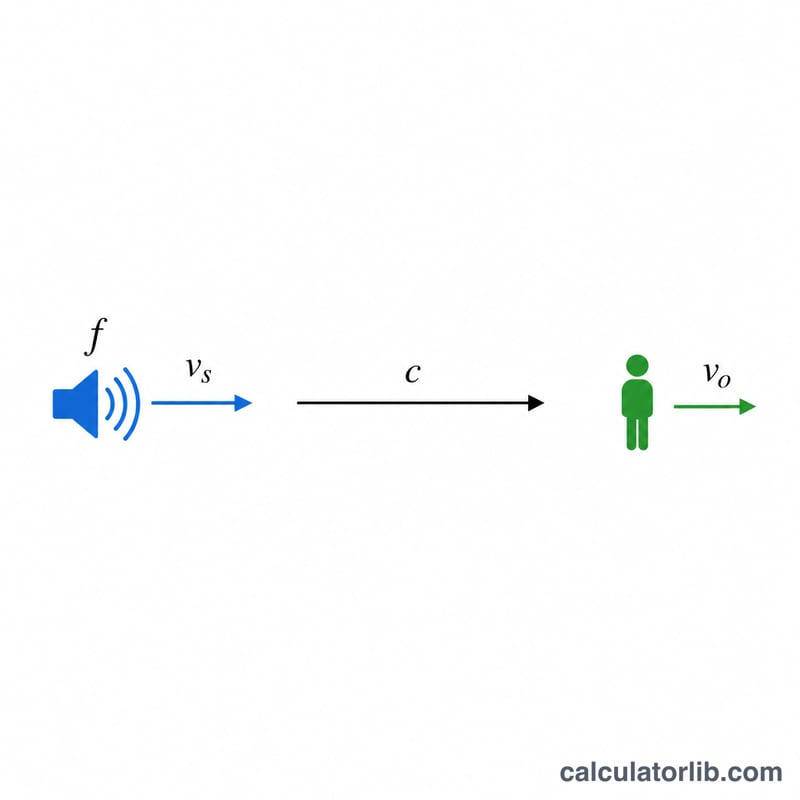
Enter the source frequency f in hertz, the speed of sound c in the medium (about 343 m/s in dry air at 20 °C), and the speeds of the observer and source. Use a positive observer speed (\(v_o\)) when the observer moves toward the source and a positive source speed (\(v_s\)) when the source moves toward the observer; use negative values for motion away. The tool returns the observed frequency \(f'\) and the shift \(\Delta f\).
The Formula Explained
The general acoustic Doppler relation is $$f' = f \cdot \frac{c + v_o}{c - v_s}.$$ Motion of the observer toward the source raises the numerator, while motion of the source toward the observer shrinks the denominator — both increase the observed frequency. Reverse the signs and the observed frequency drops below the source frequency.
Worked Example
A car horn emits \(f = 440\ \text{Hz}\) and drives toward a stationary listener at \(v_s = 30\ \text{m/s}\) in air where \(c = 343\ \text{m/s}\), with the observer at rest (\(v_o = 0\)). Then $$f' = 440 \times \frac{343 + 0}{343 - 30} = 440 \times \frac{343}{313} \approx 482.17\ \text{Hz}.$$ The pitch rises by about 42 Hz as the horn approaches.
FAQ
Does this work for light? No — light uses the relativistic Doppler formula because there is no medium. This calculator is for sound waves.
What speed of sound should I use? Around 343 m/s in air at 20 °C; it varies with temperature, humidity, and medium (≈1480 m/s in water).
What if the source reaches the speed of sound? When \(v_s = c\) the denominator is zero and the formula breaks down — this is the sonic-boom shock-wave regime, and the calculator returns 0.