
What is the sound absorption coefficient?
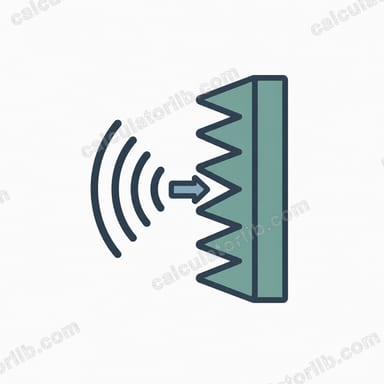
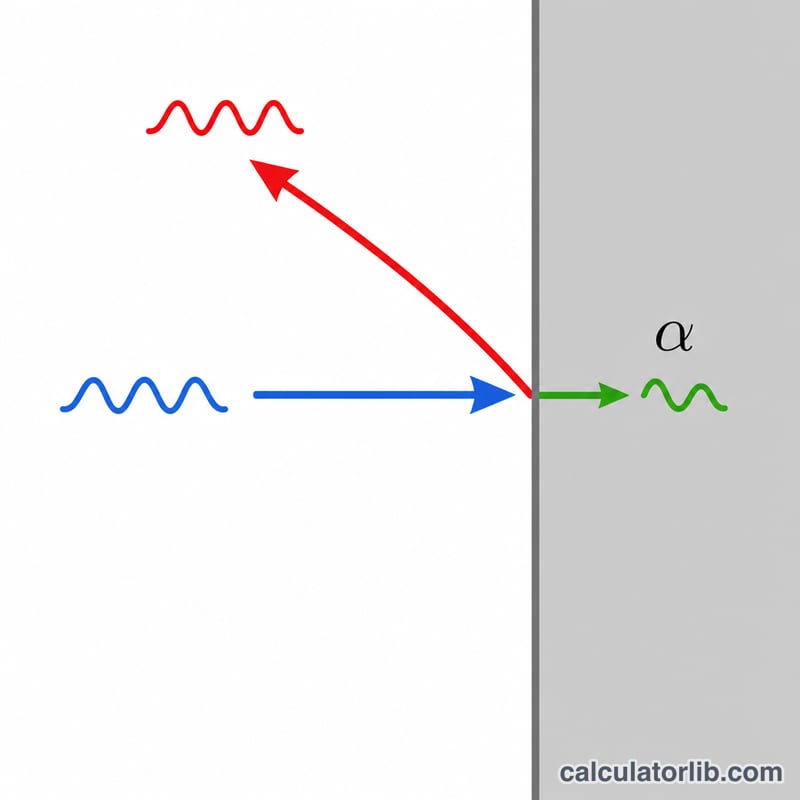
The sound absorption coefficient \(\alpha\) describes the fraction of incident sound energy that a surface absorbs rather than reflects, on a scale from 0 (perfectly reflective) to 1 (fully absorptive). Different materials — concrete, carpet, acoustic panels, glass — have very different \(\alpha\) values, and they often vary with frequency. When a room is made of several materials, acousticians use the area-weighted average absorption coefficient to describe the room as a whole.
How to use this calculator
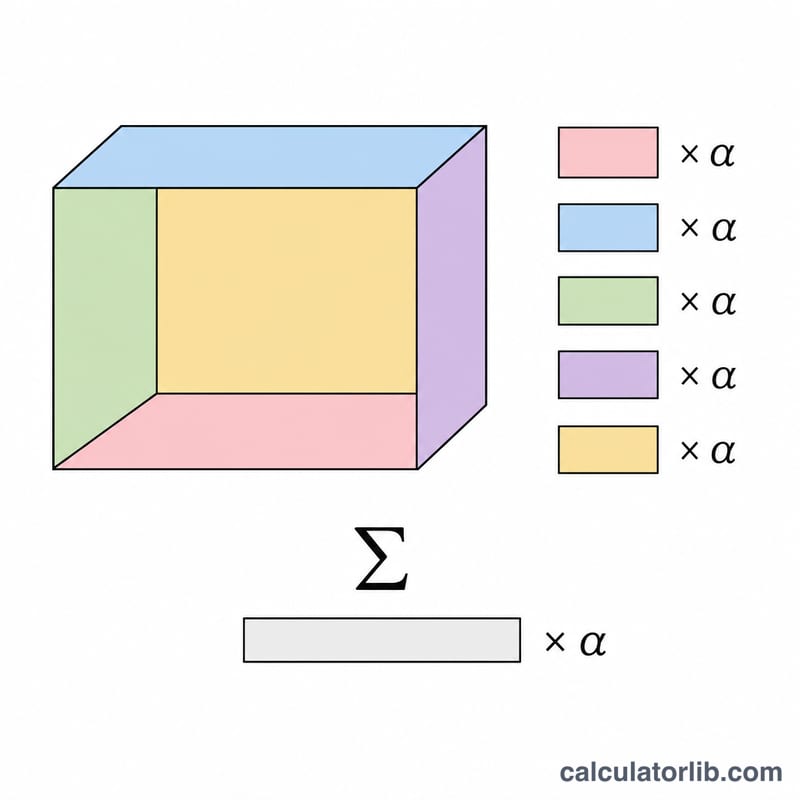
Enter the area (in square metres) and the absorption coefficient \(\alpha\) of each surface in your space — for example walls, ceiling, floor and any large furnishings. The calculator multiplies each area by its \(\alpha\) to get that surface's total absorption (in sabins), sums them, and divides by the total surface area to give the average coefficient.
The formula explained
The total absorption is \(A = \sum (\text{S}_i \cdot \alpha_i)\), measured in metric sabins (m²). The average absorption coefficient is then $$\bar{\alpha} = \frac{\text{S}_1\,\alpha_1 + \text{S}_2\,\alpha_2 + \text{S}_3\,\alpha_3 + \text{S}_4\,\alpha_4}{\text{S}_1 + \text{S}_2 + \text{S}_3 + \text{S}_4}$$ where \(\bar{\alpha} = A / S\) and \(S = \sum \text{S}_i\) is the total surface area. A larger surface or a higher \(\alpha\) contributes more to the average. The total absorption \(A\) also feeds directly into the Sabine reverberation-time equation, \(T_{60} = 0.161 \cdot V / A\).
Worked example
A room has 20 m² of painted wall (\(\alpha = 0.05\)), 20 m² of acoustic panels (\(\alpha = 0.30\)) and a 30 m² carpeted floor (\(\alpha = 0.10\)). Total absorption $$A = 20 \times 0.05 + 20 \times 0.30 + 30 \times 0.10 = 1.0 + 6.0 + 3.0 = 10 \text{ sabins}$$ Total area \(S = 20 + 20 + 30 = 70\) m². Average $$\bar{\alpha} = 10 / 70 \approx 0.143$$
FAQ
Can \(\alpha\) be greater than 1? Published lab values can slightly exceed 1 due to edge-diffraction effects, but physically it represents fractional absorption. This tool allows values up to 1.
What is a sabin? A metric sabin is 1 m² of perfectly absorbing surface; \(A\) in sabins equals the equivalent area of total absorption.
Do I need all four surfaces? No — leave unused surfaces at 0 area and they won't affect the result.