
What this calculator does
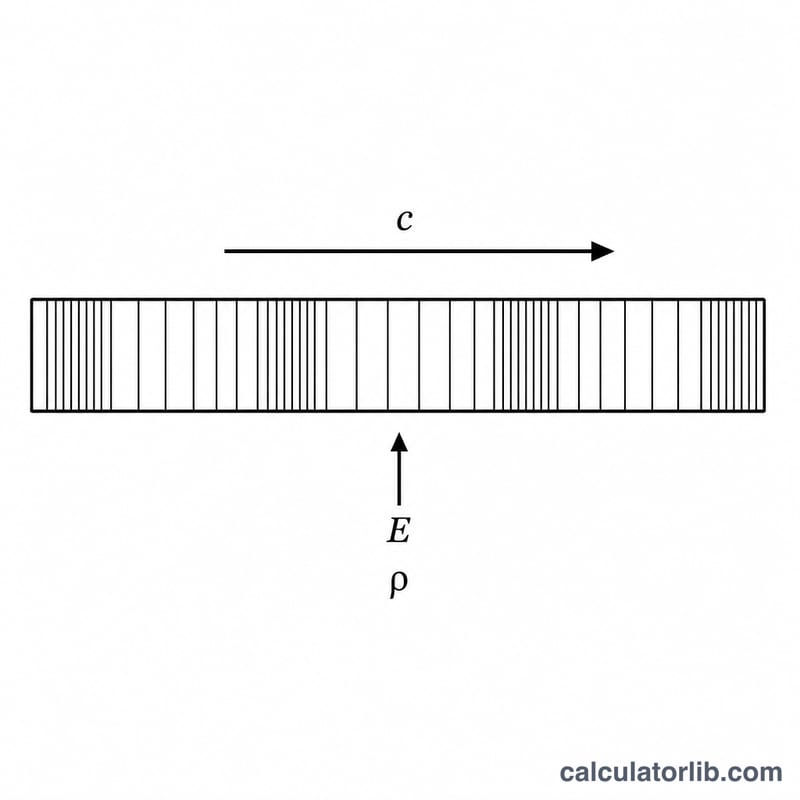
The Speed of Sound in Solids Calculator estimates how fast a longitudinal (compressional) sound wave travels through a solid rod or bar. It uses the classic thin-rod relation \(c = \sqrt{E/\rho}\), where E is the material's Young's modulus and \(\rho\) is its density. Sound travels much faster in stiff, light materials than in soft, heavy ones — which is why steel rings and lead thuds.
How to use it
Enter the Young's modulus in gigapascals (GPa) and the density in kilograms per cubic meter (kg/m³). The calculator converts the modulus to pascals, divides by density, and takes the square root. You get the wave speed in meters per second, the equivalent in km/h, and the Mach number relative to the speed of sound in air (343 m/s).
The formula explained
The wave equation for a thin elastic rod gives a phase velocity of
$$c = \sqrt{\frac{\text{E (GPa)} \times 10^{9}}{\text{Density } \rho}}$$Young's modulus E (in pascals) measures stiffness — resistance to stretching — while density \(\rho\) measures mass per volume. A higher modulus speeds the wave up; a higher density slows it down. Note this is the thin-bar speed; bulk longitudinal waves in a large solid use the constrained modulus and are slightly faster.
Worked example
For steel, E ≈ 200 GPa = \(2\times10^{11}\) Pa and \(\rho \approx 7850\) kg/m³. Then
$$c = \sqrt{\frac{2\times10^{11}}{7850}} = \sqrt{25{,}477{,}707} \approx 5048 \text{ m/s}$$That's roughly 18,170 km/h, or about Mach 14.7 compared with sound in air.
FAQ
Why is this slower than the "5960 m/s" sometimes quoted for steel? That figure is the bulk longitudinal speed, which uses the constrained modulus rather than Young's modulus. The thin-rod formula here gives the bar speed.
What units should I use? Enter E in GPa and \(\rho\) in kg/m³. The tool handles the GPa→Pa conversion internally so the result comes out in m/s.
Does temperature matter? Yes — Young's modulus and density vary with temperature, so use values appropriate to your operating conditions for the most accurate speed.