What is the Split Bill by Ratio Calculator?
This tool divides a single total amount among several groups or people in proportion to a set of ratio weights. Instead of splitting a bill evenly, you decide that one group should pay more or less than another using weights such as 5:3:2. The math is purely proportional, so it works in any currency — the amount is treated generically and no conversion is applied.
How to use it
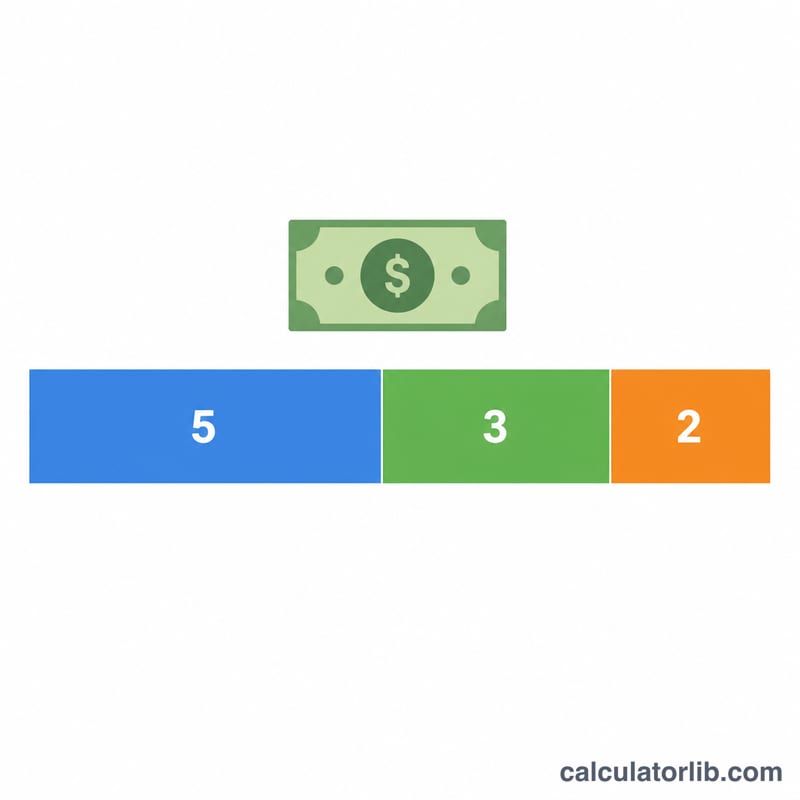
Enter the total amount to be divided, then type the ratios as a list separated by colons or commas (for example 5:3:2 or 5,3,2). The number of weights equals the number of groups. Weights may be decimals (e.g. 1.5:2.5) and need not add up to 100 — only their relative proportions matter, so 5:3:2 gives the same result as 10:6:4.
The formula explained
Let the total be A and the weights be \(w_1\), \(w_2\), …, \(w_n\). First sum the weights: \(S = w_1 + w_2 + \dots + w_n\). Each group's raw share is \(A \times w_i / S\), and we round each share to the nearest whole unit (round half up). Because each share is rounded independently, the rounded shares may add up to slightly more or less than the total; the calculator also shows an "Adjusted" column that gives the remainder to the last group so the values reconcile exactly.
$$\text{Share}_i = \operatorname{round}\!\left( \text{Total} \times \frac{w_i}{\sum_{j} w_j} \right)$$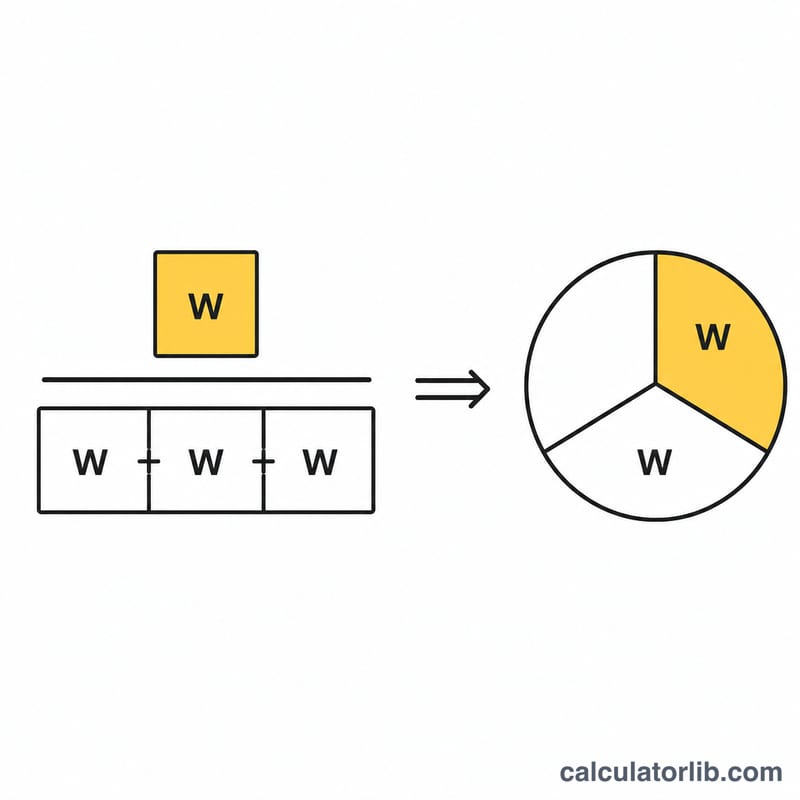
Worked example
Total = 10000, ratios = 5:3:2. The weight sum is \(S = 10\). Group 1 gets
$$10000 \times \frac{5}{10} = 5000$$group 2 gets 3000, and group 3 gets 2000. These sum back to 10000 exactly. With ratios of 1:1:1 on 10000, each raw share is 3333.33, rounding to 3333 each (total 9999); the adjusted column shows 3333, 3333, 3334 to total 10000.
Common Ratio Scenarios Compared
The table splits the same total of 12,000 under four common ratios. Each share is the total multiplied by the group's weight divided by the weight sum. The shares in every row add back to 12,000, and the percentages add to 100%.
| Ratio | Weight sum | Share of each group (in order) | Percentage of each group | Typical use |
|---|---|---|---|---|
| 1:1:1 | 3 | 4,000 / 4,000 / 4,000 | 33.33% each | Equal split among three people |
| 2:1 | 3 | 8,000 / 4,000 | 66.67% / 33.33% | A couple versus a single person |
| 5:3:2 | 10 | 6,000 / 3,600 / 2,400 | 50% / 30% / 20% | Three groups with different usage or consumption |
| 3:2 | 5 | 7,200 / 4,800 | 60% / 40% | Income-based split between two payers |
Worked check for 5:3:2: the weight sum is \(5+3+2=10\), so the first group pays \(12{,}000 \times \frac{5}{10} = 6{,}000\). The second pays \(12{,}000 \times \frac{3}{10} = 3{,}600\) and the third pays \(12{,}000 \times \frac{2}{10} = 2{,}400\).
Worked check for 2:1: the weight sum is 3, so the shares are \(12{,}000 \times \frac{2}{3} = 8{,}000\) and \(12{,}000 \times \frac{1}{3} = 4{,}000\).
Key Terms
- Total amount
- The full bill or cost to be divided, such as rent, a dinner check or a shared expense, before any splitting.
- Ratio / weight
- A set of numbers like 5:3:2 in which each number is one group's relative weight. Only the proportions matter, so 5:3:2 and 10:6:4 give identical results.
- Weight sum
- The total of all weights (for 5:3:2 it is 10). It is the denominator used to turn each weight into a fraction of the total.
- Raw share
- A group's exact, unrounded portion: total × weight ÷ weight sum. For example, 100 split 1:1:1 gives a raw share of 33.333… for each group.
- Rounded share
- The raw share rounded to the currency's precision (for example whole units or two decimals) so it can actually be paid.
- Adjusted share (remainder given to last group)
- Rounding each share separately can leave the sum slightly above or below the total. For example, 100 rounded to whole units at 1:1:1 gives 33 + 33 + 33 = 99. The leftover difference is added to or taken from the last group (34 in this case) so the shares add up to the exact total.
- Percentage share
- Each group's weight divided by the weight sum, shown as a percentage. For 3:2 this is 60% and 40%.
- Proportional vs. equal split
- An equal split gives every group the same amount no matter their circumstances. A proportional split scales each amount by an agreed weight, such as income, headcount, floor area or usage. An equal split is just the special case where all weights are the same, like 1:1:1.
FAQ
Do the weights have to be whole numbers? No. Decimals like 1.5:2.5 are allowed; only the ratio between weights matters.
Why don't the shares always add to the total? Each share is rounded to the nearest whole unit on its own, which can leave a small remainder. The adjusted column fixes this by giving the difference to the last group.
What if all weights are zero? The split is undefined because the weight sum is zero; enter at least one positive weight.