
What Is the Angle of Twist?
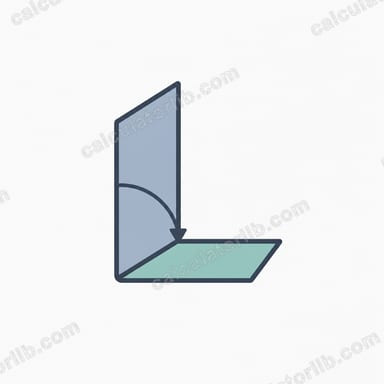
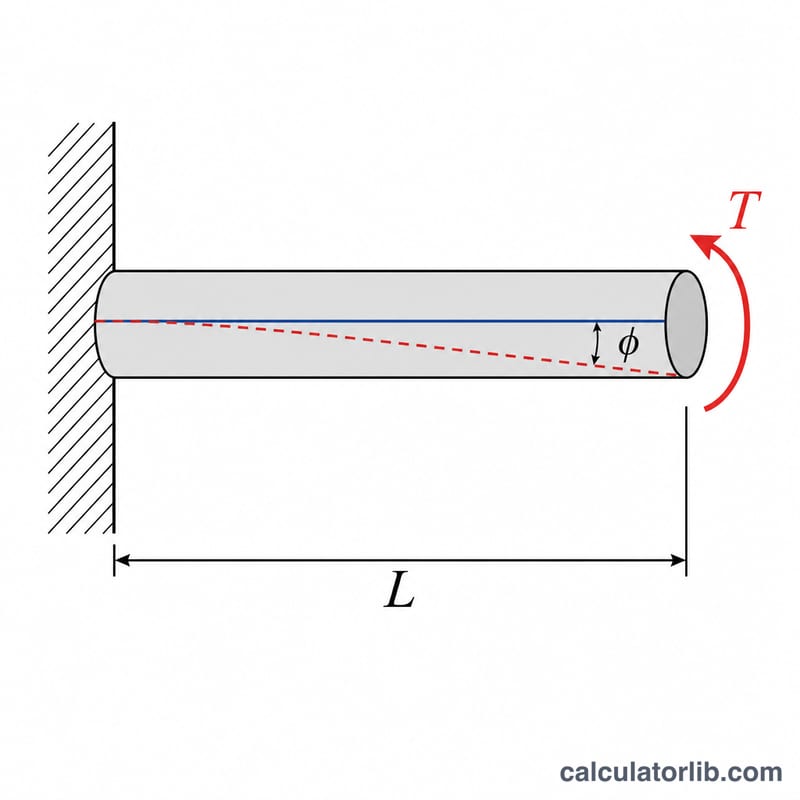
When a torque is applied to a shaft, the shaft rotates about its axis — one end turning relative to the other. The amount of this rotation is called the angle of twist, denoted \(\varphi\). It is a fundamental quantity in the torsion of circular shafts and is essential when designing drive shafts, axles, springs, and couplings where excessive twist can cause misalignment or failure.
The Formula
For a shaft of uniform circular cross-section under constant torque, the angle of twist is:
$$\varphi = \frac{T \cdot L}{J \cdot G}$$
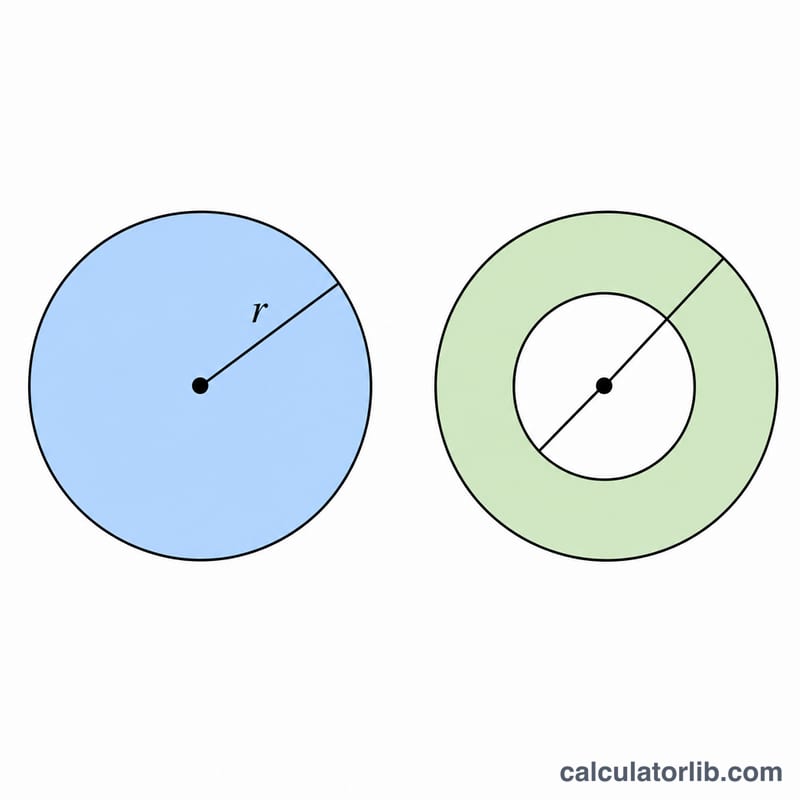
where \(T\) is the applied torque (\(\text{N}\cdot\text{m}\)), \(L\) is the length of the shaft (m), \(J\) is the polar moment of inertia of the cross-section (m⁴), and \(G\) is the shear modulus of the material (Pa). The result \(\varphi\) is in radians; multiply by \(180/\pi\) to get degrees. For a solid circular shaft, \(J = \pi d^4 / 32\); for a hollow shaft, \(J = \pi (d_o^4 - d_i^4) / 32\).
How to Use the Calculator
Enter the torque, shaft length, polar moment of inertia, and the shear modulus of the material. The calculator returns the twist angle in both degrees and radians.
Worked Example
A steel shaft (\(G = 79\ \text{GPa} = 79 \times 10^9\ \text{Pa}\)) is 1 m long with \(J = 1 \times 10^{-7}\ \text{m}^4\) and carries a torque of \(100\ \text{N}\cdot\text{m}\). Then $$\varphi = \frac{100 \times 1}{1 \times 10^{-7} \times 79 \times 10^9} = \frac{100}{7900} = 0.012658\ \text{rad} \approx 0.7252°.$$
Polar Moment of Inertia Formulas
The polar moment of inertia \(J\) (also called the polar second moment of area) describes how a cross-section resists torsion. For circular shafts it is computed directly from the diameter, with SI units of metres to the fourth power, \(\text{m}^4\).
Solid circular shaft of diameter \(d\):
$$J = \frac{\pi d^4}{32}$$Hollow circular shaft with outer diameter \(d_o\) and inner diameter \(d_i\):
$$J = \frac{\pi\left(d_o^4 - d_i^4\right)}{32}$$| Symbol | Meaning | Unit |
|---|---|---|
| \(J\) | Polar moment of inertia | \(\text{m}^4\) |
| \(d\) | Diameter of solid shaft | \(\text{m}\) |
| \(d_o\) | Outer diameter of hollow shaft | \(\text{m}\) |
| \(d_i\) | Inner (bore) diameter of hollow shaft | \(\text{m}\) |
The base torsion formula \(\varphi = \tfrac{TL}{JG}\) returns the twist angle in radians. To express the result in degrees, multiply by the conversion factor:
$$\varphi_{\text{deg}} = \varphi_{\text{rad}} \times \frac{180}{\pi} \approx \varphi_{\text{rad}} \times 57.2958$$For a worked value, a solid shaft of diameter \(d = 0.05\,\text{m}\) (50 mm) gives \(J = \tfrac{\pi (0.05)^4}{32} = 6.136\times 10^{-7}\,\text{m}^4\).
Twist Angle Across Different Shafts
The table below applies \(\varphi = \tfrac{TL}{JG}\) to several realistic solid circular shafts. For each, \(J\) is computed from the diameter using \(J = \pi d^4/32\), the twist is found in radians, then converted to degrees with the \(180/\pi\) factor. Larger diameters dramatically reduce twist because \(J\) scales with the fourth power of diameter.
| Shaft | Torque T (N·m) | Length L (m) | Diameter d (mm) | J (m⁴) | Material / G | φ (rad) | φ (deg) |
|---|---|---|---|---|---|---|---|
| Light drive shaft | 200 | 1.0 | 30 | 7.952 × 10⁻⁸ | Steel / 79 GPa | 0.0318 | 1.82 |
| Medium steel shaft | 500 | 2.0 | 50 | 6.136 × 10⁻⁷ | Steel / 79 GPa | 0.0206 | 1.18 |
| Heavy industrial shaft | 1500 | 1.5 | 80 | 4.021 × 10⁻⁶ | Steel / 79 GPa | 0.00709 | 0.406 |
| Aluminum shaft | 300 | 1.0 | 40 | 2.513 × 10⁻⁷ | Aluminum / 26 GPa | 0.0459 | 2.63 |
| Brass shaft | 250 | 1.2 | 35 | 1.473 × 10⁻⁷ | Brass / 37 GPa | 0.0550 | 3.15 |
Note the contrast between the aluminum and heavy steel cases: even with a much smaller torque, the aluminum shaft twists far more because both its diameter (smaller \(J\)) and its shear modulus are lower. The twist of the light drive shaft, \(\varphi = \tfrac{200 \times 1.0}{(7.952\times 10^{-8})(7.9\times 10^{10})} = 0.0318\,\text{rad}\), equals \(0.0318 \times \tfrac{180}{\pi} = 1.82^\circ\).
FAQ
Does this work for non-circular shafts? The simple \(J\) formula applies to circular cross-sections. Non-circular sections require a torsional constant rather than the polar moment of inertia.
What is the shear modulus of common materials? Steel \(\approx 79\ \text{GPa}\), aluminum \(\approx 26\ \text{GPa}\), brass \(\approx 37\ \text{GPa}\).
Why is the angle in radians first? The mechanics formula naturally yields radians; degrees are obtained by multiplying by \(180/\pi\) for easier interpretation.