
What Is the Euler Buckling Load?
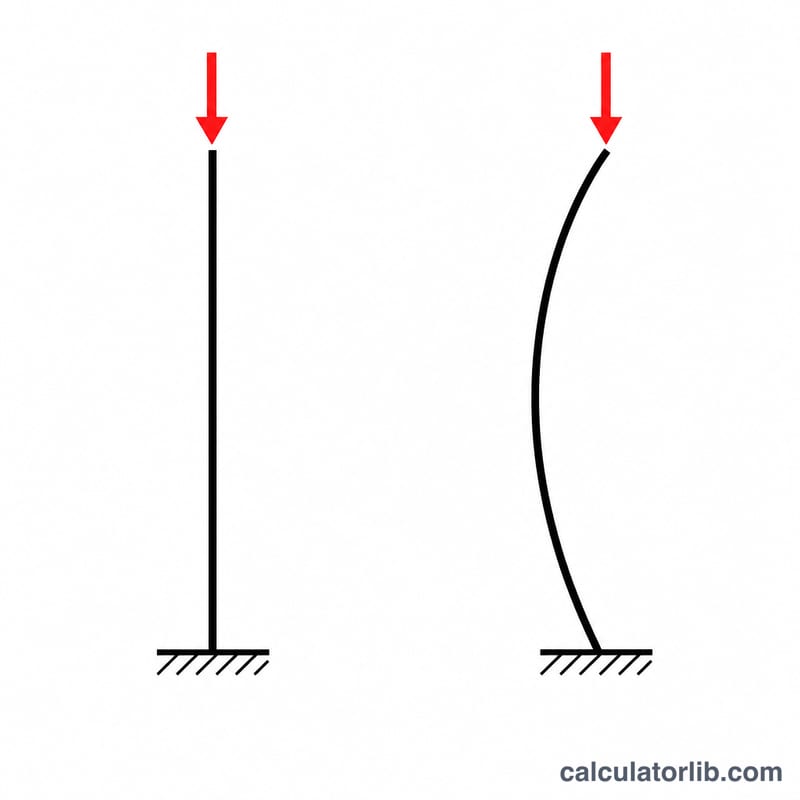
The Euler buckling load, or critical load (\(P_{cr}\)), is the maximum axial compressive force a slender column can sustain before it suddenly bows sideways and fails by buckling rather than crushing. Named after Leonhard Euler, it is one of the cornerstone formulas of structural and mechanical engineering. This calculator works in any consistent unit system; the examples here use SI units (pascals, metres, newtons).
How to Use This Calculator
Enter the column's modulus of elasticity E (for structural steel ≈ 200 GPa = \(2\times10^{11}\) Pa), the cross-sectional moment of inertia I about the weak axis, the unsupported length L, and choose the end-condition factor K. The tool returns the critical load in both newtons and kilonewtons, plus the effective length \(KL\).
The Formula Explained
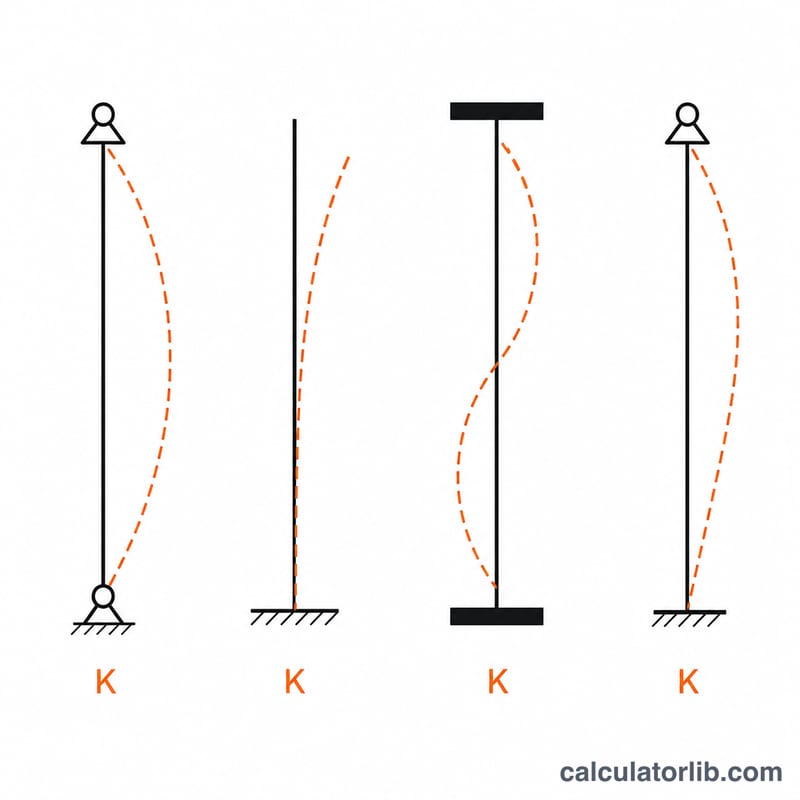
The governing equation is $$P_{cr} = \frac{\pi^2 \, \text{E} \, \text{I}}{\left(\text{K} \cdot \text{L}\right)^2}$$ The product \(EI\) is the column's bending stiffness — stiffer or fatter sections resist buckling better. The denominator \((KL)^2\) shows that buckling load drops rapidly with length: doubling the length quarters the capacity. The factor \(K\) accounts for how the ends are restrained: pinned–pinned \(K=1.0\), fixed–fixed \(K=0.5\), fixed–pinned \(K\approx0.699\), and fixed–free (cantilever) \(K=2.0\).
Worked Example
A pinned–pinned steel column with E = 200 GPa, \(I = 1\times10^{-7}\) m⁴ and L = 3 m (\(K=1\)). Effective length \(KL = 3\) m. $$P_{cr} = \frac{\pi^2 \times 2\times10^{11} \times 1\times10^{-7}}{3^2} = \frac{9.8696 \times 20000}{9} \approx 21{,}932 \ \text{N} \approx 21.9 \ \text{kN}$$
End-Condition Factor (K) Reference
The effective-length factor \(K\) accounts for how the ends of a column are restrained. The Euler critical load uses the effective length \(KL\). Theoretical values assume ideal restraint, while recommended design values (per AISC guidance) are higher to reflect that real connections are never perfectly fixed.
| End Condition | Theoretical K | Recommended Design K | Notes |
|---|---|---|---|
| Pinned–Pinned | 1.0 | 1.0 | Both ends free to rotate; baseline reference case. |
| Fixed–Fixed | 0.5 | 0.65 | Both ends rotationally restrained; design value raised for imperfect fixity. |
| Fixed–Pinned | 0.7 | 0.8 | One end fixed, one pinned (often listed as 0.699). |
| Fixed–Free (Cantilever) | 2.0 | 2.1 | One end fully fixed, other free to translate and rotate; weakest case. |
The recommended values reflect real-world end fixity recommended by AISC, since true mathematical fixity or perfect pins rarely occur in practice. Using the higher (conservative) value increases the effective length \(KL\) and therefore lowers the predicted critical load.
Typical Modulus of Elasticity (E) by Material
The modulus of elasticity (Young's modulus) describes a material's elastic stiffness. Higher \(E\) directly increases the Euler buckling load. Values below are typical; actual values vary with alloy, grade, moisture content, and mix design.
| Material | E (GPa) | E (Pa) |
|---|---|---|
| Structural steel | ~200 | 2.0 × 10¹¹ |
| Cast iron | ~120 | 1.2 × 10¹¹ |
| Titanium | ~110 | 1.1 × 10¹¹ |
| Aluminium | ~69 | 6.9 × 10¹⁰ |
| Concrete | ~30 | 3.0 × 10¹⁰ |
| Timber (softwood) | ~10–12 | 1.0–1.2 × 10¹⁰ |
For consistent SI results, enter \(E\) in pascals (Pa) and \(I\) in m4 so the critical load comes out in newtons (N).
Interpreting Your Critical Load
The Euler critical load \(P_{cr}\) is the theoretical axial force at which a perfectly straight, elastic, concentrically loaded column becomes unstable and buckles laterally. It marks the onset of elastic buckling — not a safe working load.
- Apply a safety factor. Real columns have initial crookedness, load eccentricity, and residual stresses. The allowable design load is \(P_{cr}\) divided by a factor of safety (commonly 1.5–3 depending on the code and application), so never load a column to its computed \(P_{cr}\).
- Check the slenderness ratio. Euler's formula is only valid for slender columns — those whose slenderness ratio \(KL/r\) exceeds the critical value where the buckling stress stays below the proportional limit. Below that, inelastic (Johnson parabola) buckling governs and Euler overestimates capacity.
- Watch for yielding in stocky columns. For short, thick (low-slenderness) columns, the material reaches its yield stress in compression before buckling occurs. In that regime, crushing/yielding governs, and the squash load \(P = \sigma_y A\) is the limiting value rather than \(P_{cr}\).
In short: compute \(P_{cr}\), confirm the column is slender enough for Euler to apply, then divide by a suitable factor of safety to get an allowable load. This is general engineering information, not a substitute for code-compliant design by a qualified engineer.
FAQ
What does K represent? \(K\) is the effective-length factor reflecting end restraints; it converts the actual length into the length of an equivalent pinned column.
Does Euler's formula always apply? No. It assumes a long, slender, elastic, straight column. Short or stocky columns fail by yielding first, so check the slenderness ratio and material yield stress.
Which moment of inertia should I use? Use the smallest (weak-axis) \(I\), since the column buckles about the axis of least bending stiffness.