
What This Calculator Does
This tool estimates the total electrical load of a single-family dwelling and the minimum service size (in amps) using the standard calculation method from the US National Electrical Code (NEC, Article 220). It applies to United States residential wiring at a nominal 240 V single-phase service. Results are an educational estimate — final sizing must be done by a licensed electrician and verified against the current NEC edition adopted in your jurisdiction.
How to Use It
Enter the conditioned floor area of the dwelling in square feet, the number of 20-amp small-appliance branch circuits (NEC requires at least two for kitchen/dining areas), and the combined nameplate VA of fixed appliances such as the water heater, dishwasher, dryer, range, and HVAC. The calculator returns the total volt-amperes and the equivalent service amperage.
The Formula Explained
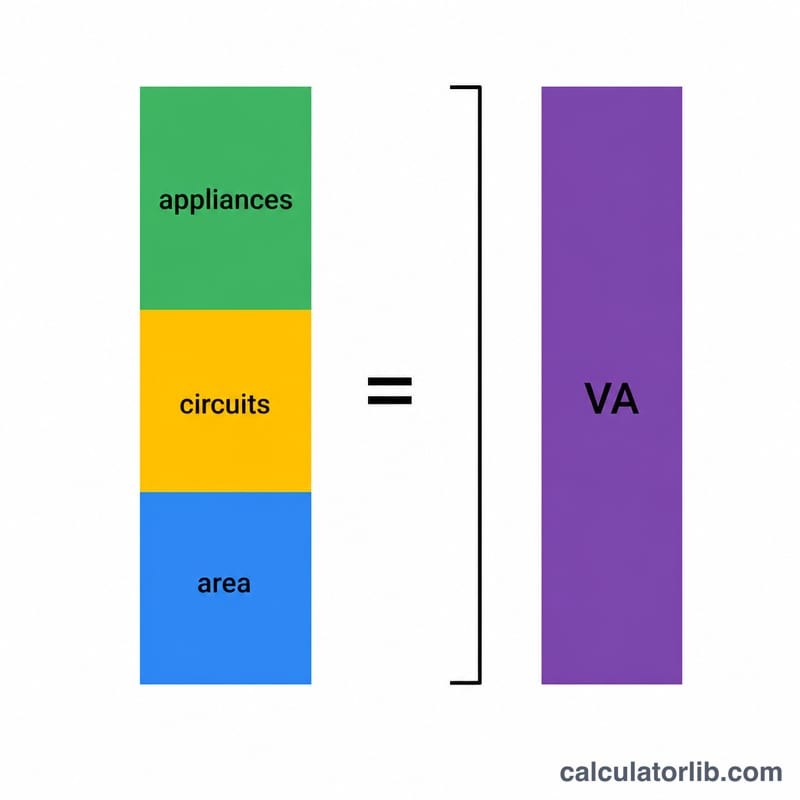
The general lighting and receptacle load is taken as 3 VA per square foot. Each small-appliance circuit adds 1,500 VA. Fixed appliance loads are added at their nameplate rating:
$$\text{Total VA} = 3 \times \text{area} + 1{,}500 \times \text{circuits} + \text{appliance loads}$$
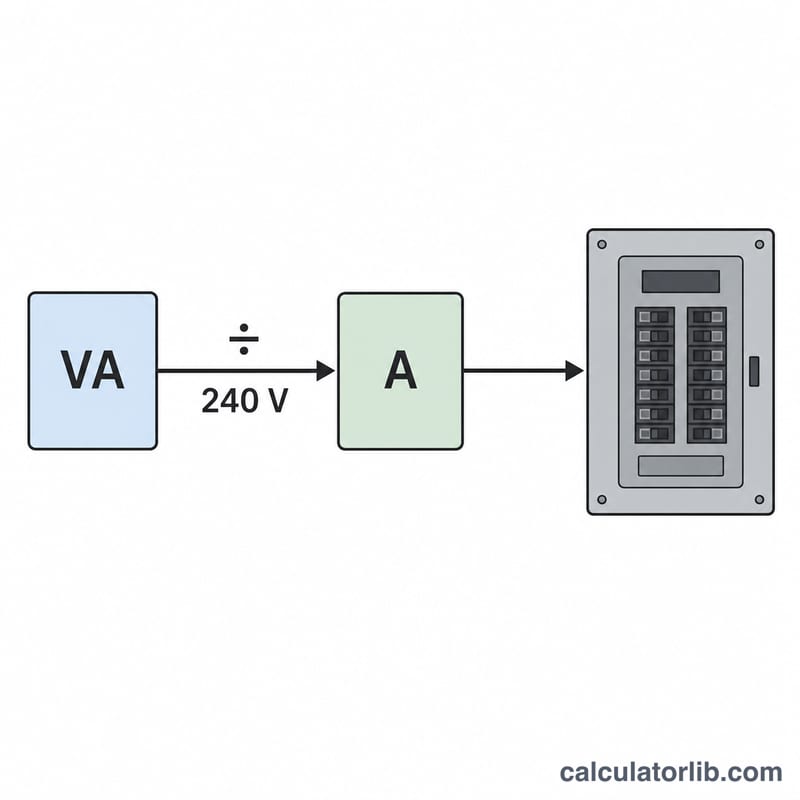
The minimum service size is the total VA divided by 240 V.
Worked Example
A 2,000 ft² home with 3 small-appliance circuits and 10,000 VA of fixed appliances: general lighting = \(3 \times 2{,}000 = 6{,}000\) VA; small appliance = \(1{,}500 \times 3 = 4{,}500\) VA; appliances = 10,000 VA. Total = 20,500 VA. Service = \(20{,}500 \div 240 \approx 85.4\) A, so a 100 A service would suffice.
FAQ
Does this include demand factors? No — this simplified version sums loads without applying NEC demand factors (e.g., the 100%/40% rule). Real designs may apply demand factors that reduce the total.
Why 240 V? US residential service is split-phase 120/240 V; the 240 V value gives the service amperage for the two ungrounded conductors.
How many small-appliance circuits? The NEC requires a minimum of two 20 A circuits; many homes have three or more.