
What is the Pallet Load Calculator?
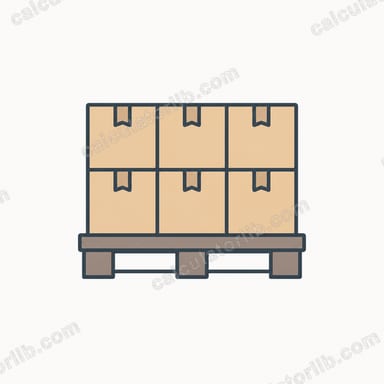
The Pallet Load Calculator estimates how many cartons (cases or boxes) fit on a single pallet. It works out how many cases fit in one layer based on the pallet and case footprint, how many layers can be stacked within your maximum allowed height, and the total number of cartons per pallet. This is essential for logistics planning, freight quoting, warehouse slotting, and container loading.
How to use it
Enter the pallet dimensions (a standard EUR pallet is 120 x 80 cm; a standard US/GMA pallet is 121.9 x 101.6 cm). Then enter your case length, width, and height. Finally, set the maximum stack height allowed (for example, a truck or warehouse rack opening) and the height of the pallet base itself. The calculator tests both case orientations on the footprint and uses whichever packs more units per layer.
The formula explained
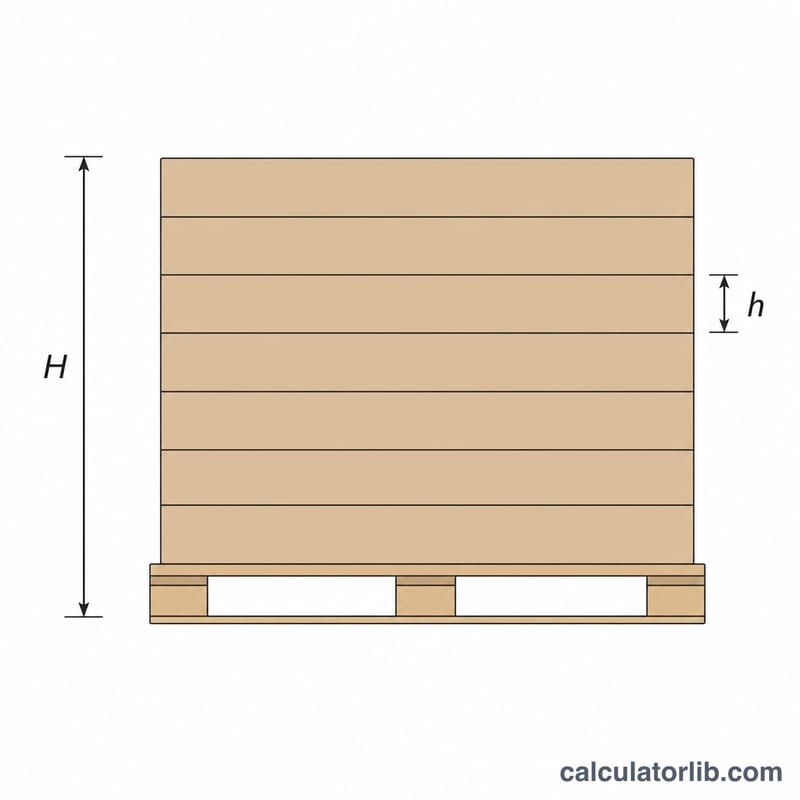
Cases per layer is found by fitting whole cases along each axis: \(\lfloor \text{palletL} / \text{caseL} \rfloor \times \lfloor \text{palletW} / \text{caseW} \rfloor\), then comparing it to the rotated layout \(\lfloor \text{palletL} / \text{caseW} \rfloor \times \lfloor \text{palletW} / \text{caseL} \rfloor\) and keeping the larger. The number of layers is \(\lfloor (\text{maxHeight} - \text{palletBase}) / \text{caseHeight} \rfloor\). The total is simply cases per layer multiplied by layers. The "area max" figure divides pallet area by case area to show the theoretical ceiling ignoring orientation waste.
$$\text{Total} = C_{\text{layer}} \times L$$$$\begin{aligned} C_{\text{layer}} &= \max\!\left( \left\lfloor \tfrac{\text{Pallet L}}{\text{Case L}} \right\rfloor \left\lfloor \tfrac{\text{Pallet W}}{\text{Case W}} \right\rfloor,\; \left\lfloor \tfrac{\text{Pallet L}}{\text{Case W}} \right\rfloor \left\lfloor \tfrac{\text{Pallet W}}{\text{Case L}} \right\rfloor \right) \\[0.4em] L &= \left\lfloor \dfrac{\text{Max Height} - \text{Base}}{\text{Case H}} \right\rfloor \end{aligned}$$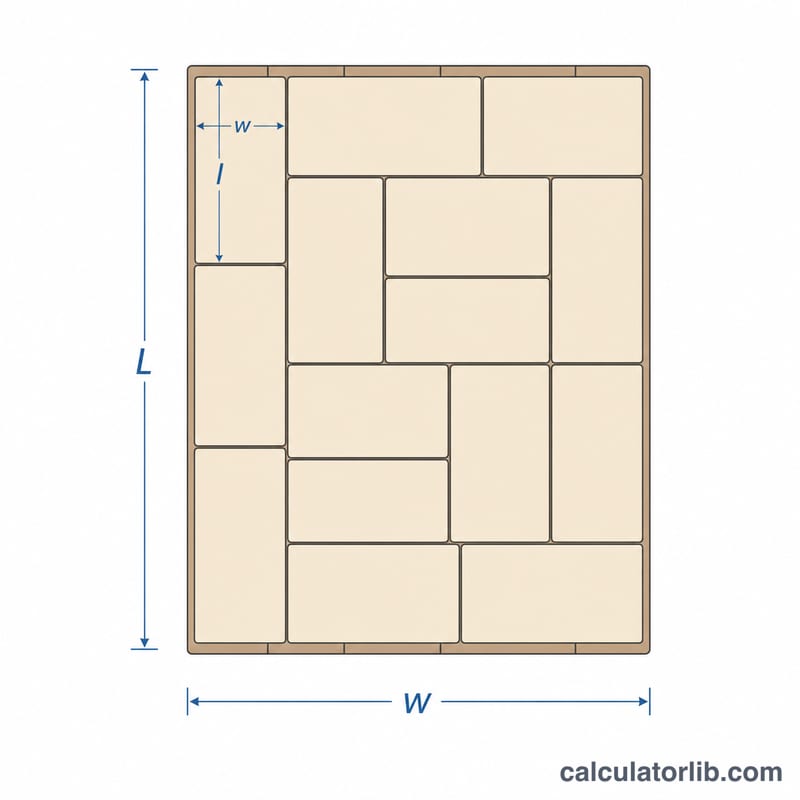
Worked example
Pallet 120 x 100 cm, case 40 x 30 x 25 cm, max stack 180 cm, base 15 cm. Orientation A: \(\lfloor 120/40 \rfloor = 3\), \(\lfloor 100/30 \rfloor = 3\) → 9 per layer. Orientation B: \(\lfloor 120/30 \rfloor = 4\), \(\lfloor 100/40 \rfloor = 2\) → 8 per layer. Best = 9. Usable height = \(180 - 15 = 165\), layers = \(\lfloor 165/25 \rfloor = 6\). Total = \(9 \times 6 = 54\) cartons.
FAQ
Does it account for overhang or interlocking? No — it assumes cases stay within the pallet footprint and are stacked in a simple block (column) pattern. Interlocked or brick patterns may differ.
Why is the area maximum higher than cases per layer? Area division ignores the fact that boxes can't be split, so real packing leaves gaps. The orientation-based figure is the realistic, achievable count.
What units should I use? Use the same unit (centimeters here) for every dimension so the ratios are consistent.