
What is the Container Loading Calculator?
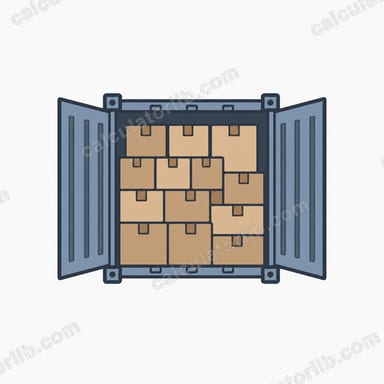
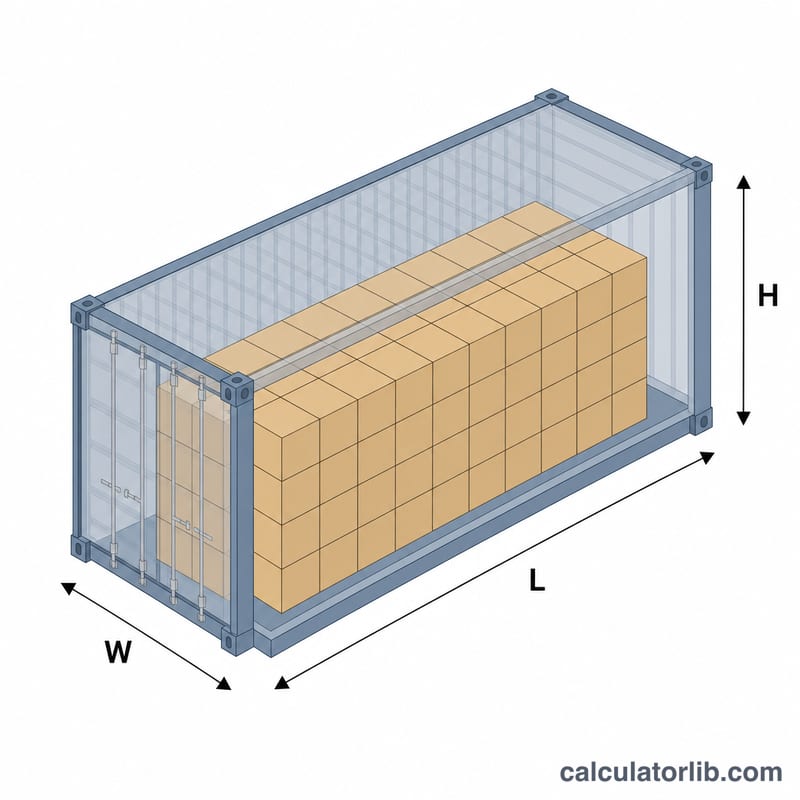
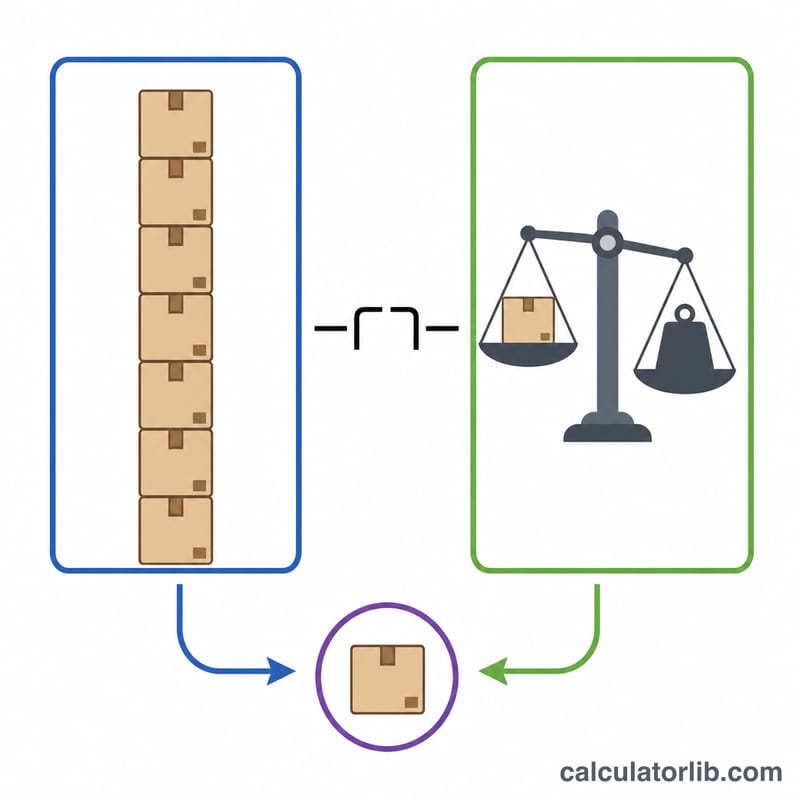
This calculator estimates how many cartons of a given size and weight you can fit into a standard shipping container. It compares two limits — the available cubic volume and the maximum payload weight — and reports whichever runs out first. It is useful for freight forwarders, importers, exporters and anyone planning an FCL (full container load) shipment.
How to use it
Pick a container type (20ft, 40ft or 40ft high cube) or choose Custom and type your own volume and payload. Enter the carton's length, width and height in centimetres, its weight in kilograms, and a realistic volume utilisation percentage. Because cartons never pack perfectly, a utilisation of 80–90% reflects real-world stacking gaps and bracing. The tool then shows the carton count and whether volume or weight is the binding constraint.
The formula explained
First the carton volume is found in cubic metres by dividing each dimension by 100 and multiplying. Usable container volume is the rated volume times your utilisation factor. The volume limit is the floor of usable volume ÷ carton volume, and the weight limit is the floor of payload ÷ carton weight. The final answer is the smaller of the two.
$$\begin{gathered} \text{Units} = \min\!\left( \left\lfloor \frac{V_{usable}}{V_{carton}} \right\rfloor,\ \left\lfloor \frac{\text{Max Payload (kg)}}{\text{Carton Weight (kg)}} \right\rfloor \right) \\[1.5em] \text{where}\quad \left\{ \begin{aligned} V_{usable} &= \text{Container Volume (m}^3\text{)} \times \frac{\text{Utilisation (\%)}}{100} \\ V_{carton} &= \frac{\text{L}}{100} \times \frac{\text{W}}{100} \times \frac{\text{H}}{100} \end{aligned} \right. \end{gathered}$$
Worked example
A 40ft standard container (67.7 m³, 26,500 kg) loads cartons of 40×30×25 cm weighing 10 kg, at 85% utilisation. Carton volume = \(0.4\times0.3\times0.25 = 0.03\ \text{m}^3\). Usable volume = \(67.7\times0.85 = 57.545\ \text{m}^3\), so by volume = \(\left\lfloor 57.545/0.03 \right\rfloor = 1918\) cartons. By weight = \(\left\lfloor 26500/10 \right\rfloor = 2650\). The volume limit wins: 1,918 cartons.
FAQ
Why not 100% utilisation? Cartons leave gaps, need bracing and rarely tessellate perfectly; 80–90% is typical.
Does it plan exact stacking positions? No — it is a quick capacity estimate, not a 3D load plan.
What if weight is the limit? The result note shows "limited by Weight", meaning you'll hit the payload cap before filling the cube.