
What Is the 20-20-20 Rule?
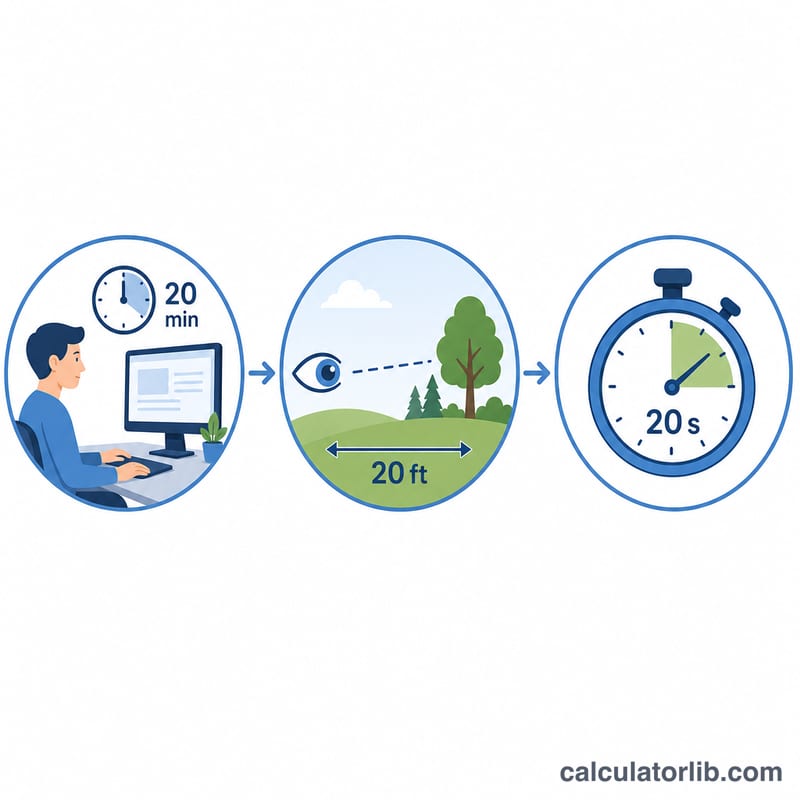
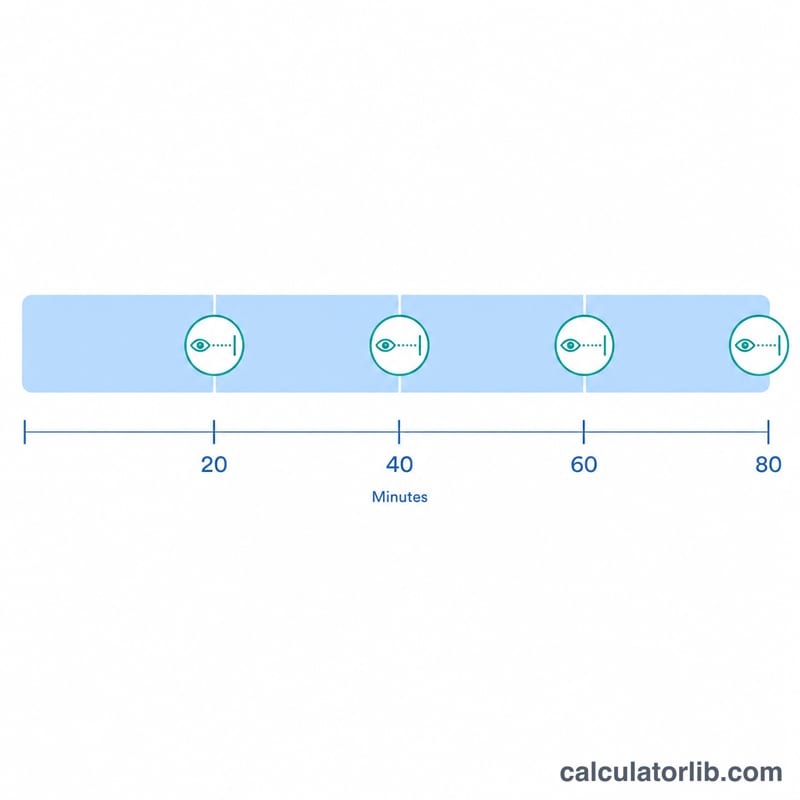
The 20-20-20 rule is a simple, widely recommended technique to reduce digital eye strain (also called computer vision syndrome). The guideline is easy to remember: every 20 minutes, look at something 20 feet (about 6 metres) away for 20 seconds. Shifting your focus to a distant object relaxes the eye muscles that stay tensed when staring at a nearby screen, and the short pause encourages you to blink, which prevents dry, irritated eyes.
How to Use This Calculator
Enter the total number of minutes you expect to spend looking at screens today. The calculator divides that time into 20-minute blocks and tells you how many 20-second eye breaks you should take, along with the total time you'll spend resting your eyes.
The Formula Explained
The number of breaks is the whole number of 20-minute intervals in your screen time: $$\text{Breaks} = \left\lfloor \frac{\text{Screen Time (min)}}{20} \right\rfloor$$ Because each break lasts 20 seconds, the total rest time in minutes is $$\text{Rest (min)} = \frac{\text{Breaks} \times 20}{60}$$ The floor (rounding down) is used because you only need a break once a full 20-minute block has passed.
Worked Example
Suppose you work at a computer for 180 minutes. Dividing 180 by 20 gives 9, so you should take 9 breaks. That's \(9 \times 20 = 180\) seconds of looking into the distance, which equals \(180 \div 60 = 3\) minutes of total eye rest spread across your session.
FAQ
Does the 20-20-20 rule cure eye strain? It helps prevent and reduce strain but isn't a medical treatment. If you have persistent symptoms, see an eye-care professional.
Why 20 feet? At roughly 20 feet, your eyes are considered to be at "optical infinity," meaning the focusing muscles fully relax.
Can I take longer breaks? Absolutely. The 20 seconds is a minimum; longer breaks and standing up to stretch are even better for overall comfort.