What is the Hair Growth Calculator?
This calculator estimates how long it will take to grow your hair from its current length to a target length. Human scalp hair grows on average about 1.25 cm (roughly half an inch) per month, though the actual rate varies between roughly 0.6 cm and 1.7 cm per month depending on genetics, age, diet, hormones, and overall health.
How to use it
Enter your current hair length, the target length you want to reach, and your personal growth rate in centimeters per month. If you do not know your rate, leave it at the 1.25 cm/month average. The calculator returns the time required in months, years, and days, plus the total length you still need to grow.
The formula explained
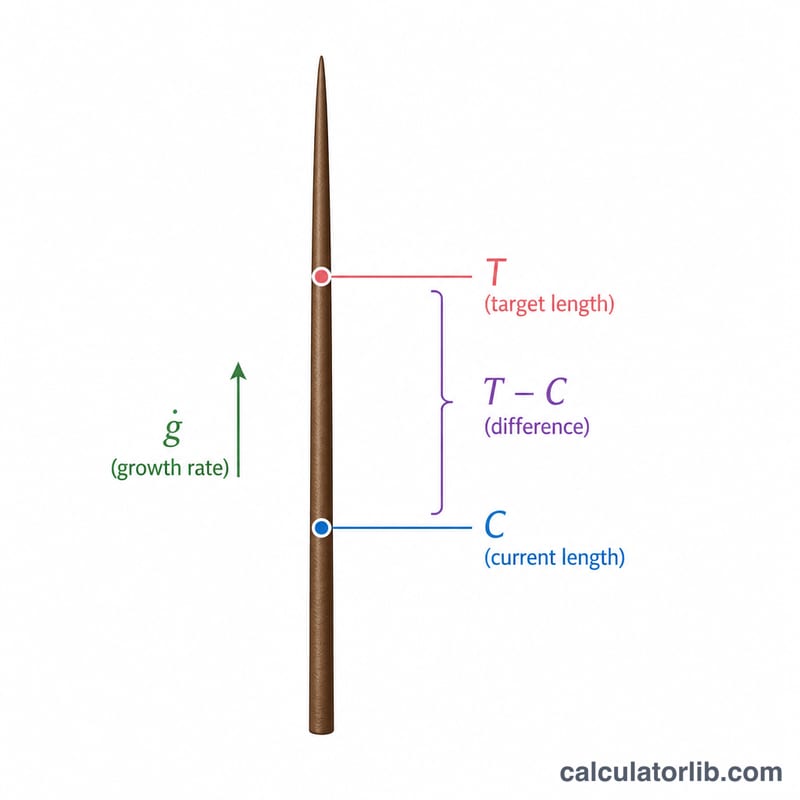
The math is simple division. First find the length you need to gain: \(\Delta L = \text{Target} - \text{Current}\). Then divide by your monthly growth rate:
$$\text{Time} = \frac{\Delta L}{\text{rate}}$$Years are months divided by 12, and days use an average month of about 30.44 days (365.25 ÷ 12).
Worked example
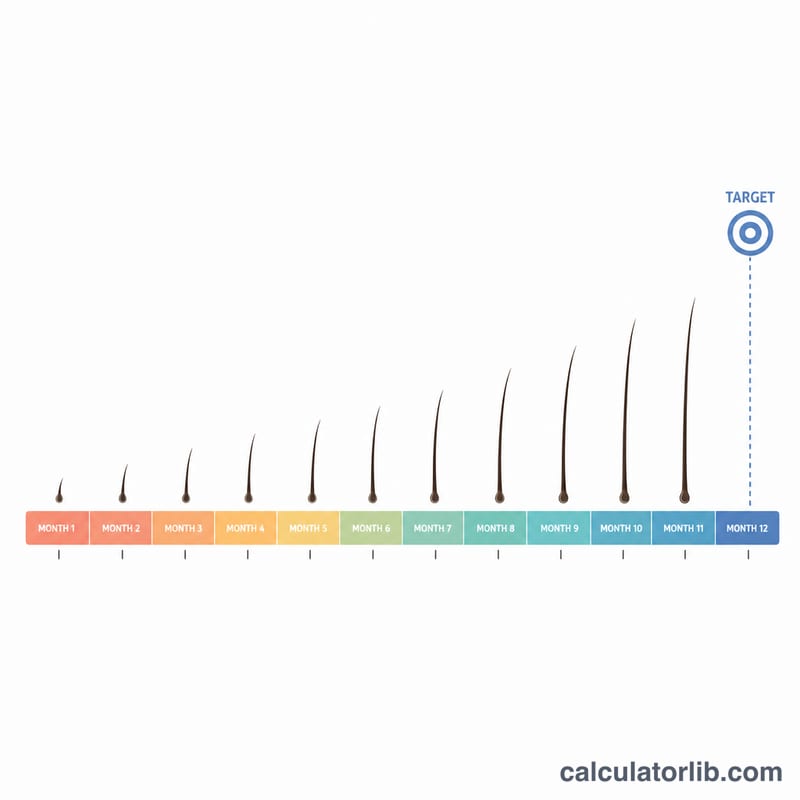
Suppose your hair is 20 cm long and you want it to reach 40 cm, growing at the average 1.25 cm/month. The length to gain is
$$40 - 20 = 20 \text{ cm}$$Dividing by 1.25 gives
$$\frac{20}{1.25} = 16 \text{ months}$$about 1.33 years, or roughly 487 days.
Time to Grow Hair at Different Growth Rates
The calculator uses \(\text{Months} = \frac{ \text{Target} - \text{Current}}{\text{Rate}}\). The table fixes the length to gain (10 cm or 20 cm) and varies the monthly growth rate. Years = months ÷ 12.
| Growth rate (cm/month) | 10 cm gain: months | 10 cm gain: years | 20 cm gain: months | 20 cm gain: years |
|---|---|---|---|---|
| 0.6 | 16.7 | 1.39 | 33.3 | 2.78 |
| 1.0 | 10.0 | 0.83 | 20.0 | 1.67 |
| 1.25 | 8.0 | 0.67 | 16 | 1.33 |
| 1.5 | 6.7 | 0.56 | 13.3 | 1.11 |
| 1.7 | 5.9 | 0.49 | 11.8 | 0.98 |
Example: \(\frac{20}{1.25} = 16\) months, while \(\frac{20}{0.6} \approx 33.3\) months. Slower growth can nearly double the wait.
Hair Length Conversion: Centimeters, Inches and Monthly Rates
All conversions use 1 inch = 2.54 cm.
Growth rate conversions
| Period | Centimeters | Inches |
|---|---|---|
| Per month | 1.25 cm | ≈ 0.49 in |
| Per year (12 months) | 15 cm | ≈ 5.9 in |
Common lengths
| Centimeters | Inches |
|---|---|
| 10 cm | ≈ 3.94 in |
| 20 cm | ≈ 7.87 in |
| 30 cm | ≈ 11.81 in |
| 40 cm | ≈ 15.75 in |
| 50 cm | ≈ 19.69 in |
Approximate length landmarks
Where a given length falls depends on your height and body proportions, so treat these as rough guides for straight hair measured from the scalp.
| Landmark | Approx. length (cm) | Approx. length (in) |
|---|---|---|
| Short crop | 2.5 cm | ≈ 1 in |
| Chin / jaw length | 15–20 cm | ≈ 5.9–7.9 in |
| Shoulder length | 25–35 cm | ≈ 9.8–13.8 in |
| Bra-strap / mid-back | 40–50 cm | ≈ 15.7–19.7 in |
| Waist length | 55–70 cm | ≈ 21.7–27.6 in |
Typical Hair Growth Rate Ranges
- Overall range: scalp hair typically grows about 0.6–1.7 cm per month.
- Common average: about 1.0–1.25 cm per month, roughly 12–15 cm per year. The calculator's default of 1.25 cm/month sits at the upper end of this average.
- What causes variation: age, genetics and hair type all influence growth rate. Curly or coily hair can look as if it grows more slowly because shrinkage hides its true length.
- Length vs. growth: the calculator estimates growth at the scalp. Breakage, trims and damage can make the length you can actually keep grow more slowly.
Use your own measurements for the best estimate. Mark your length, measure again after 2–3 months, and enter the resulting monthly rate in the calculator.
This is general information, not medical advice. If you notice sudden changes in hair growth or shedding, consider speaking with a qualified health professional.
FAQ
Can I make my hair grow faster? Growth rate is largely genetic, but good nutrition, scalp health, reducing breakage, and avoiding heat/chemical damage help you retain length.
Why does my hair seem to stop growing? Each strand has a finite growing (anagen) phase. Once it ends, the hair sheds, so very long lengths are limited by your personal cycle, not just the monthly rate.
Is this accurate? It is an estimate. Use your own measured rate for the best result, and remember breakage can offset visible growth.