Percentage Growth Calculator

Percentage Growth Calculator

Connect via MCP →

Enter Calculation

Frequently Asked Questions

How do you calculate growth percentage between two numbers?

Subtract the initial value from the final value, divide the result by the initial value, then multiply by 100. For example, going from 250 to 320 gives 320 minus 250, divided by 250, which is 0.28, so the growth is 28 percent. A result below zero means the value shrank instead.

Why doesn't increasing then decreasing by the same percentage return to the start?

Because each percentage is applied to a different base. A 50 percent rise turns 100 into 150, but the following 50 percent fall is measured against 150, removing 75 and leaving 75. The larger the percentage, the bigger this gap becomes, which is why sequential percent changes cannot simply be added together.

Can the initial value be zero?

No. Percent change divides by the starting value, and dividing by zero is undefined, so growth from exactly zero cannot be expressed as a percentage. If you start from zero, report the change in absolute terms instead, for example grew from 0 to 40 users, or measure growth from the first nonzero period.

What does a negative result mean?

It signals a decrease. For example, minus 15 percent means the value dropped by 15 percent from its starting point, so 200 would fall to 170. The formula handles this automatically: whenever the final value is smaller than the initial value, the numerator turns negative and so does the percentage.

What is the difference between percentage growth and percentage points?

Percentage growth is relative to the starting value, while percentage points measure the raw gap between two percentages. If a conversion rate moves from 10 percent to 12 percent, that is a rise of 2 percentage points but a 20 percent growth, because 2 divided by the original 10 equals 0.2.

How can growth be more than 100 percent?

Growth beyond 100 percent simply means the value more than doubled. Going from 40 to 100 is a 150 percent increase, because the change of 60 is 1.5 times the starting value. There is no upper limit for growth, while a decrease can never go below minus 100 percent, which represents falling to zero.

Formula

Advertisement

Results

Percentage Growth
50.00%
Growth Type Growth
Initial Value 100.00
Final Value 150.00
Absolute Change 50.00
Growth Factor 1.50x
Percentage Growth 50.00%

What Is the Percentage Growth Calculator?

The Percentage Growth Calculator measures how much a value has increased or decreased between two points in time, expressed as a percentage. It works for any currency or unit, so it is useful worldwide — whether you are tracking revenue in dollars, website visitors, a stock price, your salary, or the number of subscribers on a channel. Instead of guessing whether a change is significant, you get a clear figure that puts the difference in context.

How to Use It

You only need two numbers to get a result:

  • Initial value — the starting amount (for example, last year's revenue or your original investment).
  • Final value — the ending amount (this year's revenue or the current value).

Enter both figures and the calculator returns the percent change. A positive result means growth, while a negative result means a decline. The same units must be used for both values so the comparison stays accurate.

The Formula Explained

The calculation uses a simple, widely accepted formula:

  • $$\text{Percent change} = \frac{\text{Final} - \text{Initial}}{\text{Initial}} \times 100$$

You subtract the initial value from the final value to find the absolute change, divide by the initial value to express it as a proportion, then multiply by 100 to convert it into a percentage. The initial value is always the denominator because growth is measured relative to where you started.
Advertisement
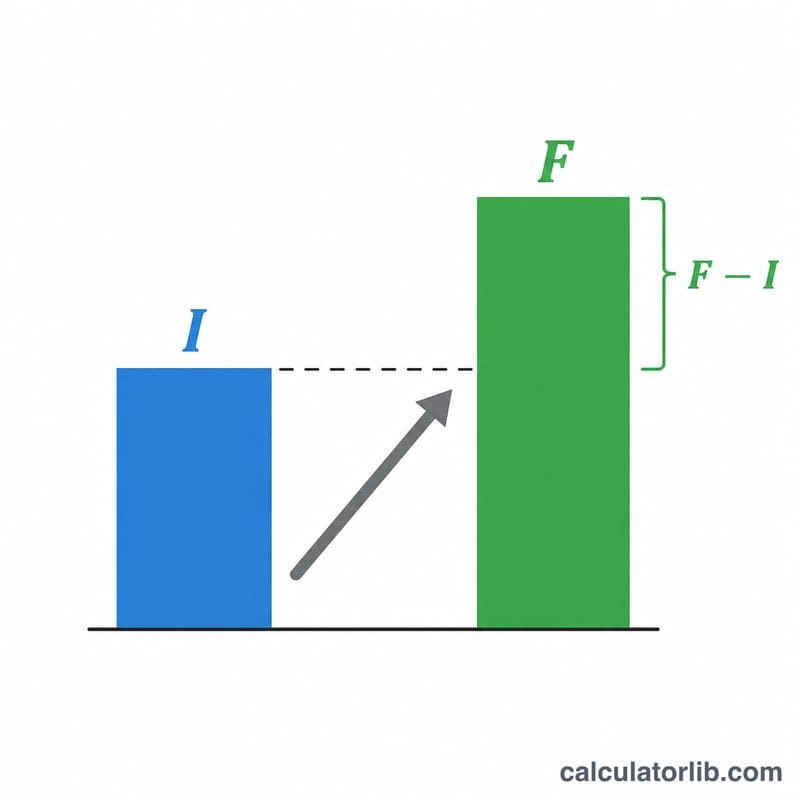
Diagram comparing initial and final value bars with the difference highlighted
Percentage growth compares the difference between final and initial values to the initial value.

Worked Example

Suppose a small business earned $40,000 in its first year and $52,000 in its second year. Plug the numbers in:

  • Change = \(52{,}000 - 40{,}000 = 12{,}000\)
  • Percent change = $$\frac{12{,}000}{40{,}000} \times 100 = 30\% \text{ growth}$$

If the values were reversed — falling from 52,000 to 40,000 — the result would be roughly −23.1%, indicating a decline.
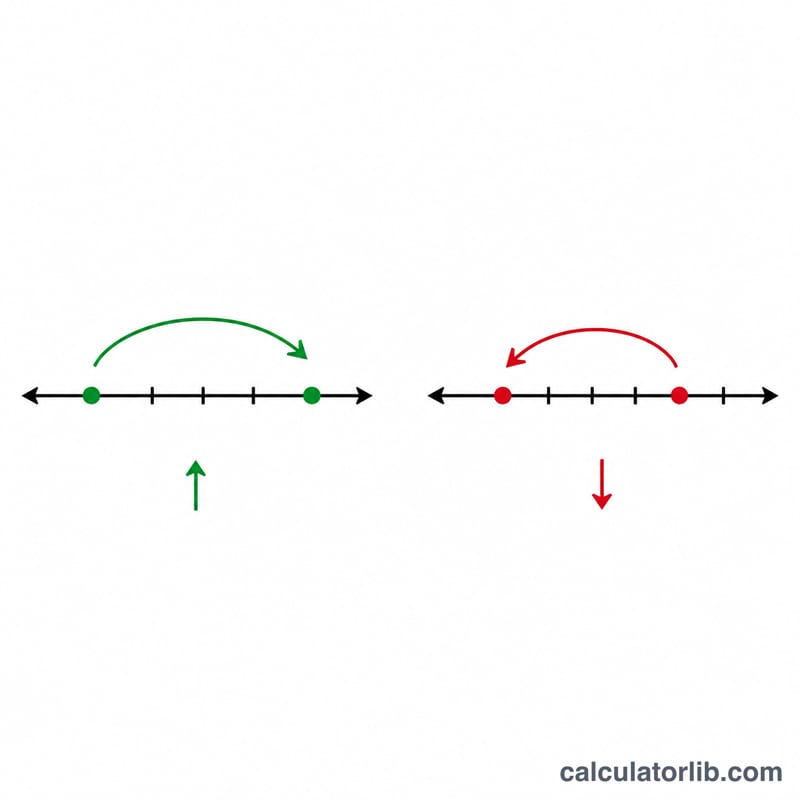

Number line showing an increase and a decrease between two values
A positive result means an increase; a negative result means a decrease.
Last updated:

Most popular in Math and Statistics

View all Math and Statistics calculators →