
What Is a Reverse CAGR Calculator?
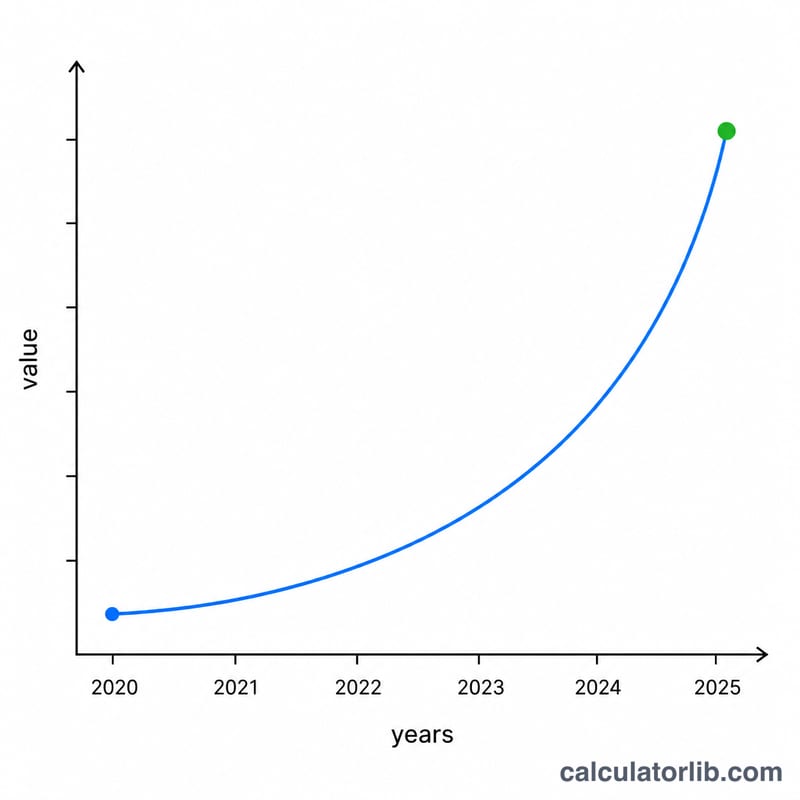
A Reverse CAGR Calculator works backwards from the traditional compound annual growth rate (CAGR) formula. Instead of taking a starting and ending value to find the growth rate, it takes a starting value, a known or assumed growth rate, and a number of years to project the future value. In other words, you already know how fast something is growing each year — this tool tells you where it will end up.
This approach is universal and not tied to any single country's currency or tax system, so you can use it for any investment, savings goal, business revenue, or population figure expressed in any currency.
How to Use the Calculator
- Present value: Enter your current amount (for example, an initial investment of $10,000).
- CAGR (%): Enter the expected compound annual growth rate, such as 8%.
- Number of years: Enter the time horizon you want to project over.
The calculator instantly displays the projected future value, letting you compare scenarios by adjusting the rate or time frame.
The Formula Explained
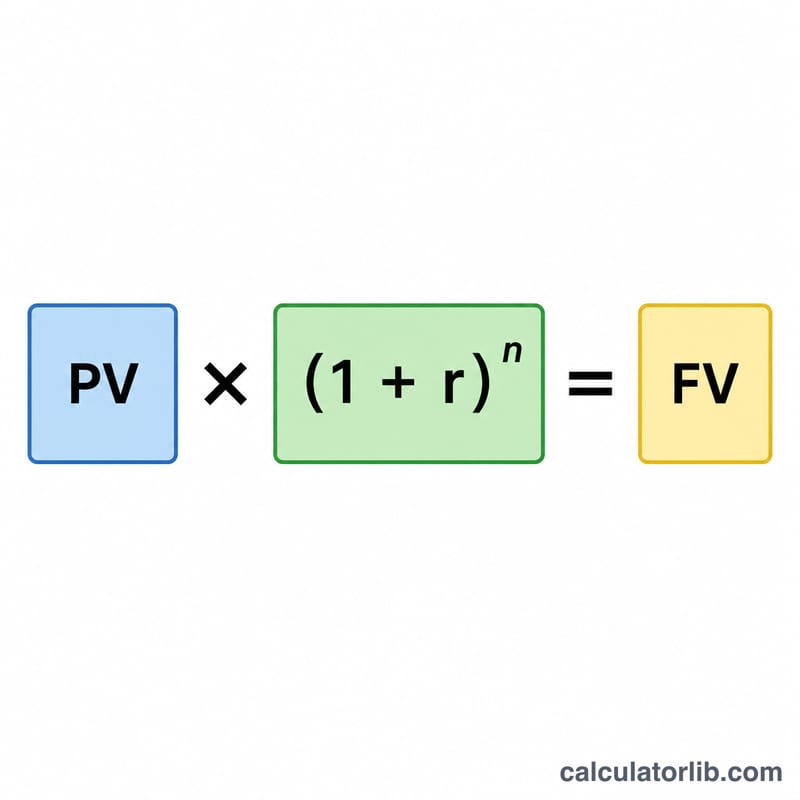
The reverse CAGR (future value) formula is:
$$\text{Future Value} = \text{Present Value} \times (1 + \text{CAGR})^{n}$$
Here, CAGR is expressed as a decimal (8% becomes 0.08) and n is the number of years. The exponent reflects compounding — each year's growth builds on the previous year's total, not just the original amount.
Worked Example
Suppose you invest $10,000 and expect a steady 8% CAGR over 10 years:
- $$\text{Future Value} = 10{,}000 \times (1 + 0.08)^{10}$$
- $$\text{Future Value} = 10{,}000 \times 2.1589$$
- \(\text{Future Value} \approx \$21{,}589\)
Your money more than doubles, even though you never added another cent — that is the power of compounding.
Frequently Asked Questions
How is this different from a normal CAGR calculator? A standard CAGR calculator finds the growth rate from two known values. This reverse version finds the future value when you already know the rate.
Is the projection guaranteed? No. CAGR is a smoothed annual average; real-world returns fluctuate year to year. Use the result as a planning estimate, not a promise.
Can I use it for goals other than investing? Yes. It works for projecting revenue, subscriber counts, savings, or any quantity that compounds at a consistent rate.