
What Is CAGR?
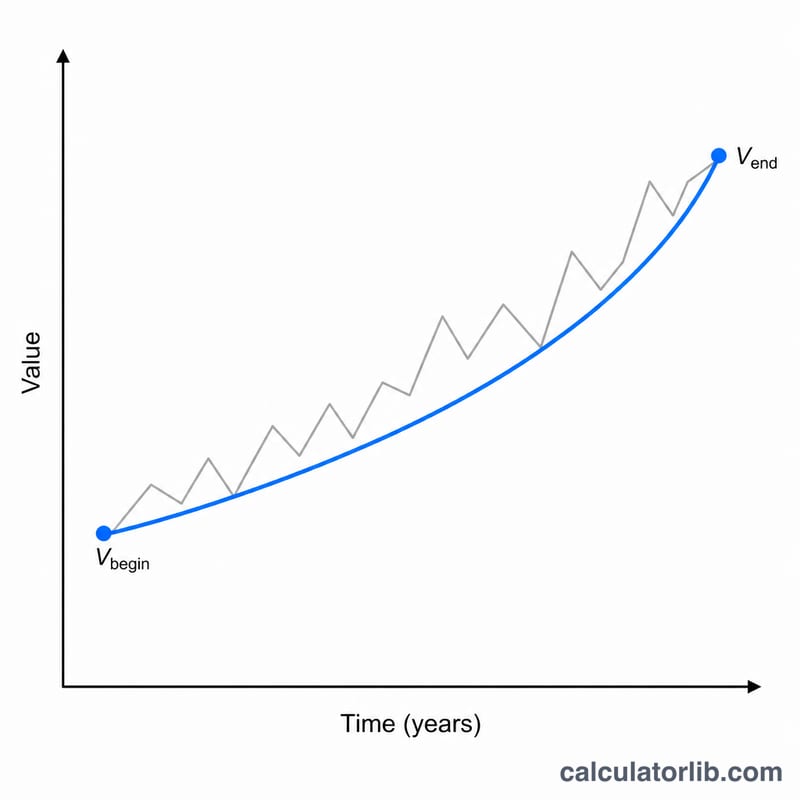
The Compound Annual Growth Rate (CAGR) is the constant rate at which an investment would have grown each year if it had grown at a steady pace and compounded annually. Because real returns are usually uneven from year to year, CAGR smooths them into a single, easy-to-compare figure. It is widely used to evaluate stocks, mutual funds, business revenue, and any value that changes over time.
How to Use This Calculator
Enter three numbers: the beginning value (what the investment was worth at the start), the ending value (what it is worth now), and the number of years between the two. The calculator returns the CAGR as an annual percentage, plus the total growth over the whole period and the absolute dollar gain.
The Formula Explained
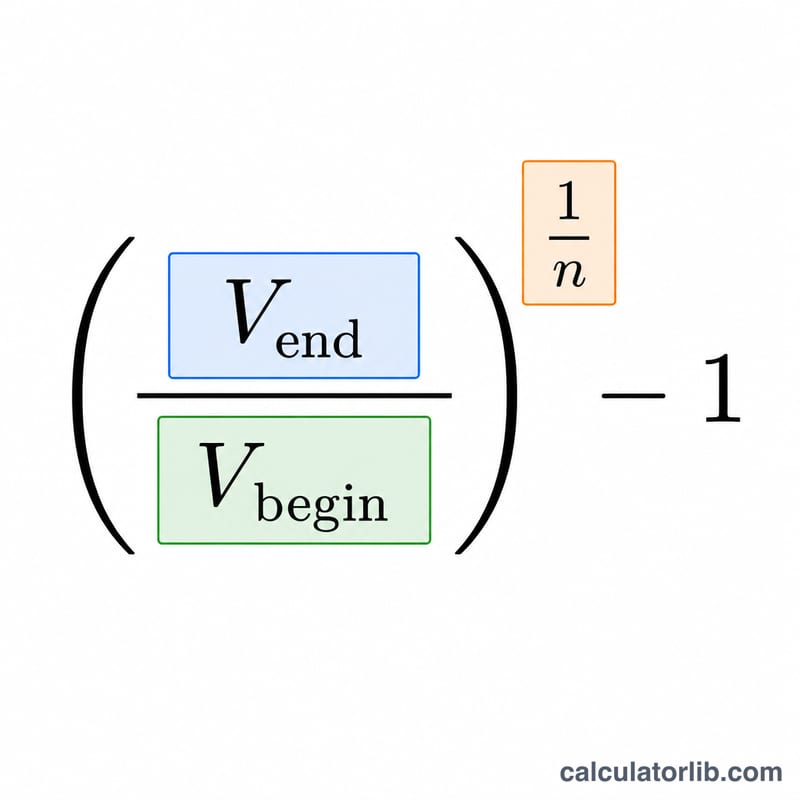
CAGR is calculated as:
$$\text{CAGR} = \left(\left(\frac{\text{Ending Value}}{\text{Beginning Value}}\right)^{\frac{1}{\text{Years}}} - 1\right) \times 100\%$$
Dividing the ending value by the beginning value gives the total growth multiple. Raising it to the power of 1 divided by the number of years finds the equivalent single-year multiple, and subtracting 1 converts that multiple into a growth rate. Multiply by 100 to express it as a percentage.
Worked Example
Suppose you invested $10,000 and it grew to $19,000 over 5 years. Then $$\text{CAGR} = \left(\frac{19{,}000}{10{,}000}\right)^{\frac{1}{5}} - 1 = (1.9)^{0.2} - 1 \approx 1.13703 - 1 = 0.13703,$$ or about 13.70% per year. The total growth was 90%, and the absolute gain was $9,000.
FAQ
Does CAGR account for volatility? No. CAGR assumes smooth, steady growth and ignores the ups and downs along the way. Use standard deviation or other risk measures to assess volatility.
Can CAGR be negative? Yes. If the ending value is lower than the beginning value, CAGR will be negative, indicating an average annual decline.
Is CAGR the same as average return? Not exactly. A simple average of yearly returns can overstate growth; CAGR (a geometric mean) reflects the actual compounded outcome and is the more accurate measure.